
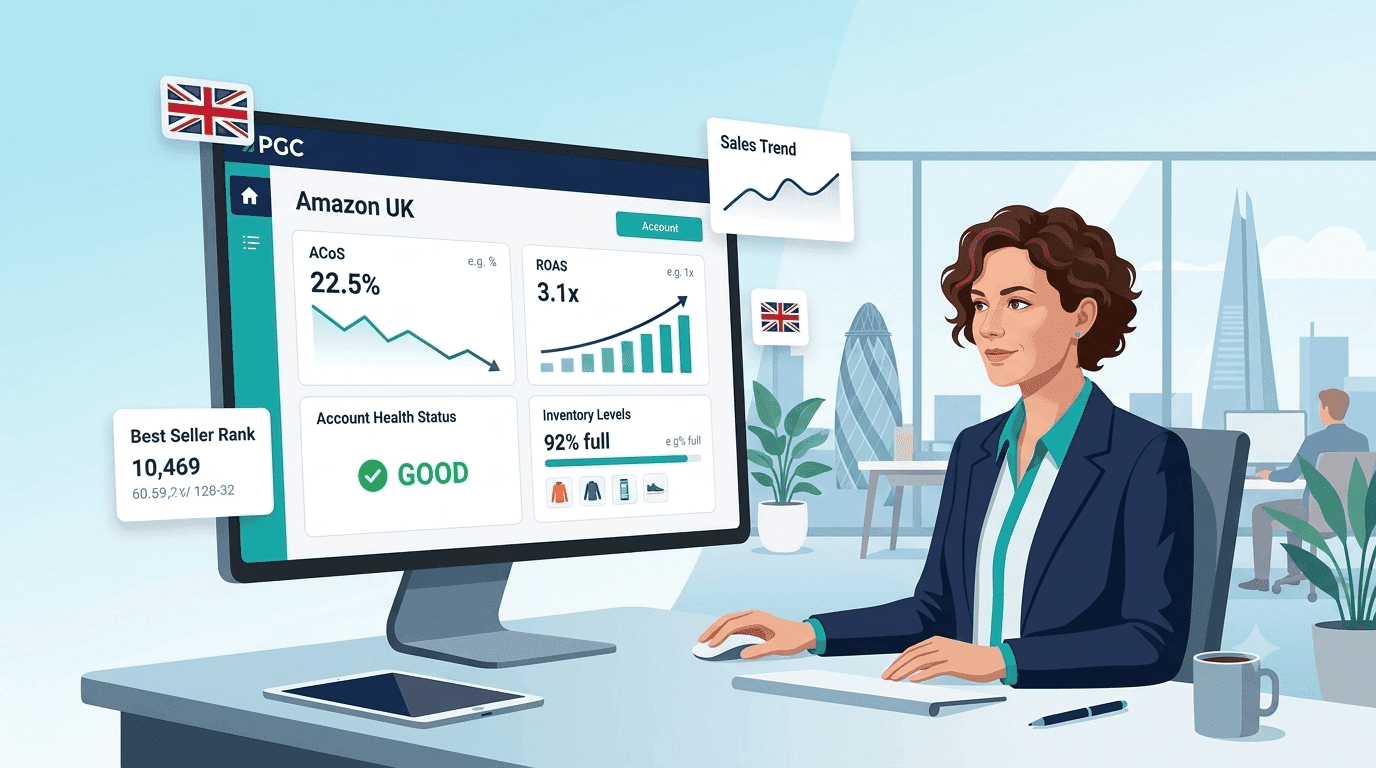
How to Scale on Amazon UK: The Complete Growth Strategy for Brand Owners
Scale your Amazon UK business with full-service account management covering listings, PPC, inventory, account health, and VAT compliance. Amazon SPN verified partner with a London presence.
Amazon UK is the fifth largest Amazon marketplace in the world and the largest in Europe. Over £30 billion in annual GMV. More than 60% of that is generated by third-party sellers. And yet most UK brand owners managing their own Amazon presence are capturing a fraction of what their category actually offers.
The gap is rarely the product. It is almost always the strategy behind it.
This guide covers the core growth levers that determine whether a UK Amazon brand scales profitably or plateaus- listings, advertising, inventory, account health, and the operational infrastructure that holds all of it together.
Amazon Account Management in the UK Requires a Market-specific Growth Strategy
Amazon UK is not Amazon India or Amazon US with a different currency. The market has its own dynamics, compliance requirements, and consumer behaviour patterns that directly affect how you grow.
Post-Brexit Compliance: What UK Sellers Must Have in Place:
VAT registration is mandatory once turnover crosses £90,000. Products in certain categories require UKCA marking, the UK's post-Brexit replacement for CE certification, covering electronics, toys, medical devices, and others. Cross-border EU shipments now require customs documentation and EORI numbers that did not exist pre-2021.
UK consumers are among the most review-sensitive in any Amazon marketplace:
A listing with fewer than 15 reviews struggles to convert regardless of listing quality or ad spend. Amazon Vine is available on Amazon UK and is one of the fastest legitimate ways to build review velocity for new product launches.
The Q4 Window: Where UK Amazon Brands Win or Lose the Year
For many UK Amazon sellers, October through December represents 35 to 40% of annual revenue. The brands that win Q4 are the ones with campaign architecture, inventory, and listing quality locked in by September, not ones scrambling to prepare in October.
Account Health on Amazon UK: What Puts Your Selling Privileges at Risk
Amazon UK tracks seller performance through an Account Health Rating scored out of 1,000. Drop below 200, and your account is flagged as At Risk; Amazon can deactivate selling privileges with limited notice.
The metrics that most commonly trigger account health issues for UK sellers are
Late Dispatch Rate (orders not confirmed as shipped by the promised dispatch date, threshold below 4%)
Late Delivery Rate (orders arriving after the promised delivery window, particularly relevant for FBM sellers whose carrier performance is their responsibility)
Pre-fulfilment Cancellation Rate (orders cancelled by the seller before dispatch, threshold below 0.5%).
UK consumers have high delivery expectations shaped by Amazon Prime standards. FBM sellers who set delivery windows their carriers cannot reliably meet, or who experience post-Brexit customs delays on cross-border shipments, accumulate late delivery flags before anyone notices the pattern on the dashboard.
By the time the Account Health Rating shows amber or red, the issue has typically been building for weeks.
Monitoring these metrics daily, not weekly, is the difference between catching a drift and managing a crisis.
Strategy 1: Build Product Pages That Convert UK Shoppers
The Product listing is the foundation everything else sits on. Ad spend drives traffic to it. Organic rank depends on it. Reviews build on top of it. A weak listing makes every other growth investment less efficient.
UK English and UK Search Behaviour
Titles, bullet points, and backend keywords need to reflect how UK shoppers actually search, not how the brand describes its products internally. Search terms that convert on Amazon India or Amazon US do not automatically transfer. "Rubbish bags" not "trash bags." "Plasters" not "band-aids." Getting this wrong means relevant shoppers cannot find your listing even when your ads are running.
UK shopper behaviour also differs in purchase psychology. UK consumers tend to read more carefully before buying. This means benefit-led bullet points that answer objections directly outperform feature-led ones that simply describe the product. Every bullet should answer a question the UK buyer is asking before they reach for the buy button.
Backend keywords on Amazon UK should also include British spelling variants, regional terminology, and category-specific search language. A brand that builds its backend keywords from US or India search data is leaving a significant volume of relevant UK search traffic uncaptured.
Product Images That Work on Mobile
Most UK shoppers browse Amazon on their phones. A main image that looks professional on desktop can be unreadable at mobile screen size. The standard that converts: front-facing pack shot, plain white background, product filling 85% or more of the frame, with any key claim or size information large enough to read without zooming.
Beyond the main image, secondary images carry significant conversion weight. UK shoppers use secondary images to verify size, understand how the product is used, confirm compatibility, and assess quality.
A complete image set typically includes:
main shot
in-use lifestyle image
size or dimension reference
key benefit callout
ingredient or material close-up where relevant.
Video is increasingly important on Amazon UK. A short product video on the listing, showing the product in use and addressing the most common pre-purchase question, consistently improves conversion rate across categories. For brands that have invested in video content, adding it to the listing is one of the highest-return, lowest-cost moves available.
Product Description and A+ Content
The product description is the last conversion layer before a shopper makes a decision. For brand-registered sellers, A+ Content replaces the standard description with a rich visual module: lifestyle imagery, comparison charts, brand story sections, and benefit-led text blocks.
A+ Content consistently improves conversion rates across Amazon UK categories. For brands competing in crowded spaces, it is the baseline standard that separates listings that convert from listings that collect impressions.
According to Amazon Advertising benchmarks, A+ Content can increase conversion rates by up to 8% on average.
The most effective A+ Content on Amazon UK follows a specific structure:
Brand story or heritage block first to establish trust
Followed by a key benefit breakdown,
A product comparison chart if you have multiple variants,
And a lifestyle image that shows the product in a real UK context.
"Real UK context" matters; imagery that looks generically American or feels culturally distant from UK shoppers underperforms against imagery that reflects everyday British life.
For brands without A+ Content live yet, this is the single highest-return listing investment available before increasing ad spend.
Review Strategy
UK shoppers are among the most review-sensitive on any Amazon marketplace. A listing with fewer than 15 reviews struggles to convert regardless of listing quality or ad spend. The review count and average rating are the first things many UK shoppers check; a listing with 4.2 stars and 200 reviews will consistently outconvert a listing with 4.8 stars and 3 reviews.
Enrol new ASINs in Amazon Vine immediately on launch. Vine invites trusted Amazon reviewers to test and review your product, building initial review velocity legitimately and quickly.
Target a minimum of 15 reviews before pushing significant ad spend toward a new listing. A listing with strong review velocity builds organic rank faster and converts paid traffic at a higher rate, reducing effective ACoS over time.
Strategy 2: Run Amazon PPC That Protects Margin, Not Just ACoS
UK CPCs typically run £0.20 to £0.80 per click depending on category. At those levels, unmanaged ad spend compounds into meaningful losses faster than most brand owners realise.
The most common mistake in Amazon UK PPC is optimising toward ACoS without understanding break-even. Your break-even ACoS is your net margin percentage before advertising costs. If your net margin before ads is 22%, an ACoS above 22% means every ad-driven sale is losing money regardless of how it looks on the dashboard.
Campaign structure determines everything. Branded keywords, category keywords, competitor keywords, and auto discovery campaigns should run separately with separate budgets and separate bids. Mixing them produces data that cannot be interpreted cleanly and optimisation decisions that affect everything simultaneously.
The auto-to-manual graduation flow. Run automatic campaigns to discover which search terms your shoppers actually use. Once a term proves it converts, graduate it to a manual exact match campaign with a precisely calibrated bid. Add non-converting high-spend queries as negative keywords. Repeat weekly. This is the compounding loop that separates accounts that grow efficiently from accounts that spend indiscriminately. Read our full guide on Amazon Sponsored Ads →
Festive season bid management. UK CPCs spike significantly in October and November as competition intensifies across every category. Brands without automated bid management or pre-set bid caps see ACoS double during their highest-revenue period, winning in unit volume while losing on margin. Festive campaign architecture needs to be in place before the spike happens, not during it. Read our full guide on Amazon Dayparting →
Sponsored Display for page defense. Without Sponsored Display ads targeting your own ASINs, a competitor can run ads directly below your buy box. You pay for the traffic. They capture the sale. Running low-bid page defense on your own listings is one of the highest-return, lowest-cost moves available in Amazon UK advertising. Read our full guide on Amazon Sponsored Ads →
Strategy 3: Manage Inventory and FBA Operations Proactively
Inventory problems on Amazon UK cost more than most brand owners calculate because the losses are spread across multiple line items rather than showing up as a single visible figure.
Stockouts destroy rank. When an ASIN goes out of stock, organic rank collapses and does not recover immediately on restock. The advertising momentum built over weeks is reset. For high-velocity SKUs, a stockout during peak season can take months to recover from in terms of organic position.
Stranded inventory generates fees without revenue. FBA inventory flagged as unsellable accumulates monthly storage fees indefinitely. It happens from listing errors, compliance flags, or parent-child relationship issues. Most internal teams catch it weeks late, by which point the fees have already accumulated.
Post-Brexit FBA planning. Pan-European FBA operates differently for UK sellers following Brexit. UK FBA inventory covers Amazon.co.uk only. Separate FBA enrollments are required for EU marketplaces. Brands selling across both UK and EU need inventory planning that accounts for this split, rather than assuming the pre-2021 model still applies.
Sales velocity and reorder planning. The right reorder point is calculated from sales velocity, supplier lead time, and Amazon's inbound processing time, not from intuition or fixed reorder schedules. Brands that calculate this properly avoid both stockouts and excess stock simultaneously.
Strategy 4: Protect Account Health Before It Becomes a Crisis
Account health on Amazon UK is a lagging indicator. By the time it shows as a problem on your dashboard, the damage is already in progress.
Listing suppression monitoring. One policy flag, one missing attribute, one compliance issue, and a listing stops showing entirely. Organic rank collapses. Sponsored ads stop serving. Without daily monitoring, a brand can lose days of revenue before anyone identifies the cause, let alone fixes it.
Policy compliance as a growth strategy. UK-specific regulatory requirements, UKCA marking, EORI compliance, correct product categorisation for customs purposes, are not administrative overhead. They are the foundation of account stability. An account that stays clean scales. An account that accumulates policy issues spends management time on recovery instead of growth.
Review and feedback management. Negative seller feedback and product reviews left unaddressed compound into account health metrics that affect both organic rank and Buy Box eligibility. A proactive review management process, responding to negative feedback, reporting reviews that violate Amazon's guidelines, and building review velocity on new ASINs, is part of a growth strategy, not separate from it.
How Pinnacle Growth Consulting Executes Amazon Account Management for UK Brands
Understanding the growth levers is one thing. Running them consistently, simultaneously, at the speed the Amazon UK marketplace demands is another.
Pinnacle Growth Consulting is an Amazon SPN verified partner with a London presence, managing Amazon seller account management for brands across 13 marketplaces globally. Every UK engagement follows a structured five-step process built around your account's specific situation, not a generic playbook.
Our approach combines Pinnaclegrowth.ai, our AI-powered Amazon ads automation platform running continuous bid, keyword, and budget optimisation 24 hours a day, with a dedicated account manager accountable for your growth outcomes every week.
Audit Your Amazon Account
A comprehensive review of your existing listings, advertising campaigns, inventory status, account health metrics, and competitor positioning. The audit surfaces immediate growth opportunities and identifies where your account is currently losing money before any strategy is built.Build a Custom Growth Strategy
A tailored account management plan built from the audit findings, focused on maximising visibility, improving conversion rates, scaling advertising efficiency, and protecting profit margins. No two UK accounts are the same- the strategy reflects your category, your current scale, and your growth targets.Optimise and Manage Your Account
Continuous refinement of product listings, proactive inventory monitoring, account health management, and day-to-day marketplace operations. This is the operational layer that most brands underinvest in and feel the cost of silently.Optimise and Manage Your PPC Strategy
Continuous bid adjustments, keyword harvesting, negative keyword management, and campaign restructuring powered by Pinnaclegrowth.ai, our AI-driven Amazon ads automation platform running 24 hours a day without periodic manual review cycles.Track Performance and Scale Growth
Regular performance monitoring through transparent reporting: SKU-level profitability, ACoS breakdown, account health metrics, and traffic trends. Strategic adjustments made continuously, not quarterly. Clear visibility into what is working, what is not, and what comes next.
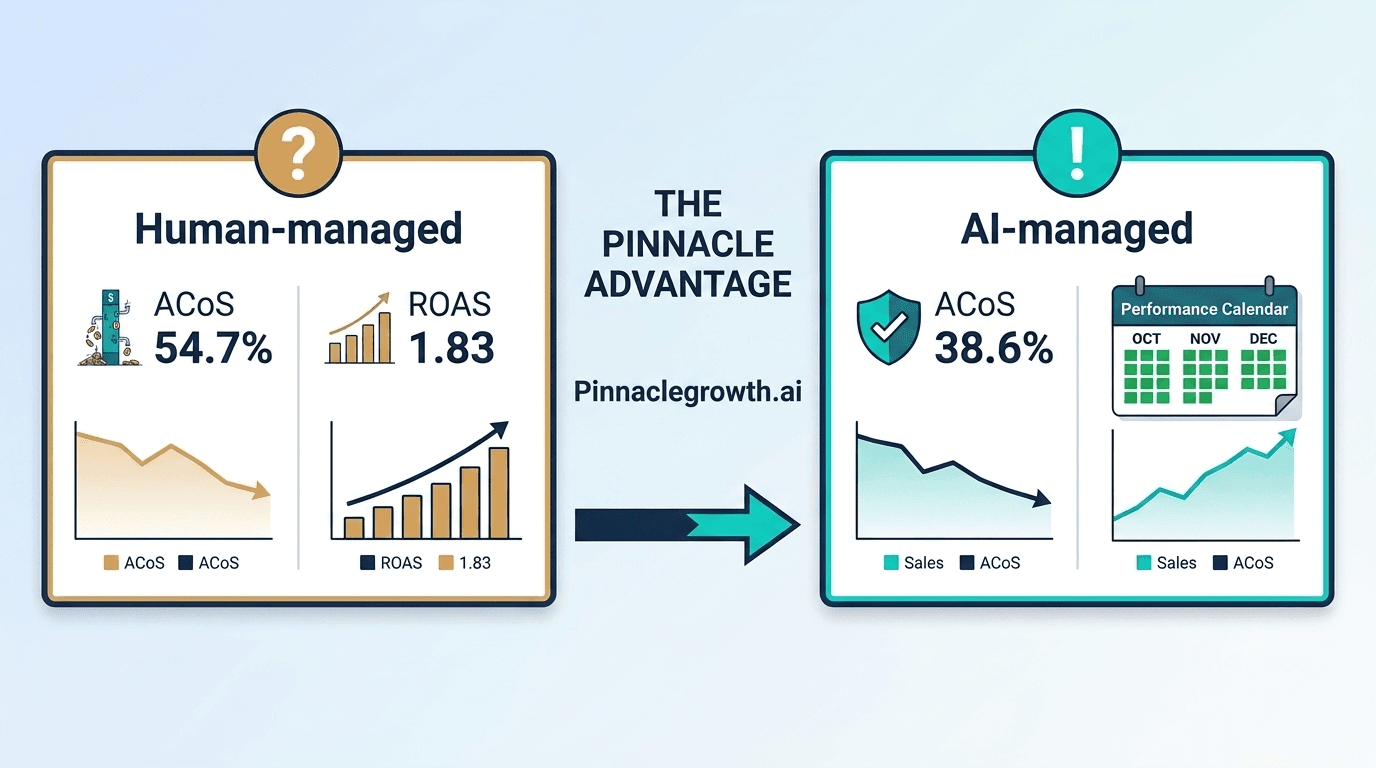
Pack8, a UK-based Amazon seller specialising in packaging and protective materials, runs its Amazon UK presence through Pinnacle. The performance gap between AI-managed and human-managed campaigns on the same account, measured over 30 days:
Metric | AI-Managed | Human-Managed |
|---|---|---|
ACoS | 38.6% | 54.7% |
ROAS | 2.59 | 1.83 |
Same account. Same products. Same marketplace. The difference was execution consistency- bids, keywords, and budgets adjusting continuously rather than in periodic manual cycles.
This is what a properly managed Amazon UK account looks like in practice. Not a one-time improvement. A compounding system across listings, advertising, inventory, and account health running simultaneously.
Ready to Scale Your Amazon UK Business?
Pinnacle Growth Consulting is an Amazon SPN verified partner with a London presence and a team managing brands across 13 Amazon marketplaces globally. Whether you are a UK brand looking to scale profitably on Amazon.co.uk, or an Indian brand entering the UK marketplace, we combine AI-powered automation with dedicated account management to deliver compounding results.
Book a Free Amazon Account Audit
Pinnacle Growth Consulting | Amazon SPN Verified Partner | London
Frequently Asked Questions
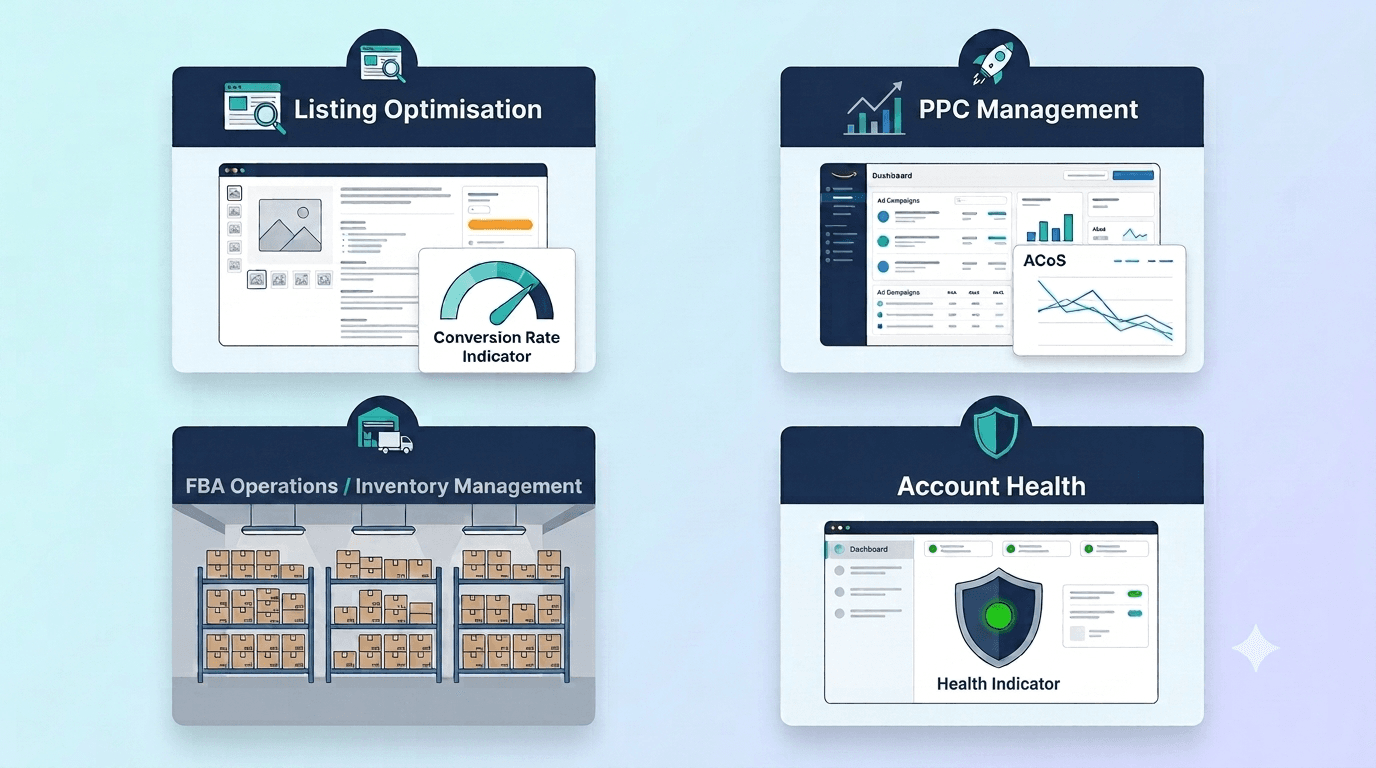
The four core growth levers on Amazon UK are listing optimisation built for UK search behaviour and UK English, Amazon PPC management governed by break-even ACoS rather than vanity metrics, proactive inventory and FBA operations that prevent stockouts and stranded inventory, and daily account health monitoring to catch suppression and compliance issues before they compound. Brands that run all four simultaneously and consistently are the ones that scale profitably.
Amazon UK has specific regulatory requirements that do not apply elsewhere: VAT registration above £90,000 turnover, UKCA marking for certain product categories post-Brexit, EORI numbers for cross-border EU shipments, and a distinct UK FBA setup separate from Pan-European FBA. Consumer behaviour also differs — UK shoppers are highly review-sensitive, mobile-first, and heavily concentrated in Q4 purchasing. A growth strategy built for Amazon India or Amazon US needs meaningful adaptation to work on Amazon UK.
There is no universal good ACoS- the right target is your net margin percentage before advertising costs. If your net margin before ads is 20%, an ACoS above 20% means every ad-driven sale is losing money. Most UK brand owners set ACoS targets based on round numbers rather than actual margin calculations, which leads to profitable-looking dashboards masking loss-making campaigns. Calculate your break-even ACoS first, then set your target below it.
Amazon PPC on Amazon UK operates through the same three ad types as other marketplaces: Sponsored Products (keyword-targeted, appears in search results and product pages), Sponsored Brands (banner ads at the top of search results, brand-registered sellers only), and Sponsored Display (audience-based, for retargeting and conquesting). UK CPCs typically run £0.20 to £0.80 per click depending on category. The auction factors in both bid amount and listing relevance, so a well-optimised listing at a moderate bid consistently outperforms a poorly optimised listing at a higher bid.
Account health protection requires daily monitoring of listing status, policy compliance, and seller metrics — not weekly reviews. The three most common account health risks for UK sellers are listing suppression from missing attributes or compliance flags, negative seller feedback accumulating without response, and post-Brexit regulatory gaps including UKCA marking and EORI compliance. Catching these early, before they affect account standing, is significantly less costly than recovering from them after the fact.
Amazon SPN (Service Provider Network) is Amazon's own vetted partner programme. Agencies listed on SPN have been formally assessed for compliance standards, marketplace expertise, and service quality by Amazon directly. For UK brands choosing an Amazon account management partner, SPN verification is a meaningful assurance that the agency operates within Amazon's own approved standards, reducing the risk of non-compliant practices affecting your account.