
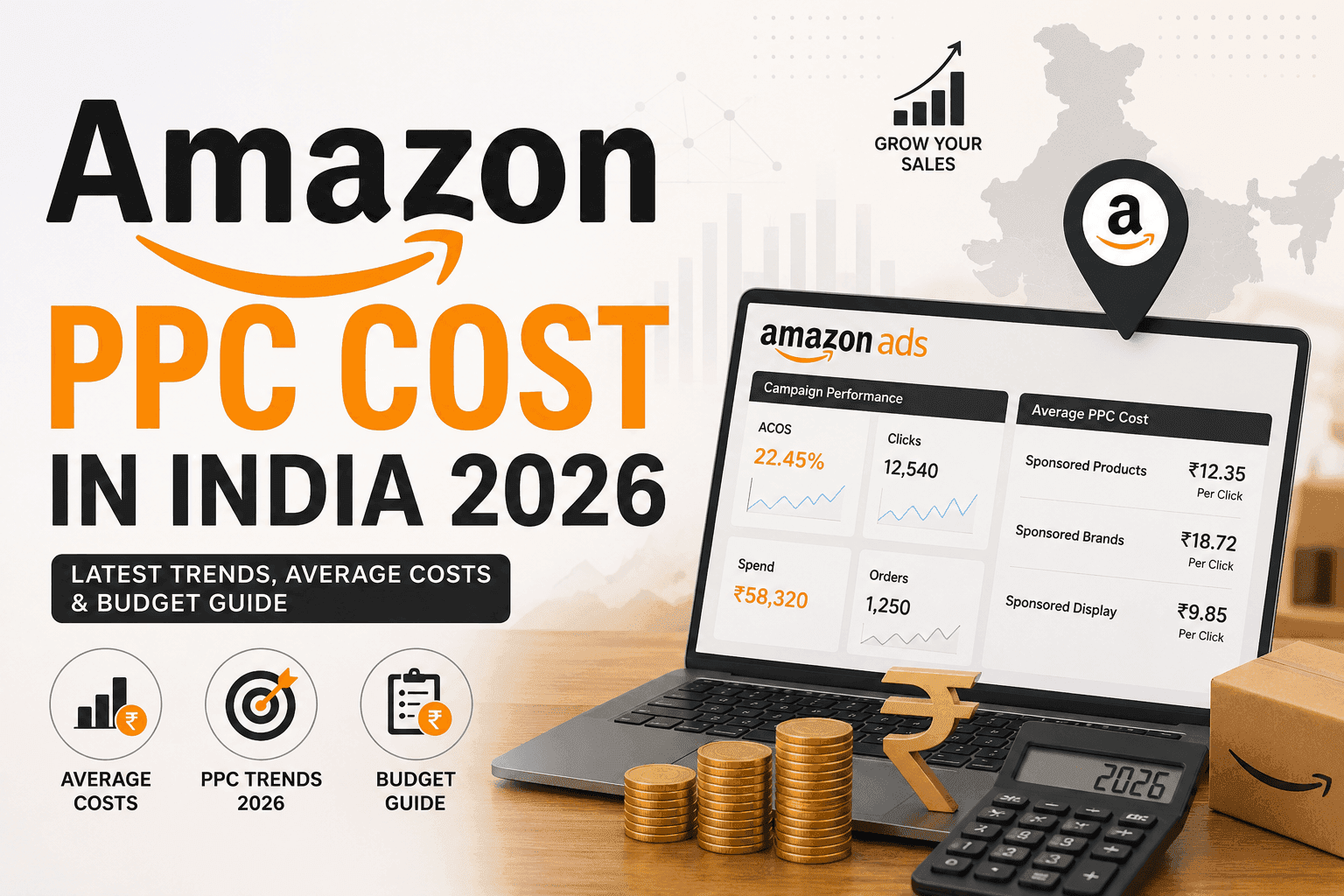
Amazon PPC Cost in India 2026: CPC Rates & Budget Guide
Discover Amazon PPC costs in India for 2026, including average CPC rates, recommended budgets, and category benchmarks. Learn how to plan your ad spend and improve PPC performance.
Amazon PPC can help a product move from page 10 to the first page of search results but how much should Indian sellers actually spend on advertising?
Amazon PPC cost in India in 2026 depends on factors such as product category, keyword competition, listing quality, conversion rate, and campaign strategy. A seller spending ₹10,000 per month may see strong returns, while another spending ₹50,000 may struggle to generate profitable sales.
The challenge is not simply deciding an advertising budget. You also need to understand CPC, ACOS, ROAS, conversion rate, and how much you can afford to pay for every customer.
In this guide, you'll discover average Amazon PPC CPC rates, practical advertising budgets, ACOS and ROAS benchmarks, and ways to reduce PPC costs without blindly increasing your ad spend.
Author credibility: This guide is designed around practical Amazon advertising principles and current marketplace economics. Replace this line with your author's verified experience, credentials, and results before publishing.
1. Amazon PPC Cost Overview: What Does Amazon Advertising Cost in India?
Amazon PPC cost is the amount a seller pays when a shopper clicks on an Amazon advertisement. Amazon generally uses a cost-per-click model, meaning you pay for clicks rather than simply for your product being displayed.
Amazon PPC is a paid advertising model where sellers bid on keywords or targeting options to promote products on Amazon. You pay when shoppers click the advertisement, and the final cost depends largely on competition, relevance, and bidding strategy.
For Indian sellers, there is no single fixed PPC price. Your actual cost can vary significantly based on category and keyword.
Typical Amazon PPC cost components
CPC: Cost paid for each click.
Daily budget: Maximum amount you are willing to spend per day.
ACOS: Advertising cost divided by advertising sales.
ROAS: Advertising sales generated for every ₹1 spent.
Conversion rate: Percentage of ad clicks that result in orders.
For example, if your average CPC is ₹12 and you receive 100 clicks, your advertising spend is approximately ₹1,200.
However, clicks alone don't determine profitability. If those 100 clicks generate only two orders, your PPC may be expensive. If they generate 15 orders, the same CPC could be highly profitable.
2. Average CPC by Category in India
Amazon PPC CPC varies by category because advertisers compete differently for keywords, products, and shoppers. Highly competitive categories can require higher bids, while niche products may attract clicks at lower costs.
Indicative CPC ranges for Indian sellers can look like this:
Category | Indicative CPC Range |
Home & Kitchen | ₹5–₹15 |
Beauty & Personal Care | ₹6–₹20 |
Apparel & Accessories | ₹4–₹15 |
Electronics Accessories | ₹8–₹25 |
Grocery | ₹3–₹12 |
Sports & Fitness | ₹5–₹18 |
Pet Supplies | ₹4–₹15 |
These figures should be treated as planning ranges, not guaranteed Amazon rates. Actual CPC depends on keyword competition, relevance, placement, bidding strategy, seasonality, and campaign performance.
Example
Suppose you sell a ₹999 kitchen product and your average CPC is ₹10.
If your conversion rate is 10%, you need approximately 10 clicks for one order:
10 clicks × ₹10 CPC = ₹100 advertising cost per order
If your product generates ₹999 in sales from that order, your advertising cost is approximately 10% of sales before considering Amazon fees, product cost, shipping, returns, and other expenses.
That is why CPC should always be evaluated alongside conversion rate and profit margin.
3. How Much Should You Spend on Amazon PPC?
There is no universal Amazon PPC budget. Your ideal budget should be based on your product's selling price, gross margin, conversion rate, growth stage, and advertising objective.
A new seller may start with a controlled daily budget and increase spending after identifying profitable keywords.
A practical starting framework
For a new product, you could test campaigns with a controlled budget of approximately ₹500–₹1,500 per day, depending on category competition and product economics.
For example:
₹500/day = approximately ₹15,000/month
₹1,000/day = approximately ₹30,000/month
₹1,500/day = approximately ₹45,000/month
These are planning examples, not mandatory spending levels.
The more important question is:
How much can you spend to acquire one profitable customer?
Calculate your break-even ACOS
Suppose:
Selling price = ₹1,000
Product + Amazon + fulfilment + other costs = ₹700
Contribution before advertising = ₹300
Your break-even advertising cost is ₹300 per sale.
Therefore:
Break-even ACOS = ₹300 ÷ ₹1,000 × 100 = 30%
If your ACOS is consistently below 30%, advertising may be contributing positively to your unit economics. If it is significantly above 30%, you need to improve either advertising efficiency, conversion rate, product economics, or selling price.
4. ACOS & ROAS Benchmarks for Amazon PPC
ACOS (Advertising Cost of Sales) measures how much you spend on advertising to generate a specific amount of advertising sales.
ACOS = Ad Spend ÷ Ad Sales × 100
For example, spending ₹2,000 to generate ₹10,000 in attributed sales produces an ACOS of 20%.
ROAS (Return on Ad Spend) measures advertising revenue generated for every rupee spent.
ROAS = Ad Sales ÷ Ad Spend
Using the same example:
₹10,000 ÷ ₹2,000 = 5X ROAS
So, ₹1 spent on advertising generated ₹5 in attributed sales.
What is a good ACOS?
There isn't one universally good ACOS.
A profitable ACOS depends on your contribution margin and business objective.
Objective | Possible Focus |
Profit maximisation | Lower, sustainable ACOS |
Product launch | Higher spend may be acceptable |
Ranking/visibility | Aggressive testing may be required |
Brand growth | ROAS alone may not tell the whole story |
Clearance | Higher ACOS may be acceptable |
A seller with a 40% contribution margin can tolerate a different ACOS from a seller with a 15% margin.
The right benchmark is your break-even ACOS—not a generic industry number.
5. 7 Ways to Reduce Amazon PPC Costs
1. Improve your product listing
A better title, images, bullet points, A+ Content, reviews, and product information can improve shopper confidence and potentially increase conversion.
More conversions from the same number of clicks can reduce your effective advertising cost per order.
2. Focus on relevant keywords
Don't pay for traffic that has little chance of converting.
Use highly relevant keywords and regularly review search-term performance. Move strong search terms into targeted campaigns where appropriate.
3. Use negative targeting
Negative keywords can help prevent advertising spend on irrelevant searches.
For example, if you sell premium leather wallets but receive clicks for an irrelevant low-cost product type, excluding unsuitable searches can reduce wasted spend.
4. Control bids
A high bid doesn't automatically mean better profitability.
Test bids and evaluate the relationship between CPC, impressions, clicks, conversions, and sales rather than increasing bids across the entire campaign.
5. Separate high-performing keywords
When profitable keywords are buried inside large campaigns, it can become difficult to control their bids and budgets.
Creating dedicated campaigns or ad groups for important terms can provide better control.
6. Improve conversion rate
PPC efficiency isn't only about lowering CPC.
If your listing converts 5 out of 100 clicks and you improve it to 10 out of 100, the same traffic can generate twice as many orders.
Improve:
Main image
Product title
Pricing
Reviews and ratings
A+ Content
Product benefits
Variation structure
7. Monitor campaigns regularly
Amazon PPC should not be treated as a “set and forget” activity.
Review search terms, CPC, ACOS, ROAS, orders, spend, and conversion trends regularly. Pause or reduce inefficient targeting and scale campaigns that consistently meet your profitability goals.
6. Amazon PPC Agency vs DIY Management
The decision between managing PPC yourself and hiring an agency depends on your experience, catalogue size, advertising budget, and available time.
DIY Amazon PPC
Best for: New sellers, small catalogues, and businesses with limited advertising complexity.
Advantages:
Lower management costs
Direct control
Learn Amazon advertising yourself
Easy to start with a small budget
Disadvantages:
Requires regular optimisation
Learning curve
Time-consuming
Mistakes can waste advertising budget
Amazon PPC Agency
Best for: Established brands, larger catalogues, aggressive growth targets, or sellers who don't have time to manage campaigns.
An experienced agency may help with campaign structure, keyword research, bid management, reporting, and optimisation.
However, agency fees should be evaluated alongside expected incremental profit—not simply against advertising spend.
A useful rule: If your campaigns are becoming difficult to manage or PPC optimisation is taking you away from higher-value business activities, professional management may be worth considering.
Conclusion
Amazon PPC cost in India in 2026 depends on much more than the price of a click. CPC, conversion rate, product margin, ACOS, ROAS, and campaign structure all influence whether your advertising is profitable.
Start with a controlled budget, identify profitable search terms, improve your listing, and optimise campaigns based on actual performance rather than generic benchmarks.
Most importantly, calculate your break-even ACOS before deciding how aggressively to advertise. This gives you a financial benchmark for scaling PPC without sacrificing profitability.
Now it's your turn: Calculate your break-even ACOS, review your current Amazon PPC campaigns, and identify your top three sources of wasted spend. Then optimise your campaigns around the keywords and products that have the strongest potential for profitable growth.
Frequently Asked Questions
There is no fixed average CPC for all Amazon products. Depending on category and competition, sellers may encounter CPCs ranging from a few rupees to ₹20+ per click, with highly competitive keywords potentially costing more.
A beginner can start with a controlled testing budget, such as ₹500–₹1,000 per day, and adjust it according to product economics and campaign performance.
Yes, Amazon PPC can be profitable when advertising costs are lower than the contribution generated by incremental sales. Profitability depends on product margin, conversion rate, CPC, ACOS, and other costs.
A good ACOS is one that supports your business objective while remaining within your profitable unit economics. Calculate your break-even ACOS before setting a target.
Improve listing conversion, target relevant keywords, use negative targeting, optimise bids, separate high-performing campaigns, and regularly analyse search-term performance.