
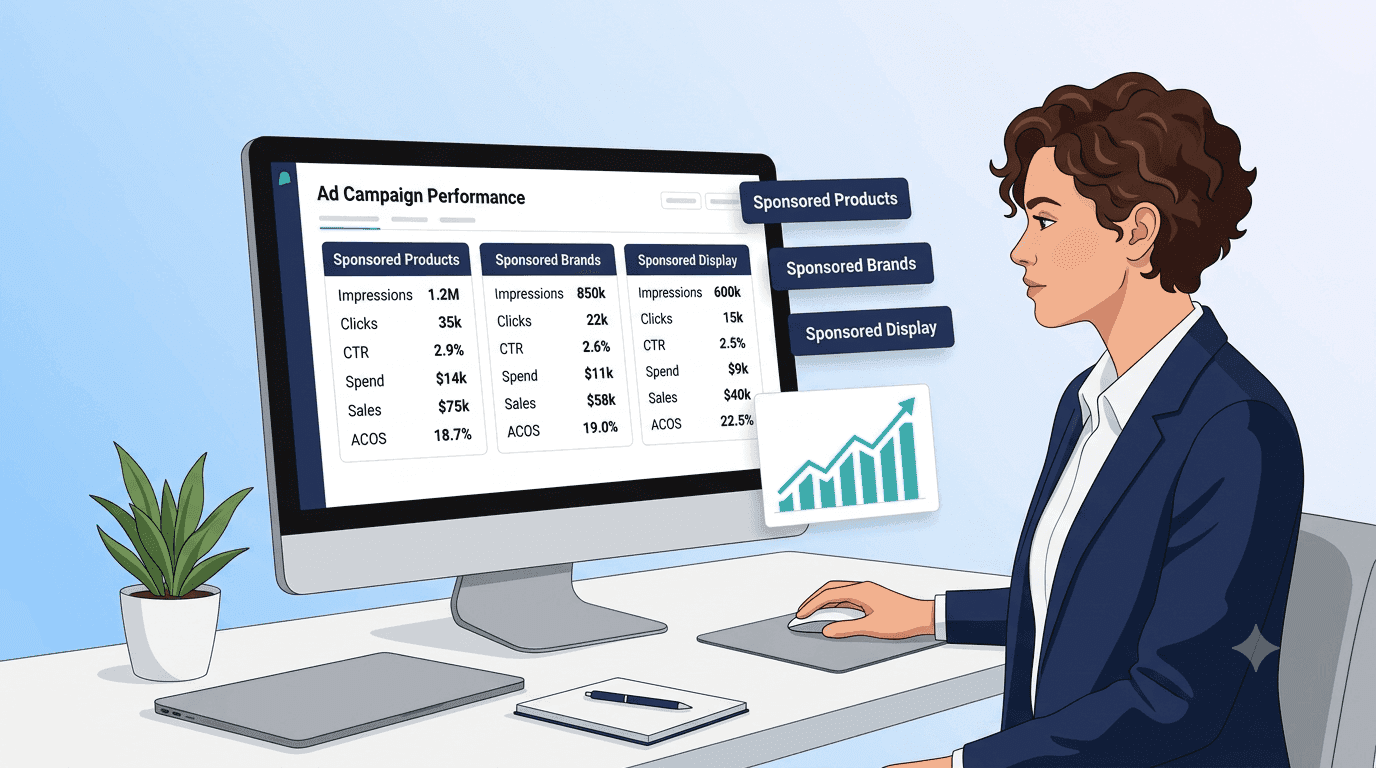
Amazon Sponsored Ads: Beginner-to-Advanced Guide for Brand Owners
Learn how Amazon Sponsored Products, Sponsored Brands, and Sponsored Display work: with campaign structure, India CPC benchmarks, and advanced optimisation levers for brand owners.
Most Indian brand owners running Amazon ads are doing some version of the same thing: an auto campaign, a moderate daily budget, and a weekly check to see if the numbers look okay.
But it is just the kindergarten set of what Amazon Sponsored Ads can do.
With over 1.2 lakh brand-registered sellers competing on Amazon India, and CPCs in top-of-search placements rising 40-60% since 2022, the margin for operational error in Amazon advertising has shrunk significantly. The brands pulling ahead are not spending more, they are running a more structured, more intentional advertising system
This guide covers all of it. What each ad type is, how the auction works, how to structure campaigns properly, what the advanced levers are, and where most Indian brand owners are leaving money on the table.
What Are Amazon Sponsored Ads and How Do They Work?
Amazon Sponsored Ads are pay-per-click advertisements (also called PPC Campaigns) that appear within Amazon's search results, on product detail pages, and across Amazon's display network. You set a bid i.e., the maximum you are willing to pay per click, and Amazon runs a real-time auction every time a shopper searches or browses.
The auction does not simply go to the highest bidder. Amazon factors in two things: your bid amount and a relevance score, a measure of how relevant your ad is to the search query, calculated from your listing quality, historical click-through rate, and keyword match. A highly optimised listing at a moderate bid can consistently beat a poorly optimised listing at a higher bid.
Three placement types determine where your ad appears:
Top of Search:
The first one to four results on page one. Highest visibility, highest conversion rate, highest CPC. According to Amazon Advertising benchmarks, top of search placements typically convert 2–3x better than other placements. This is where the auction is most competitive.Rest of Search:
Positions further down page one and on subsequent pages. Lower CPC, lower conversion rate. Useful for discovery and budget efficiency.Product Pages
Appears on competitor or complementary product detail pages, below the buy box. Lower purchase intent than search placements but valuable for retargeting and conquesting.
Understanding placements matters because you can bid differently for each, a lever most Indian sellers never use, covered in the advanced section below.
What Are The Three Types of Amazon Sponsored Ads, And When to Use Each
Sponsored Products: Your Primary Sales Driver
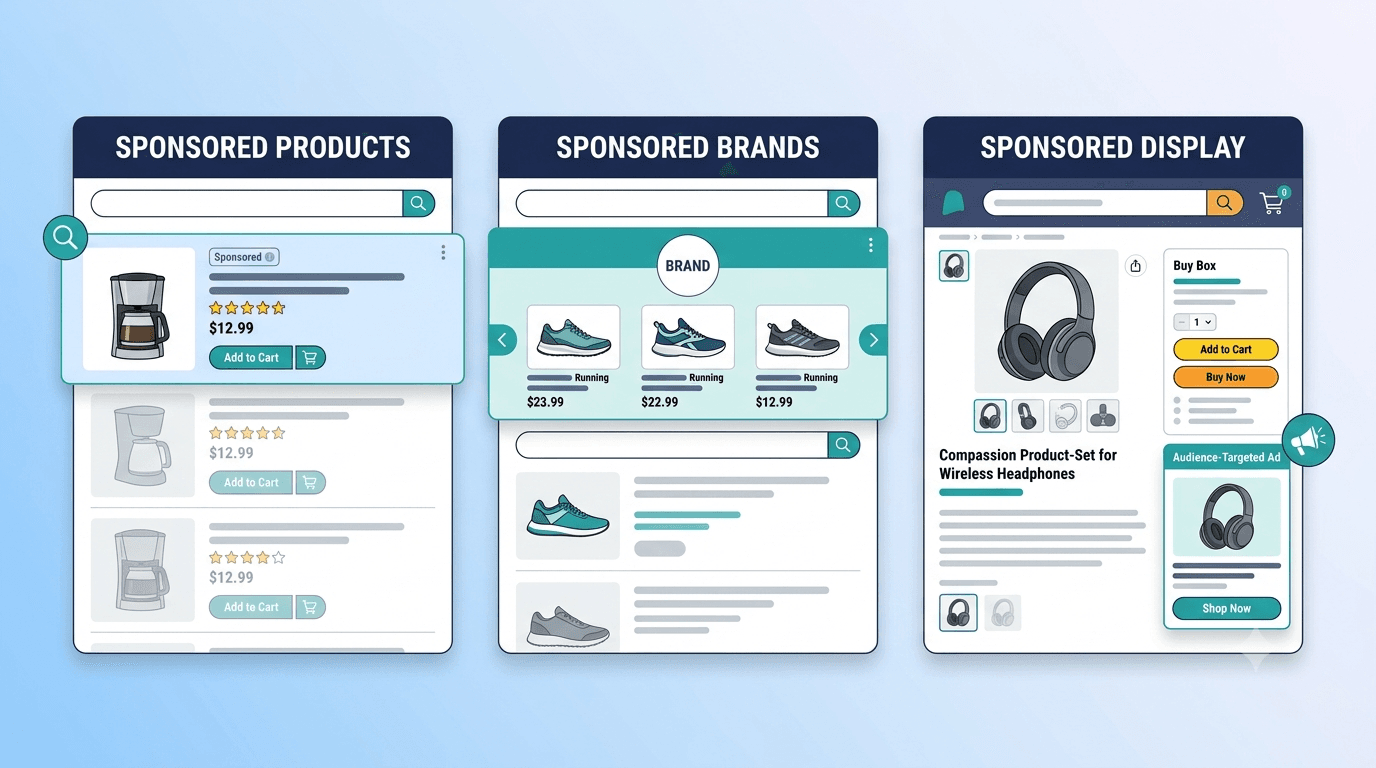
Sponsored Products is the foundational Amazon ad type. It appears in search results and on product detail pages, marked as "Sponsored." Pay-per-click: you only pay when a shopper clicks. It is the highest-volume, most directly measurable ad type available on Amazon India.
Sponsored Products can be run as automatic campaigns (Amazon selects targeting) or manual campaigns (you choose keywords). Within manual campaigns, you control targeting precision through three keyword match types: broad, phrase, and exact.
Auto vs manual campaigns: Which Does What
Automatic campaigns let Amazon decide which search queries to target based on your listing. They cast a wide net and surface search terms you would not have thought to bid on manually. The right role for auto campaigns is discovery, finding new converting terms from real shopper behaviour, not as the primary budget carrier.
Manual campaigns let you choose specific keywords and bids. Once a search term proves it converts in an auto campaign, graduate it to a manual exact match campaign where you control the bid precisely. This is the flow that separates accounts that compound from accounts that plateau.
How match types control your targeting:
Broad match
Amazon shows your ad for searches containing your keyword words in any order, plus related variations and synonyms. Widest reach, highest risk of irrelevant spend. A seller of "whey protein chocolate" on broad match may show for "chocolate milkshake recipe" because the words overlap.
Phrase match
Your ad shows for searches containing your keyword phrase in the same order, with additional words before or after. More controlled than broad. "Whey protein chocolate" phrase match shows for "best whey protein chocolate" but not "chocolate protein whey."
Exact match
Your ad only shows when someone searches your keyword precisely or very close variants. Tightest control, lowest waste, typically the highest conversion rate of the three. The most efficient match type for proven converting keywords.
The flow that works: run auto campaigns first to discover what shoppers actually search. Once a term proves it converts, move it to a manual exact match campaign with a precisely calibrated bid. Add non-converting terms as negatives. This is the compounding loop covered in the campaign structure section below.
India CPC benchmarks by category (mid-2025):
FMCG and packaged foods: Rs 3–8 per click
Beauty and personal care: Rs 8–20 per click
Health and supplements: Rs 10–25 per click
Electronics accessories: Rs 5–15 per click
Fashion and apparel: Rs 4–12 per click
These are directional benchmarks. Actual CPCs vary by keyword, time of day, and proximity to the festive season.
Sponsored Brands: How Amazon Sponsored Brands Reach Customers
Sponsored Brands is available to brand-registered sellers only. It appears as a banner ad at the top of search results, above Sponsored Products, showing your brand logo, a custom headline, and up to three products. It is the most visible placement in Amazon's ad inventory.
One way Sponsored Brands reach customers is precisely this top-of-search banner placement; your brand appears before any competitor product listing, owning the first impression on a category search page. A shopper searching "face wash" sees your brand banner before seeing any individual product listings.
Sponsored Brands can link to your brand store or a custom landing page, making it the only Amazon ad type that takes shoppers outside the standard search results experience into a curated brand environment.
Sponsored Brands Video is the faster-growing format within this category. An autoplay video appearing directly in search results generates significantly higher click-through rates than static banner formats across most categories, according to Amazon Advertising benchmarks. For Indian brand owners who have invested in product video content, this is an underused, high-performing placement.
Sponsored Brands vs Sponsored Products, the key difference:
Sponsored Products drives direct conversions from individual product searches. Sponsored Brands builds brand recognition and allows you to present multiple products simultaneously to a shopper who may not yet be searching for your specific brand. Use Sponsored Products as your primary sales driver. Use Sponsored Brands to own category-level awareness and protect brand search terms.
Sponsored Display: Reach Shoppers Beyond Search Results
Sponsored Display operates differently from the other two ad types. Where Sponsored Products and Sponsored Brands are keyword-targeted, Sponsored Display is audience-based; it reaches shoppers based on their behaviour rather than their search query.
Three targeting types within Sponsored Display:
Product targeting
Your ad appears on specific product detail pages. Use this to appear on competitor listings (conquesting) or on complementary product pages (cross-sell). A protein powder brand can appear on a shaker bottle listing. A competitor's brand page becomes your ad placement.
Audience targeting
Reach shoppers who have viewed similar products or your own listings. These are warm audiences who have shown category interest but have not yet purchased.
Views remarketing
Specifically retarget shoppers who viewed your product page but did not purchase. The highest-intent audience available outside of your own customer list. Shoppers who viewed your listing already know your product exists; views remarketing brings them back.
One powerful application of product targeting is page defense, targeting your own ASINs so competitor ads cannot appear below your buy box. This pushes competitor sponsored ads off your product pages. The cost is minimal; the protection is significant. Without page defense, a competitor can advertise directly below your buy box.
How to Structure Amazon Sponsored Ads Campaigns the Right Way
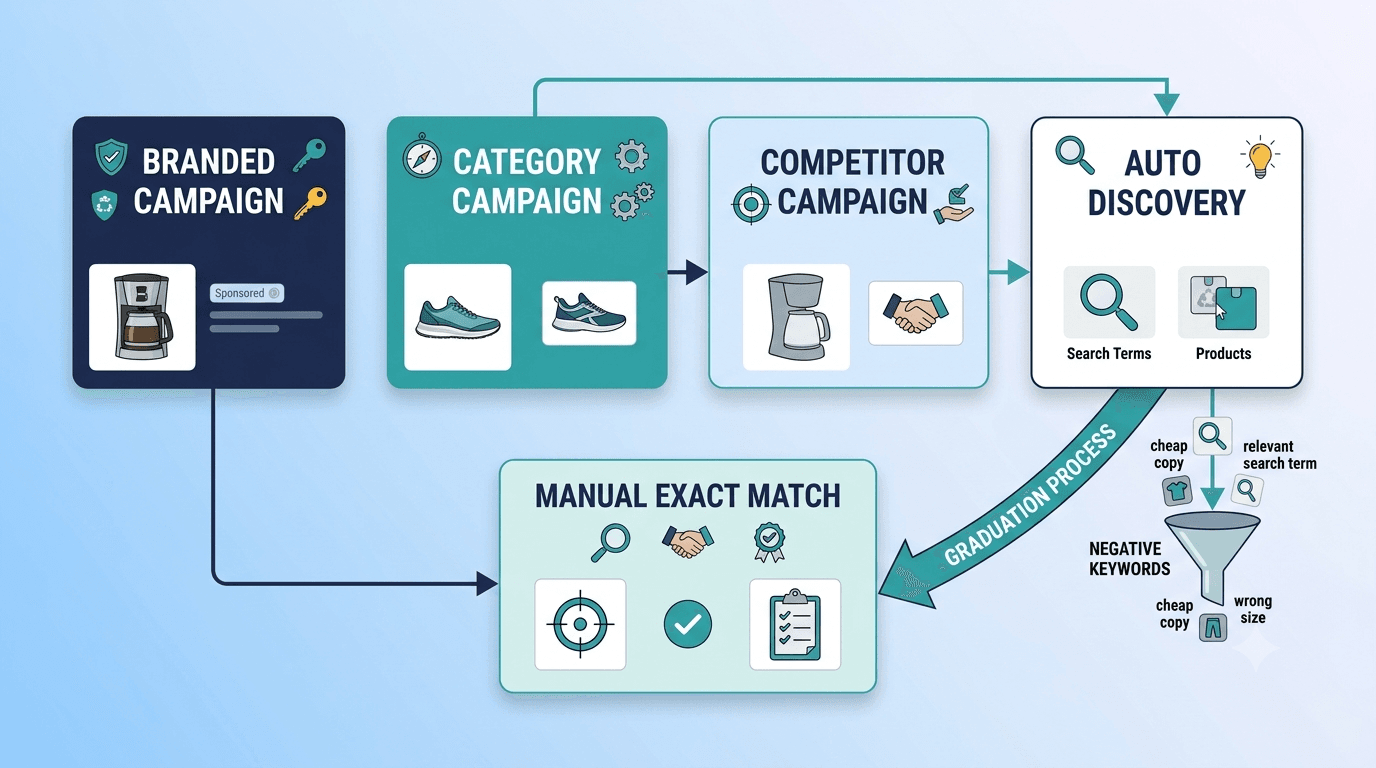
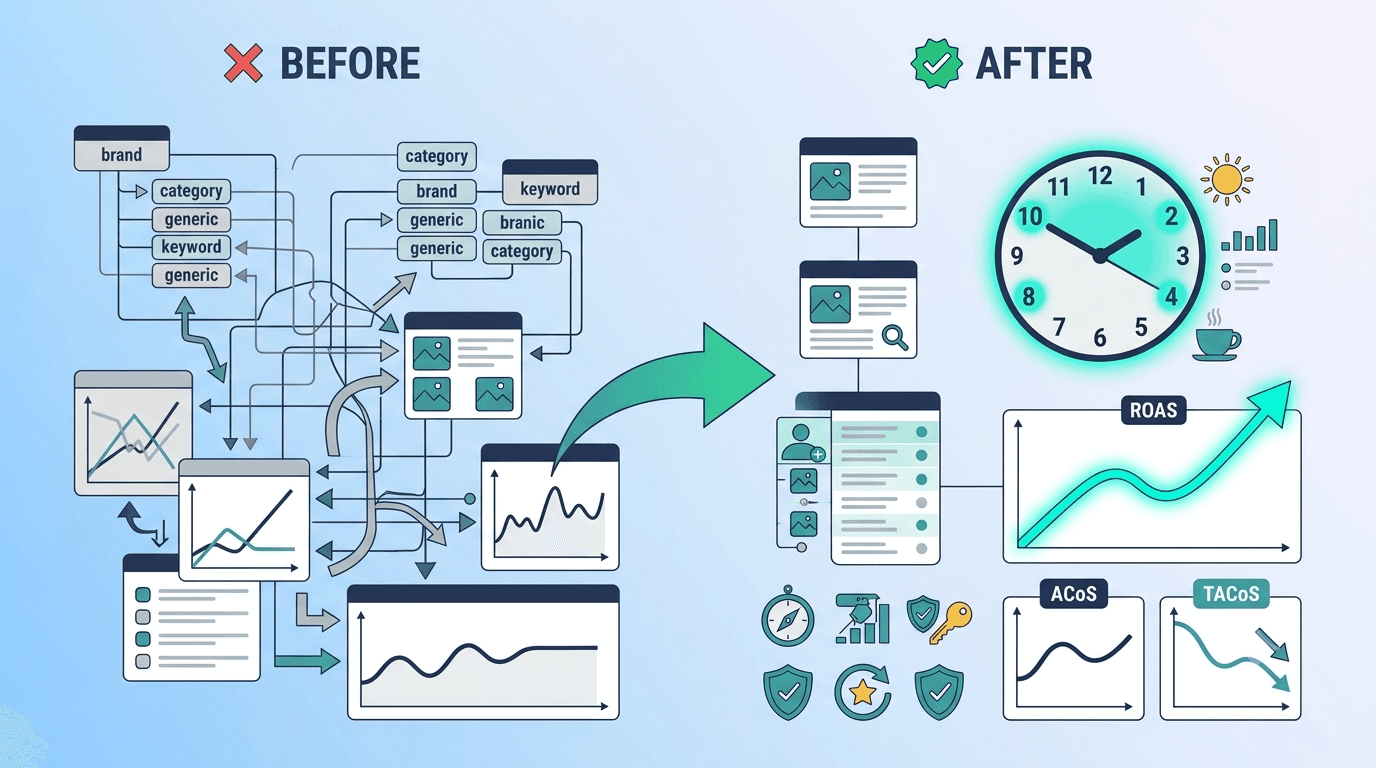
Most Indian brand owners run one or two campaigns with mixed keyword types, all targeting all products. This produces data that is impossible to interpret cleanly and optimization decisions that affect everything at once.
The campaign architecture that produces compounding results separates intent levels into distinct campaigns:
Branded campaigns
Keywords containing your brand name. Conversion rates are typically the highest of any campaign type because the shopper is already looking for you specifically. Bids can be moderate because competition is low; you are defending your own brand search. Always run this even if your brand is small.Category campaigns
Generic category keywords. Medium conversion, higher competition. Use phrase and exact match for terms you know convert, auto or broad for discovery within the category.Competitor campaigns
Competitor brand names as keywords. Low conversion rate, the shopper was looking for a competitor, not you. Keep bids low and treat this as a long-term brand awareness play, not a direct conversion driver.Auto discovery campaigns
Automatic targeting with low bids. The sole purpose is discovering new converting search terms from real shopper behaviour. Pull search term reports weekly, identify converting queries, graduate them to manual exact match campaigns, and add non-converting high-spend queries as negatives.
The flow that compounds: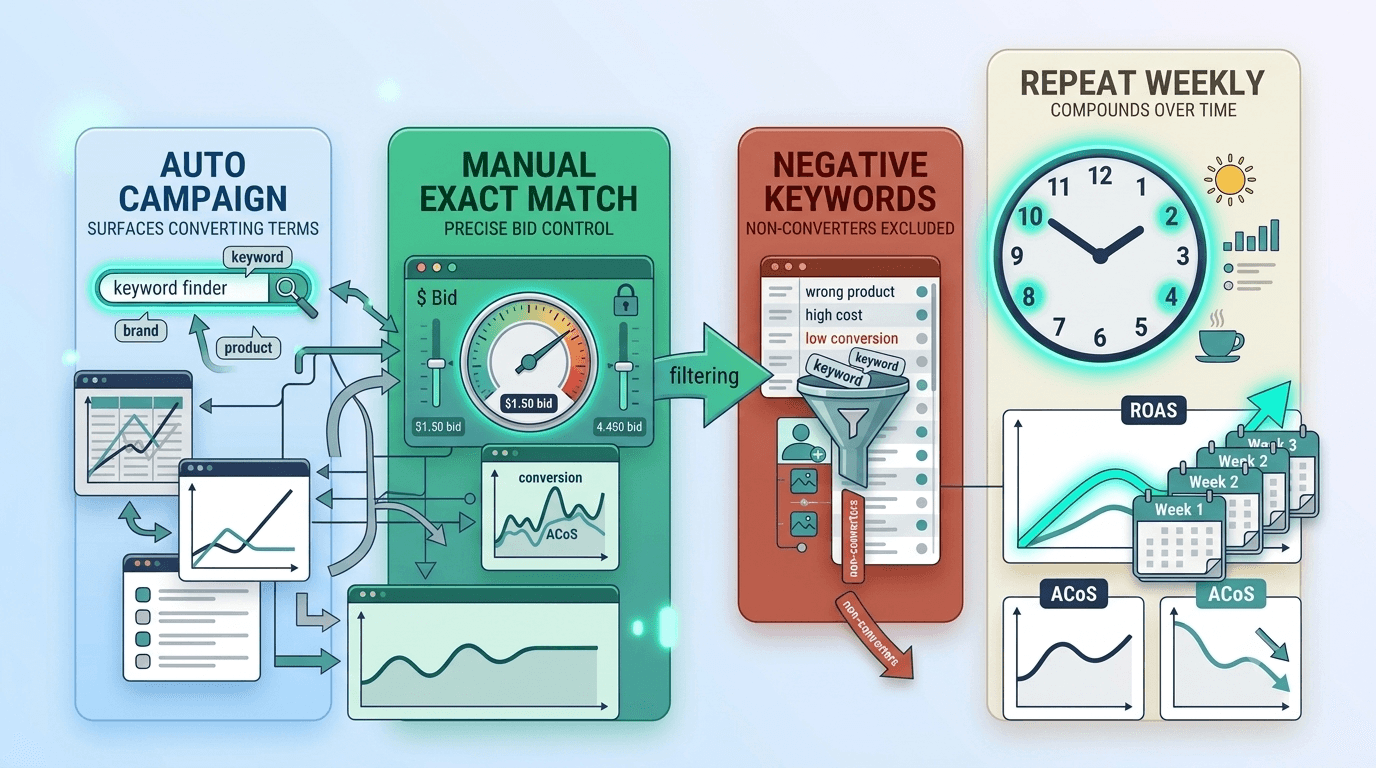
PGC has used this architecture across 70+ brands on Amazon. For Tynor Orthotics, a structured campaign approach, moving from broad discovery to precise exact match management with continuous negative keyword hygiene, contributed to an ACoS improvement from 28% to 11% over the engagement period.
Amazon Sponsored Ads Cost in India: What to Expect
How much do Amazon Sponsored Ads cost in India? There is no fixed answer; costs vary by category, keyword competitiveness, time of day, and proximity to the festive season. But there are frameworks that help you set realistic expectations.
Most brands starting on Amazon India should budget a minimum of Rs 15,000 to Rs 25,000 per month to generate enough data to optimise from. Below that threshold, impression volume is insufficient to make confident bid decisions. Brands managing Rs 50,000 to Rs 2,00,000 per month in ad spend have enough volume across campaigns to run a genuinely structured approach.
The COD/RTO correction most Indian sellers miss:
Your Amazon dashboard ACoS is calculated on attributed sales at the moment of order. In India, COD orders run 50–65% of total orders in many categories, with RTO rates averaging 20–30% in fashion. When a COD order is rejected or an order is returned, that revenue disappears from your P&L, but the ad spend that generated the click already happened.
Real effective ACoS for most Indian sellers is 5–8 percentage points higher than what the dashboard shows. A campaign reading 18% ACoS may be running at 24–26% effective ACoS once COD rejections and RTOs are factored in. Calculate your break-even ACoS using real net margin, then apply this correction before setting targets.
Festive season CPC inflation:
October and November CPCs spike 2–3x during the Great Indian Festival and Diwali periods. Brands without automated bid management or pre-set bid caps see ACoS double during their highest-volume period. Begin festive campaign preparation in September, campaign architecture built, bid modifiers set, budgets pre-loaded. PGC's managed accounts on Pinnaclegrowth.ai maintain continuous bid adjustment during festive periods, preventing the runaway spend that catches unprepared accounts off-guard.
Advanced Levers Most Indian Brand Owners Never Use

This is where accounts that were running at 25% ACoS drop to 14%. Not through dramatic strategy changes but through consistent use of levers that most sellers know exist but never systematically apply.
Placement bid modifiers
Amazon allows you to increase your bid by a percentage specifically for top of search or product page placements. If your base bid is Rs 10, a 50% top-of-search modifier tells Amazon to bid Rs 15 specifically for that placement while maintaining Rs 10 elsewhere. This concentrates your budget in the placement where conversion rates are highest without increasing total spend. Most accounts run uniform bids across all placements. Accounts using placement modifiers intelligently consistently outperform on ROAS.
Search term harvesting cadence
Pull your search term report weekly. Identify queries in auto and broad campaigns that generated purchases. Add them as exact match keywords in dedicated manual campaigns with bids calibrated to their conversion rate. Add queries with meaningful spend and zero purchases as negative keywords immediately.
This is not a monthly task. It is a weekly one. The gap between when a new irrelevant term enters your campaign and when it is excluded is where waste accumulates. PGC's accounts on Pinnaclegrowth.ai run this continuously, the AI harvests converting terms and excludes wasteful ones in real time rather than waiting for a weekly review cycle. The Pack8 account running this model showed AI-managed campaigns at 38.6% ACoS versus manually managed campaigns at 54.7% ACoS over a 30-day period.
Dayparting
Amazon's auction runs 24 hours a day. Your conversion rates do not. For some categories, the 7–10 pm window converts 2–3x better than the 2–5 am window, but without dayparting, your bids are identical at both times. Concentrating budget in high-converting windows while pulling back during low-converting periods can move ACoS meaningfully without touching a single keyword. This is covered in detail in our guide on Amazon dayparting.
TACoS - the metric smarter brands track
ACoS measures advertising cost against ad-attributed revenue only. TACoS (Total Advertising Cost of Sale) measures advertising cost against total revenue, including organic sales that your ads helped generate by improving rank.
A brand with declining TACoS and stable ACoS is building organic momentum. The ads are doing more than driving direct sales; they are compounding into organic rank improvement. TACoS is the metric that tells you whether your Amazon advertising is building a self-sustaining business or propping one up. Our guide on reducing Amazon ACoS covers how to read both metrics together.
How Ads Automation Changes the Way You Scale
All of the above- placement modifiers, search term harvesting, negative keyword management, dayparting, budget reallocation- require continuous execution to compound properly. Done manually on a weekly cycle, they produce incremental improvement. Done continuously by an AI system, they compound significantly faster.
Across live accounts on Pinnaclegrowth.ai, AI-managed campaigns running alongside human-managed campaigns on the same account over 15 days showed ACoS of 67% versus 123.3% and four times the sales at a lower CPC. The difference was not strategy. it was execution frequency. For brands ready to move beyond manual management, Pinnaclegrowth.ai runs this continuously across 13 Amazon marketplaces.
Common Amazon Sponsored Ads Mistakes Indian Brand Owners Make
Running only auto campaigns and never graduating to manual. Auto campaigns are for discovery, not for carrying your primary budget long-term. Brands that never build manual exact match campaigns from proven search terms are paying broad match CPCs for exact match quality traffic, permanently.
Flat bids across all match types and placements. Broad match keywords and exact match keywords do not convert at the same rate. Top of search and product pages do not convert at the same rate. Identical bids across all of these is the most common structural inefficiency in Indian Amazon accounts.
No negative keyword management. Every week, new irrelevant search terms enter your campaigns. Without weekly negative keyword action, 20–40% of ad budget in unmanaged accounts goes to queries that will never convert. This is covered in detail in our guide on Amazon keyword waste.
Optimising for ACoS without knowing break-even. The right ACoS target is derived from your net margin before advertising costs. A brand with 18% net margin needs ACoS below 18% to be profitable on ad-driven sales. Many Indian brands optimise toward a round number 20%, 15% without calculating whether that number actually protects their margin.
Ignoring Sponsored Brands Video. Sponsored Brands Video generates significantly higher CTR than static banner formats in most categories. For Indian brand owners who have invested in product video content, not running Sponsored Brands Video is leaving one of the highest-performing placements in the inventory unused.
No campaign separation. Branded keywords, category keywords, competitor keywords, and auto discovery in one campaign produce data that cannot be interpreted cleanly. When everything is mixed together, pausing one poor performer or scaling one strong performer affects everything else simultaneously.
Ready to Move Beyond Manual Campaign Management?
If this guide has shown you the gap between where your Amazon advertising is now and where it could be, there are two ways to close it.
For brands that want to run a smarter manual system, the campaign architecture and weekly optimisation cadence covered in this guide is the starting point. For brands that want continuous optimisation without the manual overhead- bid modifiers, search term harvesting, negative keyword management, and dayparting running automatically across every campaign: Pinnaclegrowth.ai handles all of it across 13 Amazon marketplaces without periodic reviews or manual cycles.
Book a Free Growth Call with Pinnacle Growth Consulting
Your Amazon Verified Ads Partner for PPC Strategy
Pinnacle Growth Consulting is an Amazon SPN verified partner, recognised by Amazon India for ecommerce expertise and service quality. Our team manages 70+ brands across 13 Amazon marketplaces, backed by Pinnaclegrowth.ai, our proprietary AI-powered ads automation platform.
Frequently Asked Questions
Amazon Sponsored Ads are pay-per-click advertisements that appear within Amazon's search results, on product detail pages, and across Amazon's display network. There are three types: Sponsored Products (keyword-targeted, appears in search results and product pages), Sponsored Brands (banner ads at the top of search results, brand-registered sellers only), and Sponsored Display (audience-based targeting for retargeting and conquesting). You pay only when a shopper clicks your ad.
Sponsored Products work through a real-time auction triggered every time a shopper searches on Amazon. You set a maximum bid per click and choose keywords to target using broad, phrase, or exact match types. Amazon factors in both your bid and your ad's relevance score to determine placement. The ad appears in search results and on product detail pages marked as "Sponsored." You pay the winning bid amount only when someone clicks.
Sponsored Products promotes individual product listings through keyword-targeted search placements. It drives direct conversions from shoppers searching for specific products. Sponsored Brands promotes your brand as a whole through a banner ad at the top of search results, showing your logo, a custom headline, and up to three products. Sponsored Brands requires Brand Registry. Sponsored Products is available to all sellers. Sponsored Products is your primary sales driver; Sponsored Brands builds brand-level awareness and category ownership.
Costs vary by category, keyword competitiveness, and time of year. CPC benchmarks for Amazon India range from Rs 3–8 per click for FMCG to Rs 10–25 for health and supplements. Most brands testing for the first time should budget Rs 15,000 to Rs 25,000 per month to generate actionable data. Note that real effective ACoS in India is typically 5–8 percentage points higher than dashboard ACoS due to COD rejections and RTOs. October and November CPCs spike 2–3x during festive season.
Start with an automatic Sponsored Products campaign for your 3–5 hero SKUs at a conservative daily budget. Run it for two to three weeks to collect search term data. Pull the search term report, identify queries that generated purchases, and build manual exact match campaigns around those proven terms. Add non-converting high-spend queries as negative keywords. This auto-to-manual graduation flow is the foundation of every well-structured Amazon advertising account.
One primary way Sponsored Brands reach customers is through top-of-search banner placement, appearing above all Sponsored Products results at the very top of a search page. When a shopper searches a category keyword, your brand banner with logo, headline, and up to three products is the first thing they see, before any individual product listing. Sponsored Brands Video takes this further with autoplay video in search results, generating significantly higher click-through rates than static banners.
For Sponsored Brands standard banner: logo image (400x400px minimum), headline (up to 50 characters), three product ASINs required. For Sponsored Brands Video: video file (MP4 or MOV), 6–45 seconds in length, 1920x1080px recommended, no black bars, audio optional but recommended, must comply with Amazon's creative guidelines. Brand Registry is required for both formats. Specs are subject to Amazon's updates, verify current requirements in Amazon Ads console before production.