
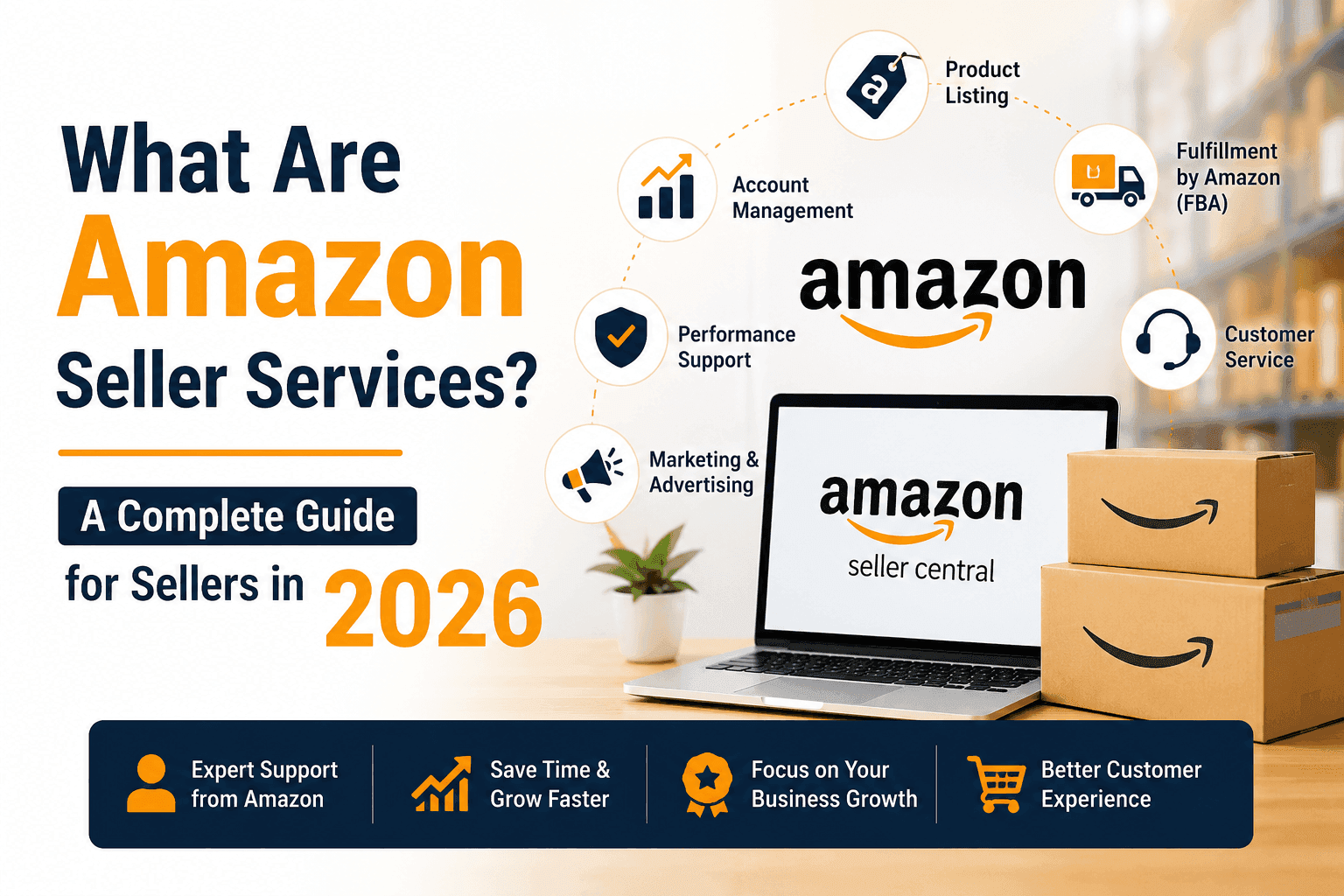
What Are Amazon Seller Services? A Complete Guide for Sellers in 2026
Discover what Amazon Seller Services include in 2026, from account setup and listing optimization to advertising, inventory, and growth support. Learn how expert management can save time, improve visibility, increase sales,and help your brand scale.
Selling on Amazon looks simple until you are three months in, buried in listing errors, rising ad spend, and account health warnings. Amazon Seller Services are professional support offerings that handle account management, product listings, advertising, inventory, and seller support so you can grow without doing everything yourself. This guide breaks down what they include, who benefits, and how to choose the right provider.
Key Takeaways | |
• What they are: Amazon Seller Services cover the operational and growth work of running a marketplace business, from setup to scaling. | |
• What is included: Amazon seller account management, listing optimization, advertising, inventory, and Amazon seller support. | |
• Why sellers use them: Managed Amazon services bring specialist expertise and coordinate SEO, ads, and inventory under one strategy. | |
• When to consider full-service: Brands with many SKUs, high ad costs, or multi-marketplace plans often need full-service Amazon management. | |
• How to choose: Judge providers on real Amazon experience, service coverage, and transparent reporting, not generic promises. |
What Are Amazon Seller Services?
Amazon Seller Services are professional services that help businesses set up, run, optimize, and grow their presence on Amazon. They exist because managing a marketplace account well takes ongoing time and specialist knowledge. Sellers use them to keep operations healthy while focusing on their products, and they support everything happening inside Amazon Seller Central.
These services fit a wide range of sellers. New Amazon sellers use them to avoid setup mistakes. Established brands use them to protect rankings and scale advertising. D2C businesses lean on them to move from their own site into the marketplace. Manufacturers use them to sell direct without building an in-house team, and international brands rely on them to enter new Amazon marketplaces. Across all of them, the work touches Amazon Ads, Amazon FBA, and the wider Amazon Marketplace.
The scale is worth understanding. Amazon reported that independent sellers, mostly small and medium businesses, accounted for more than 60% of its online store sales, showing how central third-party sellers have become to the platform. [Insert verified 2026 data point with source citation.]
Doing it yourself vs. using a service: Managing Amazon independently means you personally handle listings, ads, inventory, and support tickets, which works at small scale but gets harder as you grow. Professional Amazon marketplace management hands those areas to a team that does this daily, so problems get spotted and fixed faster.
What Do Amazon Seller Services Include?
Amazon Seller Services cover the core activities needed to operate, optimize, and scale an Amazon business. In practice, most providers group their work into five areas.
Amazon Seller Account Management
Amazon seller account management is the day-to-day running and health of your Seller Central account. It includes account setup and configuration, ongoing Seller Central management, account health monitoring, and policy and compliance support. This matters because a single unresolved health issue can suspend your listings. For example, a seller nearing an unhealthy Account Health Rating can have the team fix defect metrics before Amazon acts.
Amazon Product Listing Optimization
Listing optimization is the work of making product pages rank and convert. It covers product titles, bullet points, descriptions, backend search terms, A+ Content, images and creative, and keyword optimization. Strong listings do double duty: they help buyers decide and help Amazon's algorithm understand what you sell. A well-written title with the right keywords can lift both visibility and click-through.
Amazon Advertising Management
Advertising management runs your paid campaigns profitably. It includes Sponsored Products, Sponsored Brands, and Sponsored Display, plus campaign setup, keyword research, bid management, and ACoS and ROAS monitoring. The goal is not just more spend but efficient spend, cutting wasted budget on poor keywords and shifting it to terms that convert.
Inventory and Order Management
Inventory and order management keeps stock and fulfilment running smoothly. It covers inventory monitoring, stock planning, FBA coordination, order management, and out-of-stock prevention. Running out of a bestseller hurts twice, because you lose sales and your organic ranking drops, so proactive stock planning protects both.
Amazon Seller Support
Amazon seller support handles issues and cases as they arise. This includes account-related problems, listing suppression, catalog issues, case management, Seller Central support, and policy concerns. When a listing is suppressed or a catalog detail is wrong, quick case handling gets the product live again before sales are lost.
Why Do Businesses Use Managed Amazon Services?
Managed Amazon services let businesses outsource some or all marketplace operations to experienced professionals. The appeal is simple: Amazon needs continuous monitoring, and most sellers cannot watch every area at once.
A seller has to juggle listings, ads, inventory, account health, and support at the same time. A dedicated team brings specialist expertise to each, spots issues sooner, and coordinates SEO, advertising, inventory, and sales under one strategy rather than in silos.
Picture a growing brand with genuinely good products that still struggles with poor visibility, high advertising costs, listing errors, inventory gaps, and account health warnings. Individually these feel like small fires. A managed Amazon services provider connects them: better listings improve organic rank, which lowers the pressure on ads, while steady stock keeps rankings from slipping. One coordinated plan often fixes what five separate efforts cannot.
Amazon Seller Services vs. In-House Management
The core difference is who does the work. In-house management means building and running your own Amazon team, while managed services hand that work to an external provider. Here is how they compare.
Feature | In-House Management | Managed Amazon Services |
Team Building | Hire, train, and retain specialists yourself | Team already in place, no hiring needed |
Cost Structure | Salaries, tools, and overhead | Service fee, often flexible by scope |
Expertise | Limited to who you can hire | Broad, across SEO, PPC, and catalog |
Scalability | Slower, needs new hires to grow | Scales with your SKUs and marketplaces |
Daily Management | Fully on your team | Handled by the provider |
Best For | Large brands with budget for a team | Sellers wanting expertise without overhead |
In-house management suits larger brands that sell enough volume to justify a full salaried team and want total internal control. Outsourcing tends to be more efficient when you lack the time, budget, or Amazon expertise to build that team. In reality, the right choice depends on your business size, budget, expertise, and growth goals, and many brands blend both, keeping strategy in-house while outsourcing execution.
What Are the Benefits of Amazon Account Management Services?
Amazon account management services help sellers run daily operations while improving performance and unlocking growth. The benefits show up across six areas.
Improved Account Performance
Regular monitoring of performance metrics and account health keeps small problems from becoming suspensions and keeps your account in good standing.
Better Product Visibility
Keyword optimization, listing improvements, and Amazon SEO help your products surface for the searches that actually matter to buyers.
More Efficient Advertising
Campaign optimization and disciplined budget management turn ad spend into conversions instead of wasted clicks.
Reduced Operational Workload
Delegating repetitive tasks and centralizing management frees your internal team to focus on product and brand instead of daily marketplace chores.
Access to Specialized Expertise
You gain Amazon SEO specialists, PPC experts, catalog experts, and dedicated account managers without hiring each one yourself.
Better Growth Scalability
Whether you are adding SKUs, expanding into new marketplaces, or building a longer-term brand strategy, Amazon account management services give you the structure to scale without breaking your operations.
How Do Full-Service Amazon Management Services Work?
Full-service Amazon management combines every marketplace service, from listings and ads to inventory and support, under one coordinated strategy. Most providers follow a clear, repeatable process.
Step 1 — Audit the Amazon Account
The provider reviews account health, product listings, sales performance, advertising, competitors, and inventory to find gaps and opportunities before making changes.
Step 2 — Create a Growth Strategy
Based on the audit, they build a plan covering SEO, content, PPC, conversion rate optimization, inventory, and sales growth, with priorities set by impact.
Step 3 — Optimize Products and Campaigns
Execution begins: improving listings, keywords, images, and A+ Content, then restructuring PPC campaigns around what the strategy identified.
Step 4 — Monitor Performance
The team tracks sales, organic rankings, advertising performance, conversion rate, and account health to see what is working.
Step 5 — Continuously Optimize
Using that data, they adjust campaigns, update listings, surface new growth opportunities, and improve profitability in an ongoing loop rather than a one-time fix.
How to Choose the Right Amazon Seller Service Provider
Before choosing an Amazon seller service provider, evaluate whether they can actually deliver results for a business like yours. Five factors matter most.
Amazon Experience
Look for proven experience with your product category, similar products, and general Amazon marketplace operations, not just marketing in general.
Service Coverage
Check that they offer what you need, whether that is account management, Amazon SEO, PPC, listing optimization, or seller support, so you are not stitching together multiple vendors.
Reporting and Transparency
Insist on regular performance reports, clear KPIs, and defined deliverables so you always know what you are paying for and what results look like.
Industry Knowledge
A strong provider understands Amazon policies, competition in your category, and current marketplace trends, and adapts as the platform changes.
Customized Strategy
Avoid one-size-fits-all offers. A good strategy is shaped by your business goals, product category, competition, budget, and growth stage.
Expert Insight: Why Amazon Management Requires a Full-Funnel Approach
A common mistake is judging Amazon growth by advertising performance alone. Ads are only one lever. Sustainable growth depends on organic visibility, listing quality, conversion rate, inventory availability, account health, and advertising working together.
When any one of these breaks, the others suffer. Great ads sending traffic to a weak listing waste budget, and a strong listing that keeps running out of stock loses the rankings it earned. A full-funnel approach treats these as one connected system.
Amazon Seller Services — Which Services Does Your Business Need?
Different situations call for different services. Use this as a starting guide.
Business Situation | Recommended Services |
New Amazon seller | Account setup + listing optimization |
Low organic visibility | Amazon SEO + listing optimization |
High advertising costs | Amazon PPC management |
Account-related problems | Amazon seller support |
Multiple products | Full account management |
Rapidly growing brand | Full-service Amazon management |
International expansion | Marketplace expansion + account management |
These are starting points, not fixed rules. Your real requirements will vary with your business goals, product portfolio, operational complexity, and growth stage, and most sellers combine two or three of these as they scale.
Bringing It All Together
Amazon Seller Services are the professional support that keeps a marketplace business running and growing, spanning account management, listings, advertising, inventory, and seller support. Together these areas move a brand from simply having products on Amazon to actively scaling them. The smartest approach is not to buy everything, but to choose the services that match your specific goals, catalog, and growth stage. If your business needs support with Amazon account management, listings, advertising, and marketplace growth, explore professional Amazon management services designed to help sellers scale more efficiently.
Frequently Asked Questions
Amazon Seller Services are professional services that help businesses operate and grow on Amazon. They typically include Amazon seller account management, product listing optimization, advertising management, inventory and order handling, and seller support. Sellers use them to run their accounts efficiently and scale without managing every area themselves.
It covers account monitoring, product listings, advertising, inventory, performance tracking, and support. In practice, a provider watches your account health, optimizes listings and campaigns, plans stock, and handles Seller Central cases, so your account stays healthy and keeps improving over time rather than only reacting to problems.
They can be, especially for small teams with limited time, resources, or Amazon expertise. Outsourcing lets a small business access specialist skills without hiring, avoid costly setup mistakes, and free up time for product and brand work. Whether it is worth it depends on your margins, volume, and goals.
Pricing varies widely and depends on service scope, number of products, marketplaces covered, advertising requirements, and business goals. Some providers charge a flat fee, others a percentage of sales or a retainer. Because these factors differ so much between sellers, it is best to request a scoped quote rather than assume a fixed rate.
Amazon seller support is issue-based: it resolves specific problems like listing suppression, catalog errors, or policy cases as they come up. Account management is ongoing and strategic, covering continuous monitoring, optimization, and growth planning. Support fixes what breaks; account management works to keep the account healthy and growing.