
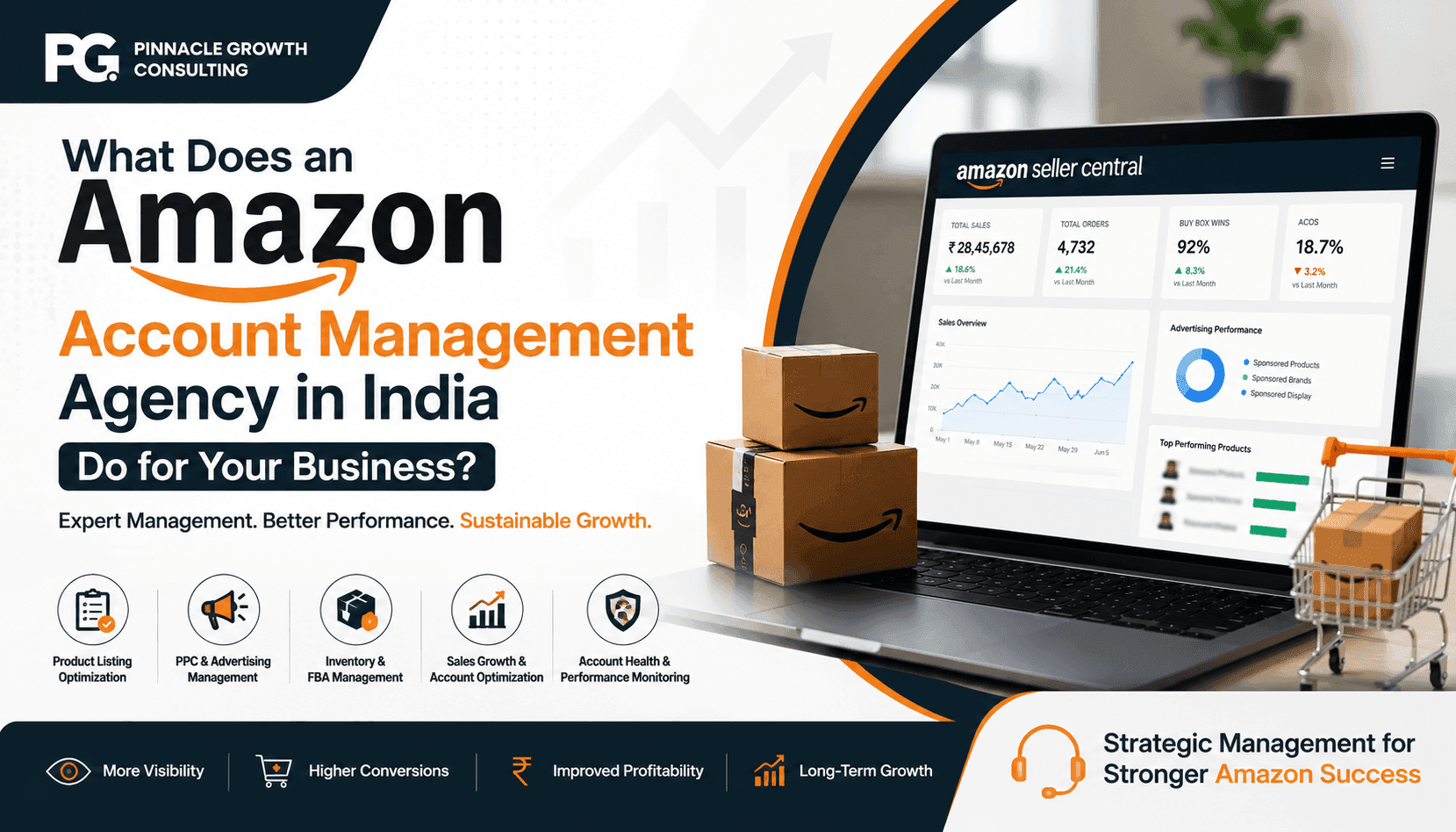
What Does an Amazon Account Management Agency in India Do for Businesses?
Selling on Amazon takes more than listing products. See how an Amazon account management agency in India handles PPC, listings, inventory, catalog and account optimization to help businesses grow efficiently.
An Amazon account management agency in India runs your Seller Central account end to end. That includes product listings, catalogue health, advertising campaigns, inventory planning, pricing decisions, account health monitoring and marketplace reporting. In practice, the agency handles the daily marketplace work that decides whether your products get seen, bought and reordered.
Most sellers do not struggle on Amazon because the product is weak. They struggle because listings are only half optimised, ad budget flows to search terms that never convert, stock runs dry during a sale event, or a suppressed listing sits unnoticed for three weeks. Add pricing pressure, catalogue errors, review issues and shrinking margins, and Seller Central starts consuming more time than the channel returns.
These problems are connected. Better ads cannot rescue a poor listing. A great listing cannot sell an item that is out of stock. That is exactly why sellers hand the account to a specialist team instead of splitting the work across people who each own one piece of it.
What Is an Amazon Account Management Agency?
An Amazon account management agency is a specialist ecommerce service provider that manages a brand's Amazon Seller Central or Vendor Central account on its behalf. It combines listing optimisation, catalogue management, Amazon advertising, inventory coordination, pricing support, account health monitoring and performance reporting under one accountable team.
It helps to see the three usual options side by side.
Managing Amazon in-house: your own team owns everything. You keep full control and context, but you also need listing, advertising, operations and analytics skills sitting inside the company, plus the tools to support them.
Using freelancers: you hire task by task. One person writes listings, another runs ads, a third handles cataloguing. It is flexible and often cheaper for a narrow job, but nobody owns the overall outcome and coordination falls back on you.
Hiring an agency: one team owns the marketplace as a whole, with a defined scope, reporting rhythm and a shared set of KPIs across listings, ads, inventory and account health.
The difference is not effort. It is integration and accountability.
What Does an Amazon Account Management Agency in India Do?
An Amazon account management agency manages Seller Central operations, optimises product listings, maintains catalogue accuracy, plans and runs advertising campaigns, monitors inventory and pricing, tracks account health metrics, and reports on marketplace performance. The aim is steady growth in visibility, conversions and profitability rather than a single isolated improvement.
Amazon Seller Central Management
Seller Central is the control panel for everything: orders, listings, ads, payments, cases, policy notifications and performance data. Amazon Seller Central management covers account settings, day to day operational monitoring, response to alerts and notifications, and case management with Seller Support when something breaks.
This is unglamorous work with real commercial weight. A shipment stuck in receiving, a listing pulled for a compliance flag or a pricing error alert can quietly cost a week of sales. A managed account means somebody sees these events on the day they happen rather than at month end.
Amazon Product Listing Management and Optimisation
Amazon product listing management covers titles, bullet points, product descriptions or A+ content, backend search terms, attributes, images, variations and category placement. Each element does a different job.
Titles, search terms and attributes mainly influence whether Amazon's search engine, A9, shows your product for a query.
Images, bullets, pricing and A+ content mainly influence whether the shopper who lands on your page actually buys.
Amazon account optimization services work on both sides at once. A keyword rich title that reads like a spreadsheet may pull traffic and lose the sale. A beautiful listing with no relevant search terms may convert well for the handful of people who find it. The workable target is a listing that ranks for buying intent keywords and answers the shopper's objections above the fold.
Amazon Catalogue Management
Amazon catalog management services keep the underlying product data clean. That means consistent attributes, correct category and browse node placement, properly built parent child variations, merged or removed duplicate listings, and fast resolution of suppressed or stranded inventory.
Catalogue problems are easy to underestimate. A variation family that breaks apart splits reviews and sales history across separate pages. A missing required attribute can suppress a listing from search without any obvious warning on the storefront. For a brand with several hundred SKUs, catalogue hygiene is often the cheapest available source of recovered revenue.
Amazon PPC Management Services
Amazon advertising has moved from optional to structural. New products in competitive categories rarely gain organic traction without paid support, because early sales velocity feeds ranking. Amazon PPC management services cover Sponsored Products, Sponsored Brands and Sponsored Display campaigns.
The work includes keyword research, search term analysis, bid optimisation, campaign restructuring, negative targeting, budget allocation across products, and placement adjustments. Three metrics guide most decisions:
ACOS (Advertising Cost of Sales): ad spend as a percentage of the revenue those ads produced. It measures campaign efficiency.
TACOS (Total Advertising Cost of Sales): ad spend as a percentage of total revenue, organic included. A falling TACOS at steady sales usually indicates organic strength is building.
ROAS (Return on Ad Spend): revenue earned per rupee spent. It is simply the inverse view of ACOS and is useful for budget conversations.
Spending more does not automatically produce growth. Higher budgets on inefficient search terms usually produce higher costs and thinner margins. Good advertising management is about moving money towards terms that convert, cutting the ones that do not, and protecting the contribution margin per unit.
Amazon Inventory Management
Amazon inventory management services connect sales data to supply planning. This covers stock level monitoring, reorder planning, sales velocity and demand forecasting, FBA shipment coordination, and balancing between stockouts and excess inventory that attracts storage fees.
Inventory is a ranking issue as much as an operations issue. When an item goes out of stock, the listing loses the Buy Box and sales momentum, and recovery is rarely instant when stock returns. Overstocking has the opposite cost, tying up working capital and long term storage fees. Planning ahead of festive peaks matters especially in India, where demand around major sale events can be several times a normal week.
Pricing and Competitor Monitoring
Pricing on Amazon is competitive and dynamic. Agencies track competitor offers, monitor Buy Box eligibility and share, review discount and coupon strategy, and watch how price changes affect conversion and margin together.
The Buy Box matters because the vast majority of purchases happen through it, and price is one of several inputs alongside fulfilment method, seller metrics and stock availability. The point is not to be cheapest. It is to hold a defensible price position where volume and margin both work, which sometimes means competing on content and delivery speed rather than discounting.
Account Health and Seller Performance Management
Account health decides whether you get to keep selling. Agencies monitor Order Defect Rate, Late Shipment Rate, Cancellation Rate, Valid Tracking Rate, policy compliance notifications, customer feedback and any intellectual property or authenticity complaints.
No provider can guarantee that a listing or account will never be flagged, and any agency promising that is overselling. What proactive monitoring does is shorten the gap between a problem appearing and someone acting on it, which is often the difference between a routine fix and a prolonged appeal.
Reviews and Customer Experience Monitoring
Reviews cannot be bought, incentivised or manipulated. Any agency offering that is putting your account at risk, and Amazon's policies on review abuse are strict.
What legitimate management looks like: monitoring incoming reviews and questions, spotting recurring complaints, and feeding those back into product and listing decisions. If several buyers say a size runs small or packaging arrives damaged, that is a listing correction, a packaging change or a size chart addition. Agencies can also help enrol eligible products in Amazon Vine and use compliant request review flows.
Marketplace Analytics and Reporting
Reporting should trigger decisions, not just display numbers. Useful Amazon reporting connects revenue, orders, sessions, conversion rate, advertising spend, ACOS, TACOS, ROAS, Buy Box percentage, inventory health and profitability into a single view.
The value sits in the interpretation. Sessions up and conversion down usually points to a listing or pricing problem. Ad sales up while total profit is flat usually points to a bidding or margin problem. A monthly report that says revenue grew by a percentage, with no explanation of which lever moved it, is not management.
How Do Amazon Account Management Services Work?
Most Amazon account management services in India follow a similar sequence: audit the account, analyse the business and products, research competitors and keywords, fix listings and catalogue, restructure advertising, plan inventory and operations, monitor performance, and report with recommended next actions. Onboarding usually takes a few weeks before optimisation becomes routine.
Amazon account audit. The agency reviews listings, catalogue structure, advertising accounts, account health metrics and inventory position. It matters because most accounts already contain fixable losses. The early impact is usually a prioritised list of issues ranked by revenue at stake.
Business and product analysis. Margins, fulfilment model, landed costs, returns and hero SKUs are mapped. Without this, advertising targets are guesswork. The output is a realistic view of which products can afford which level of ad spend.
Competitor and keyword research. Search demand, competitor listings, price bands and review positioning are studied. This grounds the strategy in the actual category rather than assumptions, and shapes both listing copy and campaign structure.
Listing and catalogue optimisation. Titles, bullets, images, A+ content, attributes and variation structure are corrected and rewritten. This improves both discoverability and conversion, which lifts the return on every rupee spent on ads afterwards.
Advertising restructuring. Campaigns are rebuilt around a clear structure, with keyword harvesting, negatives and bid rules. The purpose is to stop wasted spend and concentrate budget on converting search terms.
Inventory and operational planning. Reorder points, shipment plans and peak season cover are set against forecast demand. This protects ranking momentum and reduces both stockouts and storage costs.
Performance monitoring. Rankings, ad efficiency, account health and stock levels are tracked continuously so issues surface early rather than at month end.
Reporting and continuous optimisation. Results are reviewed on a fixed cadence with clear next steps. Amazon is not a project with an end date, so the cycle repeats as competitors, prices and search behaviour change.
Results vary by category, price point, competition and product quality, so no responsible agency should commit to a specific revenue number at the start.
How Does an Amazon Agency Help Sellers Grow?
Growth on Amazon comes from several small compounding gains rather than one clever tactic. An agency works on the levers together: organic visibility, listing conversion, advertising efficiency, catalogue quality, inventory availability, account health and decision quality.
The mechanics are fairly logical. Better listings and keyword coverage bring more relevant sessions. Stronger content and images convert more of those sessions. Higher conversion improves ad relevance and organic ranking, which brings more sessions again at a lower acquisition cost. Consistent stock availability keeps that cycle running, and clean catalogue data keeps reviews and sales history consolidated on the pages that matter.
Beyond the existing catalogue, agencies typically support marketplace expansion: launching new SKUs with a defined ranking plan, entering additional categories, or extending to other marketplaces once the core account is stable. The operational efficiency gain is real too, since your internal team stops firefighting Seller Central tickets.
Benefits of Hiring an Amazon Account Management Agency
Access to marketplace specialists. Amazon changes its policies, ad formats and reporting regularly. A team that works across many accounts sees those changes early and knows what has worked in comparable categories.
Reduced internal workload. Seller Central administration, case handling, shipment planning and campaign maintenance take real hours. Moving them out frees your team for product, sourcing and brand work.
Faster problem identification. Suppressed listings, ranking drops, buy box loss and rising ACOS get noticed when somebody is looking at the account daily.
Professional PPC management. Structured campaigns, disciplined negatives and bid management usually deliver more from the same budget than ad hoc adjustments.
Better listing optimisation. Research led copy and imagery, tested and iterated, rather than written once at launch and forgotten.
Improved reporting and data backed decisions. Consistent metrics make it possible to compare months, judge campaigns and decide where the next rupee should go.
Centralised marketplace management. One team accountable for listings, ads, inventory and account health removes the coordination gaps that appear when three vendors each own a slice.
Easier scaling. Adding SKUs, categories or marketplaces becomes a scope conversation rather than a hiring cycle.
Managing Amazon In-House vs Hiring an Agency
Factor | In-House Management | Amazon Account Management Agency |
Expertise | Depends on what your team already knows; the learning curve on Amazon is steep | Specialists working across multiple accounts and categories daily |
Team requirement | You need listing, advertising, operations and analytics skills internally | One engagement covers a mixed skill team |
PPC knowledge | Usually the hardest gap to fill and retain internally | Typically a core capability with dedicated ad managers |
Listing optimisation | Possible with training, tools and time | Structured process backed by keyword and competitor research |
Marketplace tools | You buy and maintain your own subscriptions | Tooling is generally included in the fee |
Scalability | Adding SKUs or marketplaces usually means hiring | Scope can be expanded without new hires |
Reporting | Depends on internal discipline and bandwidth | Usually contractual, with an agreed frequency and format |
Operational workload | Sits entirely with your team | Shifts to the agency, with approvals staying with you |
Cost structure | Salaries, tools and training as fixed cost | Retainer, percentage of sales, fixed package or hybrid |
An agency is not automatically the right answer. Internal management often makes better sense when Amazon is a small share of revenue, when the catalogue is tiny and stable, when you already employ an experienced marketplace manager, or when your category is so specialised that product knowledge outweighs marketplace technique. Some brands also run a hybrid: internal ownership of pricing and inventory, agency ownership of advertising and listings.
When Should You Hire an Amazon Account Management Agency?
Use these signals as a checklist. If several apply at once, the case for outside help is usually stronger than the cost.
Sales have plateaued despite steady or rising ad spend.
PPC costs are climbing and ACOS stays high without a clear reason.
Listings receive sessions but conversion rate is below category norms.
Catalogue errors, suppressed listings or broken variations keep recurring.
Your internal team is capable but has no specific Amazon experience.
Stockouts or overstock keep happening because forecasting is manual.
Seller Central is consuming a disproportionate share of someone's week.
You are planning a multi SKU launch and want ranking support from day one.
You are expanding to new categories or additional marketplaces.
Account health notifications need closer and faster attention.
Amazon revenue is growing but profit after fees, ads and returns is not.
Why Hire an Amazon Account Management Agency in India?
For brands selling on Amazon.in, an India based agency brings direct familiarity with the local marketplace. That includes how Indian shoppers compare prices, which categories are crowded, how regional demand differs, and how sale events like the Great Indian Festival, Prime Day and Republic Day sales reshape demand and advertising costs for weeks around them.
Practical advantages usually include:
Working knowledge of Amazon.in category rules, fee structures and fulfilment options.
Understanding of price sensitivity and the role of coupons, exchange offers and EMI in Indian buying decisions.
Awareness of India specific categories and compliance expectations, from packaged goods labelling to BIS requirements in relevant categories.
Coordination with your finance and operations teams on GST related documentation, invoicing and marketplace reconciliation where the scope includes it.
Shared time zone, language and working calendar, which shortens response times during peak events.
Access to a broader pool of marketplace specialists than most single brands can employ directly.
This does not mean an Indian agency is automatically cheaper or better than any alternative. Quality varies widely, and a poorly run local agency will underperform a strong offshore one. Judge the team, not the postcode.
What Businesses Can Benefit From Amazon Account Management Services?
The service scope changes with business maturity, though the underlying disciplines stay the same.
New Amazon sellers need account setup, brand registry, catalogue creation and a launch plan for ranking their first products.
Established sellers usually need efficiency work: advertising restructuring, listing refreshes, catalogue clean up and profitability analysis.
D2C brands entering Amazon need positioning and pricing that supports the marketplace without cannibalising their own website margins.
Manufacturers moving to direct selling need catalogue architecture, content creation and channel policy, since they often have no retail marketing history.
Private label sellers live or die on launch execution, review velocity and advertising efficiency in crowded categories.
Retailers and multi brand sellers need catalogue scale, Buy Box strategy and inventory coordination across many SKUs.
International brands entering Amazon India need local pricing, compliance guidance, listing localisation and category benchmarking.
How to Choose the Best Amazon Account Management Agency in India
There is no single best Amazon account management agency in India, because the right fit depends on your category, catalogue size, margin structure and growth stage. What you can do is evaluate candidates against consistent criteria.
Proven marketplace experience, ideally in categories with similar price points and competition to yours.
Category understanding, shown through specific observations about your listings rather than a generic pitch deck.
PPC depth, including how they structure campaigns, handle negatives and manage bids against margin.
Listing and catalogue capability, covering variation architecture, A+ content and attribute hygiene, not only copywriting.
Account health knowledge, including how they have handled suppressions, appeals and policy issues before.
Technology and analytics, meaning the tools they use and the reporting you will actually receive.
Strategic thinking, shown by a willingness to say which products are not worth advertising.
Transparent pricing and clear KPIs, agreed before the engagement starts.
Profitability awareness, so growth is measured after fees, ads, shipping and returns.
Verifiable experience, through references, case studies or accounts you can check.
Questions worth asking before you sign:
1. Who will manage our account day to day, and how many other accounts do they handle?
2. Which services are inside the scope, and which are billed separately?
3. How often will we receive reporting, and what will it contain?
4. How do you measure advertising performance, and at what ACOS or TACOS would you pull back?
5. What is your process for listing optimisation, and how do you validate keywords?
6. Which KPIs will you be accountable for in the first ninety days?
7. How do you handle catalogue errors, suppressions and account health issues?
8. How do you balance revenue growth against profitability?
9. What does the exit look like, and who retains access to the account and assets?
How Much Do Amazon Account Management Services Cost in India?
Pricing for Amazon account management services in India varies widely, and any figure quoted without seeing your account is guesswork. Cost is generally driven by the number of SKUs, catalogue complexity, monthly sales volume, advertising spend under management, the number of marketplaces, the current condition of the account, the services included and the depth of reporting required.
Four commercial models are common:
Monthly retainer: a fixed fee for a defined scope. Predictable for both sides and the most common structure.
Percentage of sales: the fee scales with revenue. Aligns incentives on growth, but you should check how it treats existing baseline revenue.
Fixed service packages: discrete deliverables such as listing creation or an account audit, priced individually.
Hybrid: a smaller retainer plus a performance component tied to agreed metrics.
Compare proposals on scope and accountability, not just the monthly number. A lower fee that excludes catalogue work and advertising management is not actually cheaper.
What KPIs Should an Amazon Account Management Agency Track?
Metric | What It Measures | Why It Matters |
Revenue and growth rate | Total sales value over a period | Shows whether marketplace activity is translating into business growth |
Sessions | Visits to your product detail pages | Indicates how much traffic listings attract from search and ads |
Conversion rate | Share of sessions ending in a purchase | Tells you whether content, images and pricing are convincing buyers |
Organic ranking | Position for target keywords | Reflects listing strength and reduces long term dependence on paid traffic |
Advertising spend | Money invested in Amazon Ads | The base against which all efficiency metrics are judged |
ACOS | Ad spend as a percentage of ad revenue | Measures campaign level advertising efficiency |
TACOS | Ad spend as a percentage of total revenue | Shows whether organic sales are growing alongside advertising |
ROAS | Revenue earned per rupee of ad spend | A simple efficiency view for budget allocation |
CPC and CTR | Cost per click and click through rate | Reveal keyword competitiveness and creative appeal |
Buy Box percentage | Share of time you hold the Buy Box | Directly limits how much of the demand you can capture |
Inventory availability | In stock rate and days of cover | Stockouts damage ranking momentum and waste ad spend |
Account health metrics | ODR, Late Shipment Rate, policy status | Protects your ability to keep selling at all |
Profitability | Margin after fees, ads, shipping and returns | Confirms that the growth is worth having |
Is an Amazon Account Management Agency Worth It?
An Amazon account management agency is usually worth it when Amazon is a meaningful revenue channel, internal marketplace expertise is limited, advertising is running inefficiently, or operational workload is slowing growth. The return depends on your product economics, competition, pricing and the quality of the agency itself. It is an investment decision, not a guaranteed outcome.
A practical test: estimate what you currently lose to inefficient ad spend, stockouts, suppressed listings and unoptimised pages over a quarter. If that figure comfortably exceeds the fee, the case is straightforward. If Amazon contributes a small share of revenue and the catalogue is simple, internal management may serve you better for now.
Turning Amazon Into a Managed Channel
An Amazon account management agency in India manages the connected parts of your marketplace presence: Seller Central operations, listings, catalogue, advertising, inventory, pricing, account health and reporting. The reason integration matters is that these parts influence each other continuously, and improving one in isolation rarely holds.
Professional management mostly buys you consistency. Issues get caught earlier, budget gets spent more deliberately, launches follow a plan, and decisions rest on data instead of instinct. That is what makes the channel scalable rather than merely busy.
When you evaluate a partner, weigh expertise, strategic clarity, transparency and attention to profitability more heavily than promises about rankings or revenue. If you would like a clearer picture of where your own account stands, an audit of your listings, catalogue health and advertising efficiency is a sensible first step. It costs you little and usually surfaces a few fixable problems straight away.
Key Takeaways
An Amazon account management agency handles the full marketplace operation, covering Seller Central administration, listings, catalogue, PPC, inventory, pricing, account health and reporting under one accountable team.
Growth comes from connected improvements, not single tactics. Better listings raise conversion, higher conversion improves ad efficiency and organic ranking, and consistent stock keeps that cycle running.
Advertising efficiency matters more than advertising volume. ACOS, TACOS and ROAS should be read together with margin, since higher spend on non converting search terms simply raises cost.
Catalogue and inventory issues are silent revenue leaks. Suppressed listings, broken variations and stockouts damage ranking momentum in ways that ad budget cannot compensate for.
Evaluate agencies on scope, KPIs and profitability awareness, not on promised rankings or revenue. Any guarantee about Amazon results should be treated as a warning sign.
Frequently Asked Questions
It manages a seller's Amazon account end to end. That covers Seller Central operations, product listing creation and optimisation, catalogue management, Sponsored Products and Sponsored Brands advertising, inventory planning, pricing support, account health monitoring and performance reporting. The agency is responsible for the daily marketplace work that drives visibility, conversions and marketplace profitability.
Typical scope includes Seller Central administration, listing optimisation, catalogue and variation management, PPC campaign management, inventory forecasting and FBA coordination, competitor and pricing monitoring, account health tracking, review and customer feedback monitoring, and analytics reporting. Exact inclusions vary by agency and contract, so confirm scope in writing before signing.
An India based agency brings direct familiarity with Amazon.in category rules, fee structures, local price sensitivity and major sale events such as the Great Indian Festival. Shared time zone and language also speed up decisions during peak periods. Quality still varies by agency, so evaluate the specific team rather than assuming a location advantage.
It improves several levers at once: keyword coverage and listing quality raise relevant traffic, better content and images lift conversion, restructured campaigns reduce wasted ad spend, and reliable stock protects ranking momentum. These effects compound, since higher conversion improves organic ranking and lowers acquisition cost. Actual results depend on product, pricing and competition.
Yes, advertising is usually a core part of the service. That includes Sponsored Products, Sponsored Brands and Sponsored Display campaigns, keyword and search term research, bid optimisation, negative targeting, budget allocation and placement adjustments. Performance is normally reported through ACOS, TACOS, ROAS, CPC and conversion rate alongside overall profitability.
Yes, and managing them together is one of the main advantages. Listing quality determines conversion, while stock availability determines whether that conversion can happen at all. Agencies typically handle listing content and catalogue structure alongside reorder planning, demand forecasting and FBA shipment coordination so ranking momentum is not lost to stockouts.