

How a Global eCommerce Agency Accelerates Expansions on International Marketplaces
Explore the strategic advantages global eCommerce agencies bring to brands seeking rapid, seamless expansion across diverse e-marketplaces, including localization, compliance, and cross-border logistics management.
International marketplace expansion requires more than listing products in another country. A brand must validate demand, calculate landed margins, meet local compliance requirements, localize its listings, select a fulfilment model, prepare advertising and establish measurable launch targets. This checklist helps ecommerce leaders assess readiness, decide what can remain in-house and identify where specialist support may reduce execution risk.
What Is International Marketplace Expansion?
International marketplace expansion is the process of taking an ecommerce brand into a new country through platforms such as Amazon, Walmart Marketplace, Noon, Shopee or Lazada, or through a localized D2C website.
It includes market selection, registration, compliance, pricing, fulfilment, listings, advertising, customer service and performance management. It is not simply the process of creating a seller account and uploading an existing domestic catalogue.For a broader overview of market selection, localization, payments and global logistics, read our guide on how to expand your ecommerce business globally
International Marketplace Expansion Readiness Checklist
Before investing in registrations, inventory or advertising, leadership should determine whether the business is commercially and operationally ready. A reliable international ecommerce readiness checklist should cover the following twelve areas.

1. Validate Target-Market Demand
Do not treat a large ecommerce market as proof that your product will sell.
Review marketplace search demand, category growth, competitor positioning, review volumes, price bands and customer pain points. Demand should be validated at the individual SKU level, not only at the broad category level.
A product category may be popular while your specific format, price point or value proposition remains unsuitable for the target market.
2. Analyse Competitors and Price Gaps
Identify both direct competitors and substitute products.
Compare:
Product specifications and pack sizes
Pricing and discount patterns
Review scores and common complaints
Delivery promises
Listing quality
Brand positioning
Advertising visibility
Bundles and promotional offers
A product may have visible demand but still be commercially unattractive if established sellers dominate every viable price range.
3. Confirm Product-Market Suitability
Check whether the product’s size, format, ingredients, voltage, packaging, labelling, colours, claims or bundle structure align with local expectations.
The best-selling domestic SKU is not automatically the best product for an international marketplace launch.
A brand may need to change its pack size, product name, instructions, design or assortment before the offer becomes suitable for the new market.
4. Calculate Landed Cost and Contribution Margin
Model the economics before committing inventory.
Your calculation should include:
Manufacturing or product cost
Packaging
International freight
Customs duties
Marketplace fees
Fulfilment and storage
Currency conversion
Advertising
Discounts
Returns and damaged stock
Applicable local taxes
Account-management costs
The final question is not, “Can we sell there?” It is, “Can we sell there profitably at a competitive price?”
Brands should also establish a clear marketplace pricing strategy before committing inventory or advertising budgets.
5. Establish Tax, Registration and Compliance Readiness
Registration and compliance requirements vary by country, marketplace and product category.
Review product-safety rules, labelling, trademarks, taxes, customs requirements and restricted-product policies before launch. Amazon’s official global-selling process, for example, places taxes, regulations, compliance, safety and listing requirements before products are listed in a new marketplace.
Legal, customs and tax requirements should always be verified with qualified professionals and current official sources.
6. Select the Right Marketplace
Choose a marketplace according to:
Customer fit
Category demand
Seller eligibility
Competitive intensity
Platform costs
Fulfilment capability
Return requirements
Advertising opportunities
Brand-building potential
Do not select a marketplace only because it is large, well-known or already used by competitors. Indian brands evaluating Amazon US can follow our Amazon Global Selling guide for Indian brands for a detailed breakdown of registration, compliance, fulfilment, listings and advertising.
7. Localize Product Listings
Localization involves more than translating domestic content.
Product titles, bullet points, images, units, keywords, claims, size references, offers and FAQs should reflect local search behaviour and customer expectations.A domestic product page may need to be substantially rebuilt rather than copied and translated. For Amazon-specific execution, review how professional Amazon listing optimization improves keyword relevance, product visibility and conversion.
8. Prepare Payments and Currency Operations
Determine how marketplace payments will be received, reconciled and converted.
The operational plan should address:
Settlement currency
Conversion fees
Refund accounting
Tax documentation
Payment reconciliation
Ownership of financial reporting
Currency movement should be incorporated into margin planning rather than handled after the launch.
9. Design the Fulfilment and Returns Model
Compare marketplace fulfilment, local third-party logistics, cross-border direct shipping and hybrid approaches.
Model:
Delivery time
Storage costs
Replenishment cycles
Damaged inventory
Reverse logistics
Customer returns
Disposal or liquidation
Inventory transfer
The lowest outbound shipping rate does not always produce the lowest total operating cost.
10. Build the Advertising Launch Plan
New listings usually begin with limited organic visibility, sales history and social proof.
Before inventory becomes available, define:
Launch budget
Campaign structure
Keyword discovery process
Branded defence
Competitor targeting
Category targeting
Performance thresholds
Optimization frequency
Advertising should support marketplace learning and listing improvement—not simply generate initial revenue .Brands launching on Amazon can use this Amazon Sponsored Ads guide to understand campaign types, keyword discovery and campaign structure.
11. Prepare Customer Support
Set response times, escalation rules, return processes, review monitoring and language coverage.
Customer service should reflect both local buyer expectations and marketplace account-health requirements.
The team must also know who will handle damaged products, listing complaints, fulfilment failures and policy notices.
12. Define Reporting and Scaling Criteria
Agree on the metrics and decision rules that determine whether to scale, optimize, pause or exit.
Without pre-approved thresholds, teams often continue funding an underperforming market because they confuse sales growth with profitable growth.
Readiness area | Question to answer | Evidence needed | Where specialist support may help |
Market demand | Is there verified demand for selected SKUs? | Search, competitor and sales data | Market research and demand validation |
Unit economics | Will margins remain viable after all costs? | Landed-cost and contribution model | Financial modelling |
Compliance | Can the product be legally listed and imported? | Category-specific documentation | Compliance coordination |
Localization | Will listings match local search intent? | Keywords, content and creative tests | Listing localization |
Fulfilment | How will inventory, orders and returns work? | Marketplace, 3PL or direct-shipping plan | Logistics planning |
Advertising | How will initial visibility be created? | Budget, campaign and KPI plan | Marketplace advertising |
Operations | Can the team support the market consistently? | Owners, workflows and service levels | Programme management |
Scaling | What will trigger expansion or withdrawal? | KPI thresholds and review cadence | Performance reporting |
How to Select the Right International Marketplace
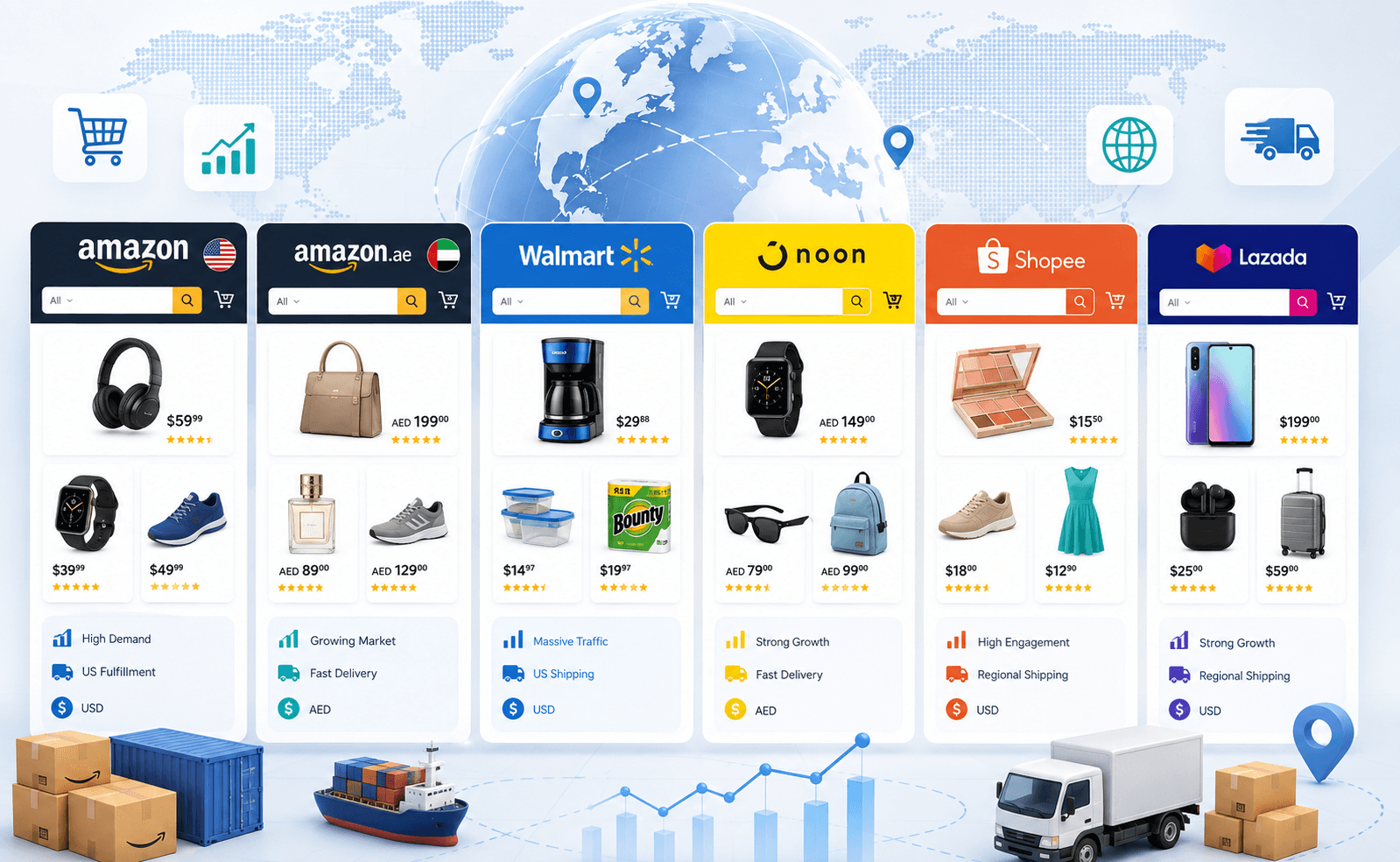
A practical global marketplace entry strategy should use a weighted scorecard.
Evaluate every country-and-platform combination against:
Customer demand
Category fit
Platform fees
Competition
Fulfilment options
Regulatory complexity
Advertising costs
Returns
Local payments
Brand-building potential
Marketplace | Often suitable for | Main advantage | Main challenge to evaluate |
Amazon US | Consumer brands with validated US demand | Global-selling infrastructure and multiple fulfilment options | Competition, compliance and landed economics |
Amazon UAE | Brands testing Middle East demand | Regional Amazon marketplace access | Smaller demand pool and category economics |
Walmart Marketplace | Established sellers with strong catalogues and US fulfilment readiness | Access to Walmart’s US ecommerce customers | Qualification, catalogue and returns requirements |
Noon | Brands focused on the UAE and GCC | Seller tools, advertising and flexible fulfilment | Local documentation and market-specific operations |
Shopee or Lazada | Brands entering selected Southeast Asian markets | Regional reach and cross-border programmes | Country-level localization and logistics |
Amazon offers regional and country-specific accounts along with tools for listings, shipping, fulfilment and market exploration. Walmart currently allows eligible India-based sellers to apply for its US marketplace, subject to verification and fulfilment requirements. Noon requires seller documentation, catalogue preparation and a selected fulfilment model. Shopee’s international programme supports cross-border operations in participating markets.
The right marketplace is therefore different for every brand. A beauty company may prioritize visual merchandising and reviews, while an industrial seller may care more about approval requirements, logistics and account economics.
What Should Remain In-House Versus Be Outsourced?

The decision is not whether everything should be outsourced. The real question is whether the internal team has the expertise, capacity and local context required for each workstream.
Workstream | Can remain in-house when | Specialist support may help when |
Market research | The team has reliable country and category data | The market is unfamiliar or data is fragmented |
Compliance | Internal legal and tax specialists cover the market | Multiple countries or regulated products are involved |
Listing localization | Native-language and marketplace SEO skills exist | Local keyword and creative adaptation is required |
Advertising | The team has relevant platform experience | The marketplace has no historical campaign data |
Logistics | A proven fulfilment and returns network exists | Cross-border fulfilment is new or complex |
Reporting | Marketplace and finance data are centralized | Multiple currencies and dashboards must be reconciled |
Customer service | Local-language support and workflows exist | Coverage or escalation requirements exceed capacity |
Retention | The brand controls customer journeys and CRM | Localized CRO and lifecycle systems need development |
Strategic ownership should remain internal even when execution is outsourced. Leadership should retain control of market selection, margin thresholds, brand standards and final scale-or-pause decisions. Teams comparing internal execution with outsourced operations can also review our guide to managed ecommerce services.
When Should You Hire a Global Ecommerce Agency?
A brand should consider specialist support when the cost of learning through mistakes is greater than the cost of external expertise.
Common signals include:
The company plans to enter more than one marketplace or country.
Compliance requirements are unclear.
The internal team has strong domestic experience but limited cross-border expertise.
Landed margins have not been modelled after duties, storage, advertising and returns.
Product listings require cultural and keyword localization.
Fulfilment, local 3PL or direct-shipping decisions remain unresolved.
Performance data is spread across disconnected dashboards.
Previous international launches generated sales but failed to deliver sustainable profit.
Leadership needs one accountable partner across research, onboarding, growth and reporting.
An agency should not replace internal decision-making. Its role should be to reduce uncertainty, coordinate specialist workstreams and develop a repeatable ecommerce market expansion process.International expansion should also connect with the brand’s wider ecommerce growth strategy, including profitability, conversion, retention and operational performance.
A Practical 90-Day Marketplace Launch Framework
Days 1–30: Validate
Select one priority market and a focused set of SKUs.
Complete:
Market selection
Competitor analysis
Category and compliance review
Landed-margin calculation
SKU selection
Fulfilment assessment
Risk analysis
The output should be a clear recommendation: proceed, proceed after specific changes, run a limited pilot or delay market entry.
Days 31–60: Build
Create the seller account, complete documentation, prepare localized listings, finalize pricing and establish fulfilment and returns.
This phase should also cover:
Catalogue setup
Listing content
Product imagery
Advertising structure
Inventory planning
Reporting dashboards
Customer-service processes
Operational problems are easier to correct before substantial inventory has been shipped.
Days 61–90: Launch and Optimize
Launch with controlled inventory and a defined advertising budget.
Collect search-term and conversion data, improve listings, test pricing or bundles and monitor stock coverage. Review customer feedback, returns and account health alongside sales.
At the end of the pilot, make a scale-or-pause decision using pre-approved thresholds. A successful launch should prove repeatable unit economics—not merely produce a temporary revenue spike.Indian founders can also review how Indian D2C brands expand into international marketplaces and adapt their market-entry strategy by region.
KPIs to Track During International Expansion
Contribution margin: Revenue remaining after product, fulfilment, marketplace, advertising, return and other variable costs.
Landed cost per unit: The complete cost of making one unit available for sale in the target market.
Listing conversion rate: The percentage of product-page visitors who purchase.
Advertising cost of sales: Advertising spend as a percentage of attributed sales.
Customer acquisition cost: The average acquisition spend required to generate a new customer or order.
Return rate: The percentage of fulfilled orders that are returned or refunded.
Inventory sell-through: The share of available inventory sold during a defined period.
Account health: Marketplace-specific operational and policy performance.
Organic keyword rank: Listing visibility for priority non-branded search terms.
Repeat purchase rate: The percentage of customers purchasing again within a defined period.
Revenue by marketplace: Sales contribution by country and platform.
Time to break even: The period needed to recover setup and launch investment.
These metrics should be reviewed together. Strong sales can hide weak contribution margins, excessive returns or slow inventory movement. Use these metrics alongside a structured framework to evaluate ecommerce agency performance and separate sustainable growth from vanity reporting.
Common International Expansion Mistakes
Confusing Market Size With Product Demand
A large marketplace does not guarantee demand for your specific category, product format or price point.
Reusing Domestic Listings
Directly translating domestic listings can weaken both search visibility and conversion. Localization should reflect customer language, search behaviour and objections.
Reviewing Compliance Too Late
Documentation, labelling or category restrictions can delay or stop a launch after inventory has already been produced.
Ignoring Duties, Storage and Returns
These costs can turn an attractive gross margin into an unprofitable contribution margin.
Launching in Too Many Countries
Simultaneous expansion spreads inventory, budget and management attention before one repeatable model has been proven.
Starting With Too Many SKUs
A focused launch creates cleaner data and reduces operational complexity.
Ignoring Local Reviews and Proof
New listings need a compliant plan for developing trust and gathering genuine customer feedback.
Operating Without Scale-or-Stop Criteria
Decisions become emotional when financial and operational thresholds are not defined in advance.
How Pinnacle Growth Consulting Supports International Expansion
Pinnacle Growth Consulting approaches international expansion as an integrated programme rather than a collection of unrelated activities.
Pinnacle Growth Consulting combines market research, localization, marketplace onboarding, payment and compliance coordination, cross-border advertising, conversion optimization, retention and performance reporting through its global marketplace expansion services.
A practical engagement should begin with readiness and unit economics not account creation. The right recommendation may be to narrow the target market, change the selected SKUs, adjust pricing or delay the launch until compliance and fulfilment become viable.
[Explore more international ecommerce case studies to understand how marketplace entry, pricing, compliance and performance strategies work in practice.}
Before publication, add:
Client industry
Domestic marketplace
Target marketplace
Selected SKUs
Original challenge
Compliance and fulfilment approach
Listing and advertising changes
Measurement period
Verified outcome
Data source
Relevant limitation
A measurable client example will provide stronger evidence than a hypothetical success story.
Conclusion
Successful international expansion depends on readiness and operational discipline, not simply listing products in another country.
Validate demand, model landed margins, confirm compliance, localize the offer, establish fulfilment and set performance thresholds before committing significant inventory or advertising spend.
A focused pilot with clear decision rules helps leadership reduce risk and identify whether a market can deliver sustainable, repeatable growth.
Get an International Marketplace Readiness Assessment
Identify your strongest market opportunity, margin risks, compliance gaps and launch priorities before investing in marketplace setup.
Frequently Asked Questions
An international marketplace expansion strategy is a structured plan for entering a new country through a marketplace or localized ecommerce channel. It covers market and SKU selection, compliance, pricing, fulfilment, listings, advertising, customer service, reporting and scale criteria.
A brand is closer to being ready when it has verified demand, viable landed margins, compliant products, a fulfilment and returns model, localized content capability, a launch budget and clear performance thresholds. Readiness should be demonstrated through evidence rather than inferred from domestic sales.
The right first marketplace depends on category demand, customer fit, competition, pricing, seller eligibility, fulfilment and compliance. Score every country-platform combination and begin with the option offering the strongest balance of demand, operational feasibility and contribution margin.
Include product cost, packaging, international freight, customs duties, applicable taxes, marketplace fees, fulfilment, storage, payment conversion, advertising, discounts, returns, damaged stock, localization and account-management expenses.
Specialist support may be useful when the market is unfamiliar, several countries are involved, compliance or fulfilment is complex, listings require localization, performance data is fragmented or the internal team lacks platform-specific experience.
There is no universal timeline. Registration, compliance, catalogue approval, manufacturing, shipping and fulfilment vary by marketplace, country and product category. A 90-day framework can guide a focused pilot, but the schedule should reflect verified operational dependencies.
Track landed cost, contribution margin, conversion rate, advertising efficiency, acquisition cost, returns, inventory sell-through, account health, organic visibility, repeat purchases, revenue by marketplace and time to break even. Commercial, marketing and operational performance should be reviewed together.