

Building a Marketplace Pricing Strategy in India (Amazon vs D2C)
Stop destroying profits in a brutal price war. Discover the ultimate marketplace pricing strategy India. Learn why flat channel pricing ecommerce models fail, and master marketplace vs website pricing India. Get the definitive guide to the right pricing strategy Amazon vs D2C for premium brands.
If your brand is currently losing money in a brutal price war on Amazon or Flipkart, the reason is usually simple: your channel pricing ecommerce strategy is broken. You are paying for a marketplace’s growth out of your own pocket. Too many consumer brands operate with zero pricing intelligence. They calculate their manufacturing costs, add a standard markup, and push the exact same price everywhere. But you cannot survive without a dedicated marketplace pricing strategy India. When looking at marketplace vs website pricing India, business owners need to understand that these are completely different worlds. Treating them the same hurts your profits and cheapens your brand.
Let’s look at the reality of the Indian e-commerce market in 2026. Advertising is more expensive than ever, and platforms are taking larger cuts of your sales. This forces founders to ask the ultimate question: Should D2C prices be different from Amazon prices? The answer is an absolute yes. If you want to survive the current margin squeeze, you need a very distinct pricing strategy Amazon vs D2C.
Below is the exact blueprint for a profitable marketplace pricing strategy India, and how to build pricing models that actually protect your bank account.
The Reality of Channel Pricing Ecommerce:The "Fee Floor"
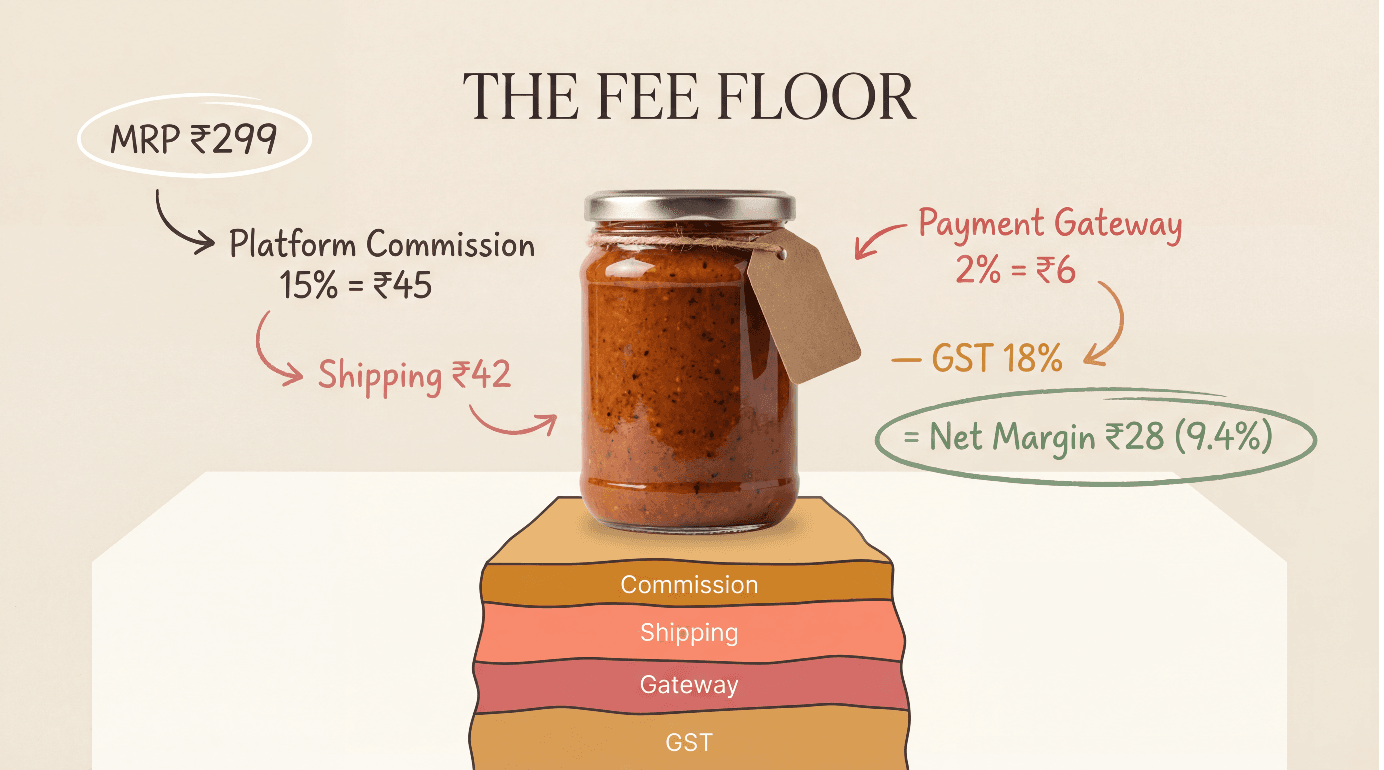
An infographic detailing the hidden fees that shape a profitable marketplace pricing strategy India.
The best approach for marketplace sellers is High-Volume Algorithmic Pricing. Marketplace search engines care mostly about conversion rates and who offers the best deal. If your price is too high compared to similar products, you lose the "Buy Box," your product gets pushed to page two, and your advertising costs go through the roof.
Furthermore, a successful marketplace pricing strategy India must account for the brutal "Fee Floor" unique to this region. In India, you have to factor in the high cost of Cash on Delivery (COD) and Return to Origin (RTO) rates. When a ₹399 product gets returned because a customer rejected the delivery, the shipping fees eat the profit of your next three successful sales. These combined fees routinely swallow 30% to 40% of your total revenue.
Because of this, your marketplace prices must be set specifically to get new customers and move inventory fast. It should be the lowest sustainable price point that allows your brand to show up first in search results and absorb the cost of returned orders.
Understanding Marketplace vs Website Pricing India: The D2C Experience
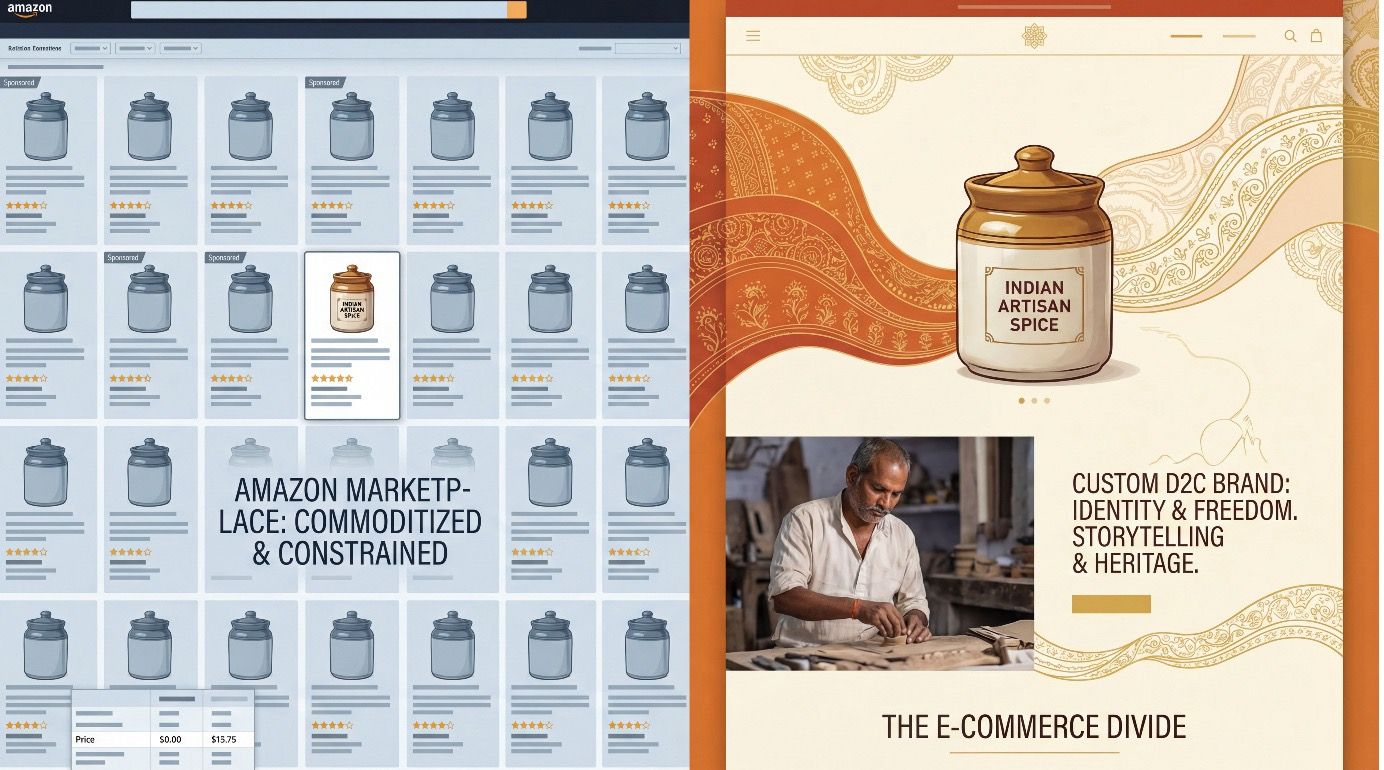
A visual layout comparing commoditized grids against premium storefronts for marketplace vs website pricing India .
Your direct-to-consumer website is a completely different environment. There are no competitors running "Sponsored Products" across your screen. There are no flashing discount timers from rival brands. You own 100% of the customer's attention. It is a quiet experience where your brand's story takes centre stage.
When evaluating marketplace vs website pricing India, your D2C channel is where you make money off the user experience and the quality of your product. However, getting people to your website is expensive. Brands pay a huge premium to run ads on Meta or Google just to get a single click.
Because this advertising cost is so high, your D2C pricing cannot just copy your Amazon pricing. You have to use data to maximize how much a customer spends per order (Average Order Value, or AOV) and how much they spend with you over years (Lifetime Value, or LTV). If you try to match your lowest Amazon prices on your Shopify store, your ad costs will drain your cash flow before the customer ever buys a second time.
Operational Note: If you feel like you are losing money on certain channels, there is likely a flaw in how your products are priced and packaged. You can run your product catalog through our internal Pricing & Profitability Review [here] to find out where your money is leaking.
How to Execute the Right Pricing Strategy Amazon vs D2C

A strategic desk mapping the exact pricing strategy Amazon vs D2C and channel pricing ecommerce.
The biggest hurdle for brands is Amazon's price-checking bots. If Amazon's system sees that you are selling the exact same item for a lower price on your own website, they will penalize your Amazon listing. But if your website price is much higher for no reason, customers will just leave and buy it on Amazon anyway.
Here is how smart operators execute the right pricing strategy Amazon vs D2C:
1. The "Decoy and Bundle" Strategy
Simply stop selling the exact same product on both platforms.
Marketplace: Sell the basic, single-unit product (e.g., A standard 50ml bottle of Ayurvedic hair serum for ₹499). This acts as a cheap trial product for new buyers.
D2C: Focus on large bundles. On your website, push a "Complete Root Therapy Routine" that includes the serum, a derma roller, a herbal shampoo, and a hair-health guide for ₹2,199. You instantly quadruple your order value, which pays for your Facebook ads in a single sale.
2. Shadow Pricing (Hidden Discounts)
Keep the sticker price the exact same across both platforms to keep the Amazon bots happy but change the actual deal on your own website. Offer "Buy 1 Get 1" deals, free gifts with a purchase, or special discounts for email subscribers. Automated Amazon bots struggle to read complex shopping cart discounts. This allows you to give your loyal D2C customers a better deal without triggering an Amazon penalty.
3. The Post-Purchase Migration Playbook
The ultimate goal of selling on Amazon is to eventually pull that customer over to your own website for their second purchase. Put a high-quality insert card in your Amazon packages that offers a massive discount on a D2C-exclusive bundle, accessed via a QR code. This turns a low-profit Amazon buyer into a high-profit website subscriber.
Strategic Proof Point: The Clinical Skincare Pivot
Let's look at a real-world example of a premium D2C skincare brand. At first, they charged a flat ₹899 for a Vitamin C serum on both Amazon and Shopify. It was a disaster. On Amazon, they were constantly losing sales to cheap ₹399 competitors. On Shopify, that ₹899 sale was entirely wiped out by the ₹750 it cost to acquire the customer through Facebook ads.
To fix this, the brand dropped the Amazon price to an aggressive ₹449 for a smaller, 15ml "discovery" bottle. This was done purely to get high sales volume, collect reviews, and find new customers quickly.
At the same time, they completely removed those single bottles from their D2C website. They replaced them with a "90-Day Advanced Brightening Kit" for ₹2,499, focusing heavily on getting real clinical results from a daily routine.
Their sales volume on Amazon tripled because the algorithm loved the new price. Meanwhile, their website order value jumped so high that their paid advertising finally became profitable from day one.
Frequently Asked Questions
The best pricing strategy Amazon vs D2C involves using the marketplace to sell high-volume, lower-priced "discovery" items to acquire customers cheaply. You then use your D2C Shopify site to sell higher-value bundles, subscriptions, and exclusive kits to maximize your profit margins and Lifetime Value (LTV).
When managing marketplace vs website pricing India, never sell the exact same SKU for a cheaper base price on your own site, as Amazon's bots will suppress your listing. Instead, use shadow pricing: offer the exact same MSRP, but include exclusive "Buy 1 Get 1" or hidden cart discounts on your website.
A flat channel pricing ecommerce model fails because the costs associated with platforms are completely different. Amazon has referral fees, FBA storage, and high RTO logistics costs. D2C has high Meta/Google advertising spend. Applying the exact same margin across both means you are likely losing money on at least one of those platforms.