
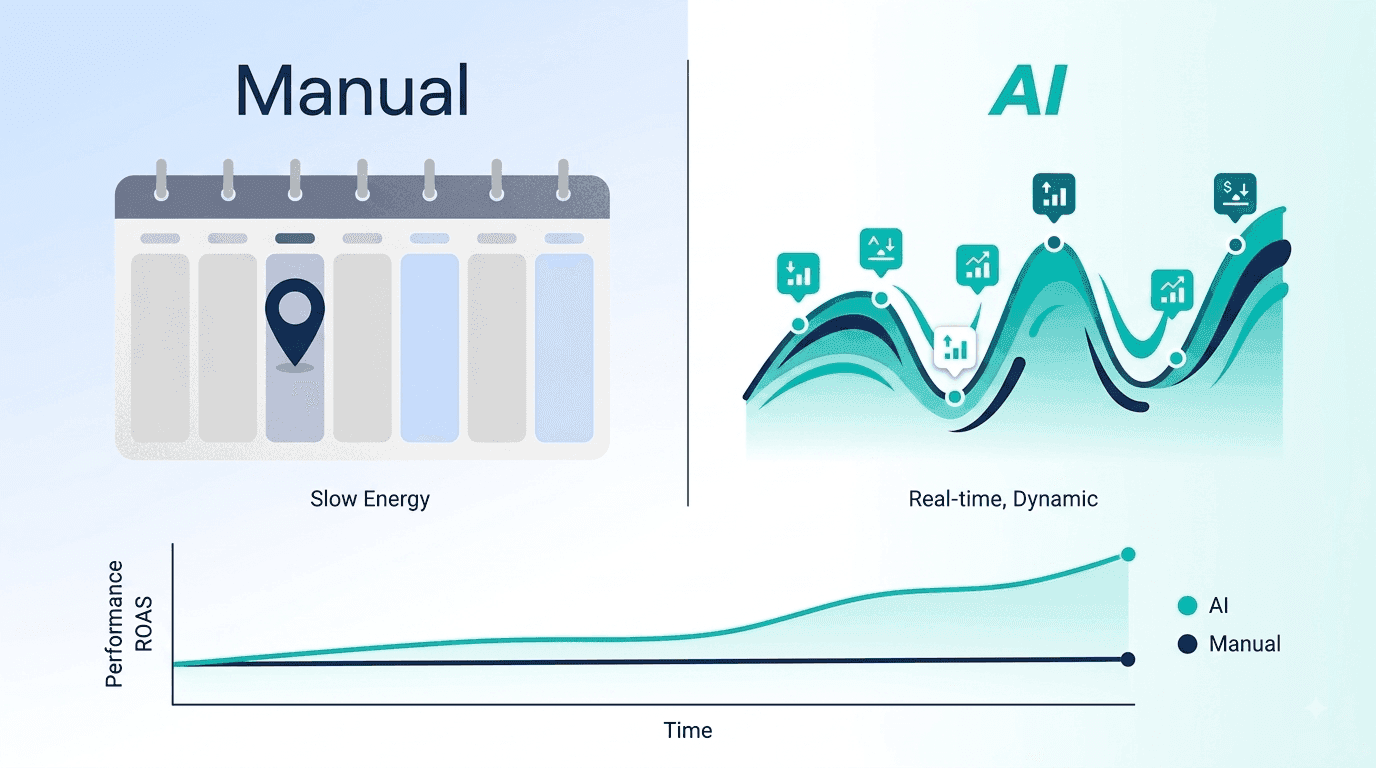
AI vs Manual Amazon PPC Management: Which Drives Better ROI in 2026?
AI vs manual Amazon PPC is no longer theoretical. Real account data from two markets shows a consistent performance gap. This guide breaks down what each approach delivers and what the data says
This is not a theoretical debate anymore.
The data exists. The performance gap between AI-managed and manually managed Amazon PPC campaigns is measurable, documented, and widening as Amazon's auction becomes faster and more competitive. The question is not whether AI outperforms manual management, but how much, in what areas, and what role human judgment still plays alongside it.
If you are managing Amazon ads manually in 2026, or evaluating an agency that does, this is the comparison you need to see.
What Manual Amazon PPC Management Actually Looks Like in 2026
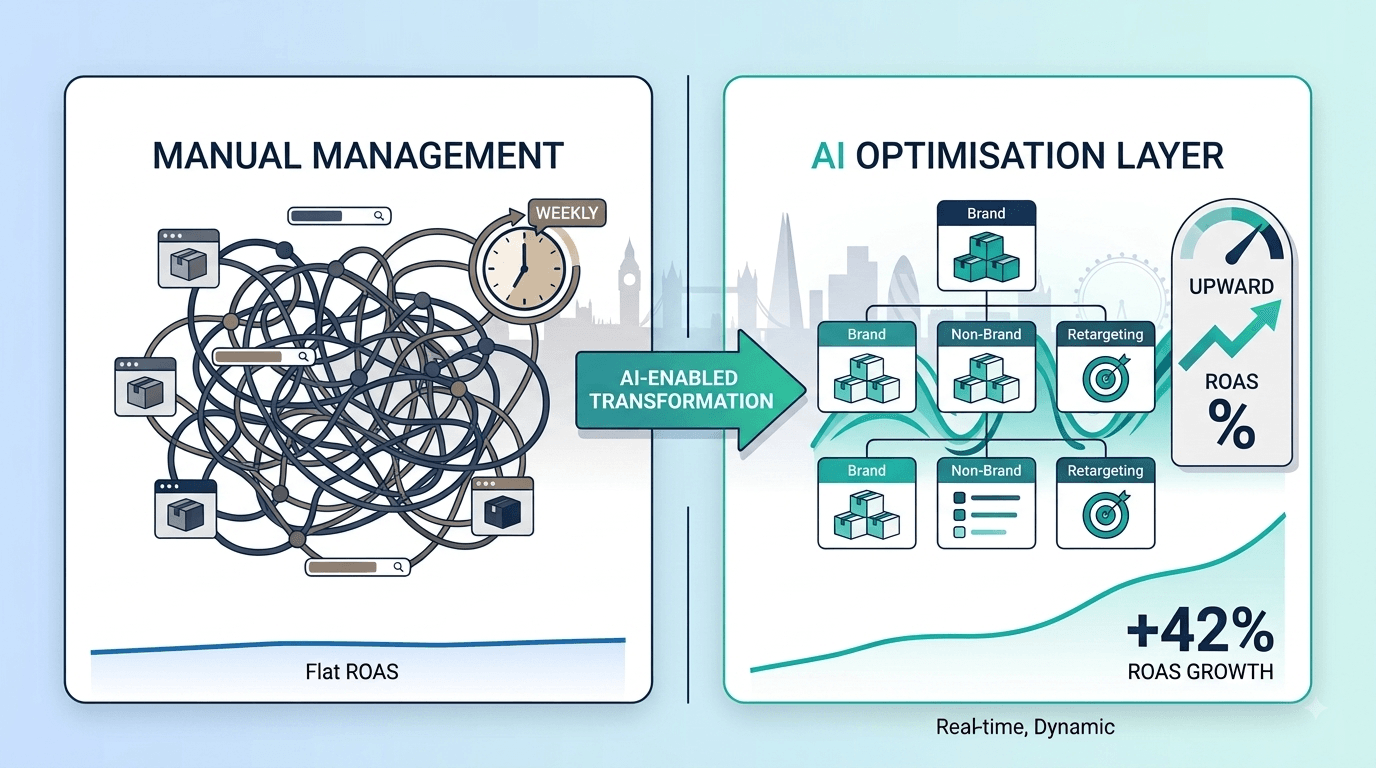
Manual management is the default for most Amazon sellers and many agencies. The typical cycle: campaigns set up with initial keyword selection and bid structure, reviewed weekly for performance, adjusted based on last week's data, and restructured periodically when something is clearly underperforming.
This approach worked when Amazon's marketplace was less competitive and auction dynamics moved slowly. In 2026, it does not keep pace.
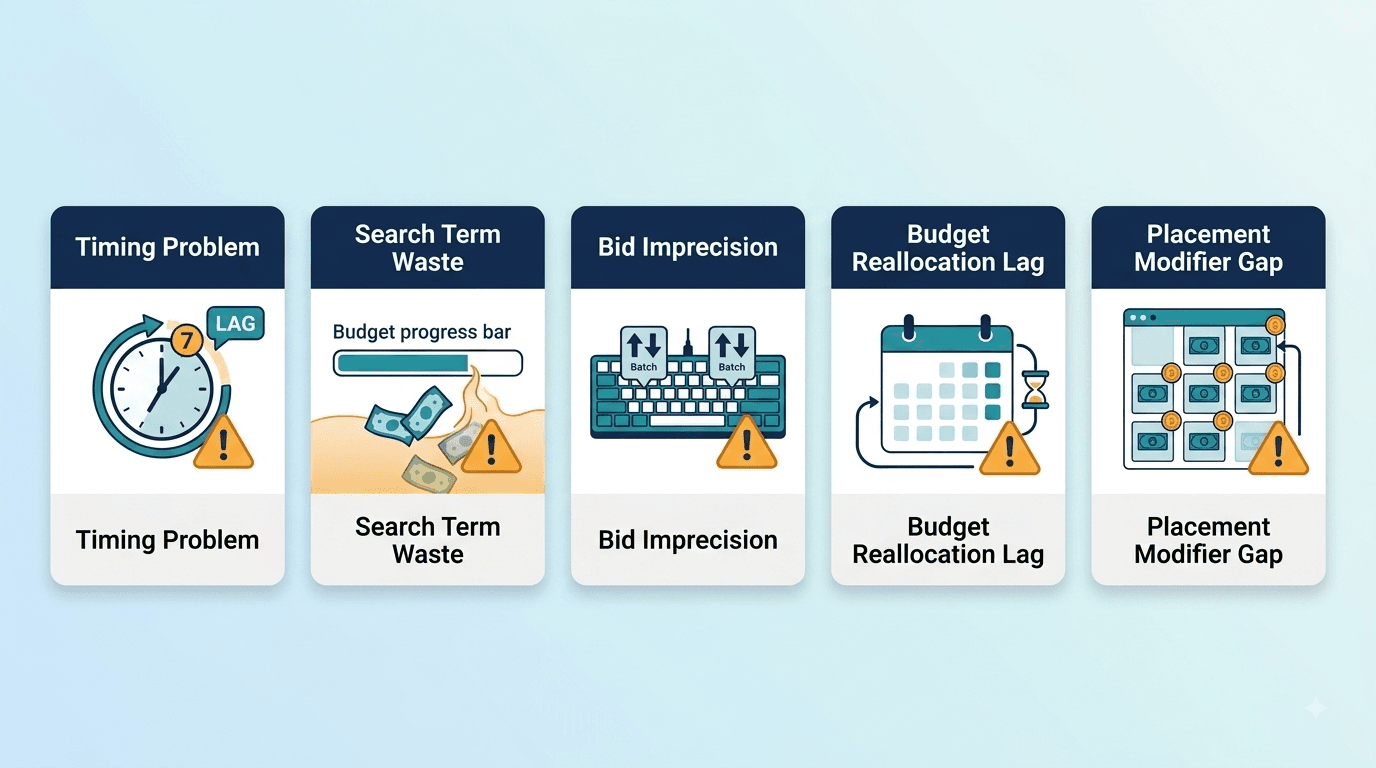
The structural problem is timing. Amazon's auction and bidding updates in real time. A weekly review is working with data that is already seven days old. In that week:
Search terms that stopped converting continued to receive budget.
Bids that were overpaying continued to overpay.
Budget that should have shifted to a better-performing campaign continued to fund a weaker one.
They are small, continuous leaks that compound into meaningful margin loss over time.
Five specific gaps that manual management cannot close:
Dayparting at scale. Manually adjusting bids by hour of day across dozens of campaigns, every day, is operationally impossible for any realistic team. Most manually managed accounts run uniform bids 24 hours a day despite conversion rates varying 2 to 3 times between peak evening windows and overnight dead zones.
Search term hygiene. New irrelevant queries enter campaigns daily through Amazon's matching behaviour. Manual audits happen weekly or monthly at best. In the gap, 20 to 40% of ad budget goes to zero-purchase queries. It is a silent, continuous drain that looks like normal advertising cost.For a complete breakdown of how keyword waste compounds and how to fix it, read our full guide on Amazon keyword waste.
Bid precision at the keyword level. Manual bid management adjusts in batches across keyword groups. The granularity difference between batch adjustments and individual keyword-level real-time optimisation is significant at any meaningful scale.
Budget reallocation speed. A manually managed account reallocates budget between campaigns during a weekly review. By the time the reallocation happens, the underperforming campaign has already consumed budget it should not have.
Placement bid modifier accuracy. Top of search converts 2 to 3 times better than product pages, but most manually managed accounts run uniform base bids across all placements. Optimising placement modifiers manually across dozens of campaigns is time-consuming enough that most teams either do it infrequently or not at all.
What AI Amazon PPC Management Actually Does
AI management replaces the periodic review cycle with a continuous signal-to-action loop. Every decision that a manual manager would make once a week, an AI system makes continuously at keyword level, based on real-time performance signals.
Continuous bid optimisation. Bids recalculate at individual keyword level based on conversion signals updating in real time. Hour of day, day of week, placement performance, competitive auction dynamics, and search term quality. The bid at 8 pm on a Friday reflects what is converting right now, not what converted last Tuesday.
Automated search term harvesting. Converting search terms in auto campaigns are added to manual exact match campaigns automatically. Non-converting high-spend terms are negated as they appear. The gap between waste appearing and waste being eliminated goes from weeks to hours.
Dayparting automation. Bids adjust by hour and day of the week based on historical conversion patterns specific to that account and category. Budget concentrates in high-converting windows without anyone logging in to make the adjustment.
For a dedicated breakdown of how dayparting works and what it costs to ignore, read our full guide on Amazon dayparting.
Budget reallocation. Underperforming campaigns lose budget to overperforming ones continuously, not after a weekly review surfaces the opportunity.
ACoS training over time. The AI learns each product's ACoS history and trains bid logic to converge on a target profitability level faster over time. Each week, the system becomes more precise about that specific product in that specific category.
Placement bid modifier automation. Top of search modifiers adjust automatically based on placement-level conversion data. Budget concentrates where it converts, continuously, without manual intervention.
The Performance Gap in Real Numbers: AI vs Human on the Same Account
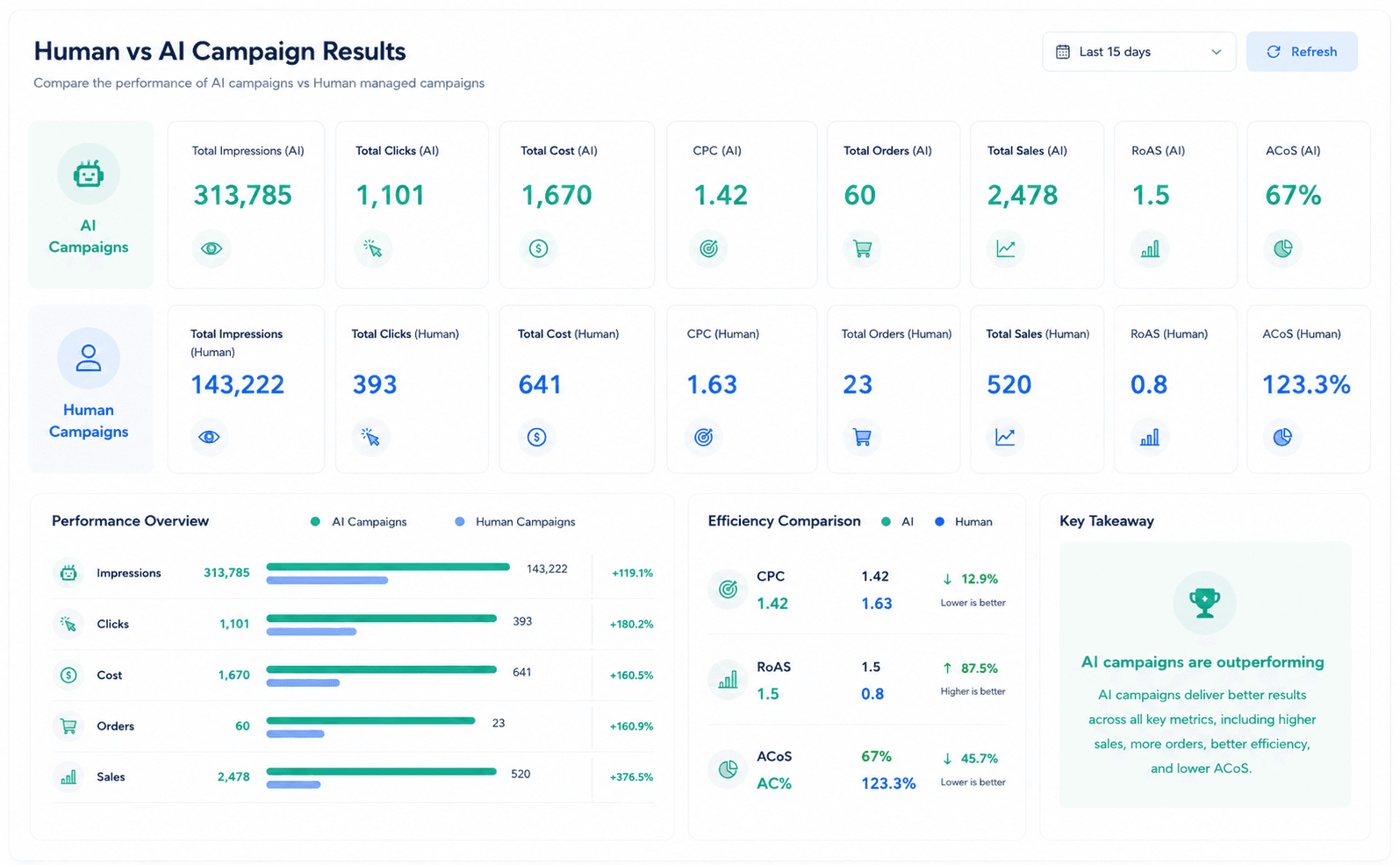
Claims about AI performance are easy to make. Account-level data on the same account, at the same time, is harder to find. Here are two.
Mocemsa account: 15-day parallel comparison AI-managed and human-managed campaigns running simultaneously on the same account, same products, same marketplace.
Metric | AI Campaigns | Human Campaigns | Difference |
Impressions | 3,13,785 | 1,43,222 | +119.1% |
Clicks | 1,101 | 393 | +180.2% |
Orders | 60 | 23 | +160.9% |
Sales | Rs 2,478 | Rs 520 | +376.5% |
CPC | Rs 1.42 | Rs 1.63 | -12.9% |
ROAS | 1.5 | 0.8 | +87.5% |
ACoS | 67% | 123.3% | -45.7 percentage points |
Pack8 UK account: 30-day comparison A UK-based Amazon seller specialising in protective packaging, managed through Pinnacle Growth Consulting.
Metric | AI Managed | Human Managed |
ACoS | 38.6% | 54.7% |
ROAS | 2.59 | 1.83 |
Two accounts. Two markets. The same pattern in both. The difference is not marginal. It is structural. And it did not come from a different strategy. It came from execution speed and consistency.
Where Human Judgment Still Matters in Amazon PPC
Honest content requires acknowledging where manual judgment remains essential. AI management does not replace human thinking; it replaces human execution.
Campaign strategy and architecture. AI optimises within a campaign structure. It does not decide which categories to enter, how to position against competitors, or what the right TACoS target is for a specific brand's margin profile. These decisions require category knowledge, business context, and strategic judgment.
Listing quality and conversion foundation. AI can optimise traffic to a listing. It cannot fix a weak main image, thin bullet points, or a 3.2-star rating. If the listing does not convert, AI sends more traffic to a broken page efficiently. The conversion foundation has to be built by people who understand what makes a listing perform.
For everything that affects Amazon listing conversion rate alongside your ad strategy, read our full guide on Amazon Sponsored Ads.
New product launches. Launching a new ASIN requires human judgment on initial keyword selection, bid strategy, and the acceptable ACoS range during the ranking phase. AI systems improve over time as they accumulate account-specific data, but they need correct initial setup to function correctly from day one.
Account health and escalations. Listing suppressions, policy violations, brand registry disputes, and account suspensions require human judgment and Amazon relationship management. No AI system handles these autonomously.
The right model is human strategy and judgment combined with AI execution. The brands winning on Amazon in 2026 are not choosing one over the other. They are running both simultaneously.
Why the Performance Gap Compounds Over Time
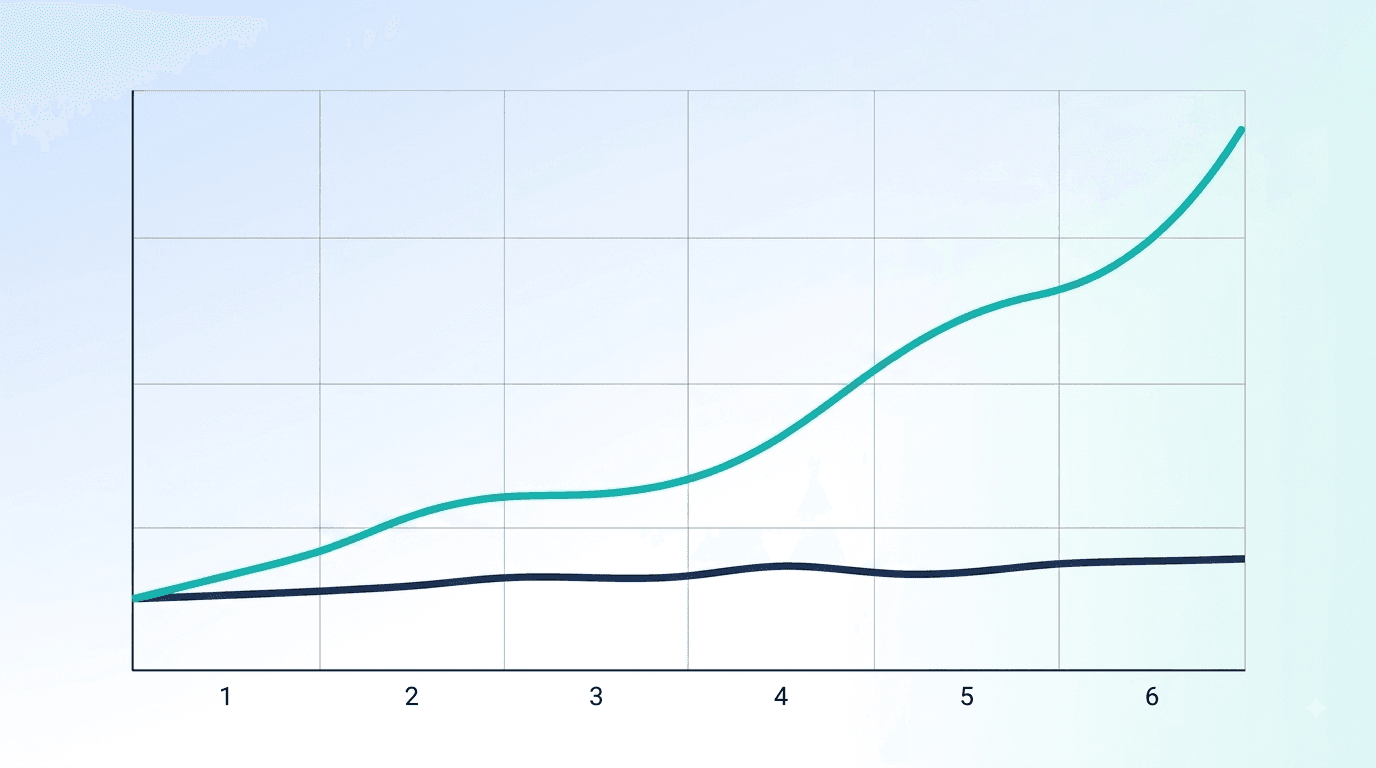
The difference between AI and manual management is not static. It widens.
An AI system that learns your account's conversion patterns week over week gets more precise in its bid decisions, faster at identifying waste, and better at concentrating budget in high-performing windows. The system managing your account in month six is meaningfully smarter than the system in month one, because it has six months of account-specific signal data informing every decision.
Manual management does not compound in the same way. A manager who has reviewed your account for six months is more familiar with it, but they are still making decisions once a week, still working with seven-day-old data, still unable to adjust bids at 7 pm without logging in manually.
This compounding dynamic explains why brands that adopted AI-driven Amazon PPC management early are increasingly difficult for late movers to displace. They have built a structural efficiency advantage that compounds every week it runs. Closing that gap requires not just adopting AI management but catching up on the lead the early movers have already built.
What This Means for UK Brands Managing Amazon Ads in 2026
The AI vs manual gap is amplified on Amazon UK by three dynamics specific to this marketplace.
Q4 Cost-Per-Click volatility:
UK CPCs spike 2 to 3 times during October and November as competition for Christmas sales intensifies. Brands running manual bid management see ACoS double during their highest-revenue period. AI systems that adjust bids continuously handle these spikes in real time rather than after a weekly review catches them a week too late.
Post-Brexit operational complexity:
UK sellers managing cross-border inventory, VAT compliance, and UKCA product requirements alongside Amazon PPC have less bandwidth for manual review cycles. The operational overhead of UK selling post-Brexit makes AI-driven execution more valuable, not less, because it removes a significant manual workload at precisely the point where management bandwidth is most stretched.
Competitive category dynamics.
UK Amazon categories like beauty, health, supplements, and electronics accessories have seen consistent CPC inflation as more brands compete for top-of-search placement. Manual management that was adequate at lower competition levels becomes progressively less effective as the auction becomes faster. AI systems that optimise at keyword level and react within hours maintain efficiency as competition increases.
For UK brands managing Amazon ads manually in 2026, the question is not whether AI management produces better outcomes.
Ready to See What AI-Managed Amazon Ads Look Like with Pinnacle Growth Consulting?
Pinnacle Growth Consulting is an Amazon Ads Advanced Partner and Amazon SPN verified partner with a London presence, managing Amazon advertising for brands across 13 marketplaces globally. Our approach combines Pinnaclegrowth.ai, our AI-powered Amazon ads automation platform running continuous bid, keyword, and budget optimisation 24 hours a day, with a dedicated account manager accountable for your growth outcomes every week.
For UK brands, every PPC engagement follows a structured process built around your account's specific situation.
Audit Your Amazon Account: A comprehensive review of your existing advertising campaigns, campaign structure, keyword coverage, search term data, and ACoS profile. The audit surfaces exactly where your ad spend is leaking before any strategy is built.
Optimise and Manage Your PPC Strategy: Continuous bid adjustments, keyword harvesting, negative keyword management, and campaign restructuring powered by Pinnaclegrowth.ai, running 24 hours a day without periodic manual review cycles. This is where the AI vs manual performance gap closes.
Track Performance and Scale Growth: Regular performance monitoring through transparent reporting: ACoS breakdown, TACoS trend, SKU-level profitability, and traffic data. Strategic adjustments made continuously, not quarterly. Clear visibility into what is working, what is not, and what comes next.
Explore our Amazon Ads Management Agency for UK brands →
Frequently Asked Questions
Based on account-level data comparing AI-managed and human-managed campaigns running simultaneously on the same accounts, AI management consistently produces lower ACoS, higher ROAS, and more efficient CPC. On the Mocemsa account over 15 days, AI campaigns produced 67% ACoS against 123.3% for human-managed campaigns. On the Pack8 UK account over 30 days, AI campaigns produced 38.6% ACoS against 54.7%. The performance difference is structural; it comes from execution speed and consistency, not strategy.
AI Amazon PPC management replaces the weekly manual review cycle with a continuous signal-to-action loop. Bids recalculate at the keyword level in real time. Converting search terms are added to manual campaigns automatically. Non-converting queries are negated as they appear. Budgets reallocate between campaigns continuously. Dayparting adjustments concentrate spend in high-converting windows without manual intervention. ACoS training improves bid precision week over week as the system learns account-specific patterns.
Self-management works at low spend and low complexity. As spend increases and category competition intensifies, the execution gap between manual weekly management and continuous AI optimisation grows. Most brands hit a ceiling where the time cost of manual management exceeds what professional management costs, and where the performance gap represents more lost margin than the management fee.
Automated Amazon PPC typically refers to rule-based automation: if ACoS exceeds a threshold, reduce the bid by a set percentage. AI Amazon PPC uses machine learning to make continuous decisions based on multiple real-time signals simultaneously, rather than relying on fixed rules. AI systems improve over time as they learn account-specific patterns. Rule-based automation applies the same logic regardless of what the data shows.
Pricing for AI-powered Amazon PPC management in the UK varies by agency and scope. Pinnacle Growth Consulting structures engagements based on your current account scale, category, and growth targets. The starting point is a free Amazon ads audit; we map your current campaign structure, identify where spend is leaking, and show you what AI-managed optimisation would look like on your specific account.
AI replaces the execution layer of agency work, the manual bid adjustments, search term reviews, and budget reallocations a human team would do on a weekly cycle. It does not replace the strategic layer, campaign architecture, category intelligence, listing strategy, account health management, and the human judgment calls that determine how the AI system is set up and governed. The strongest setups combine AI execution with experienced human oversight.