
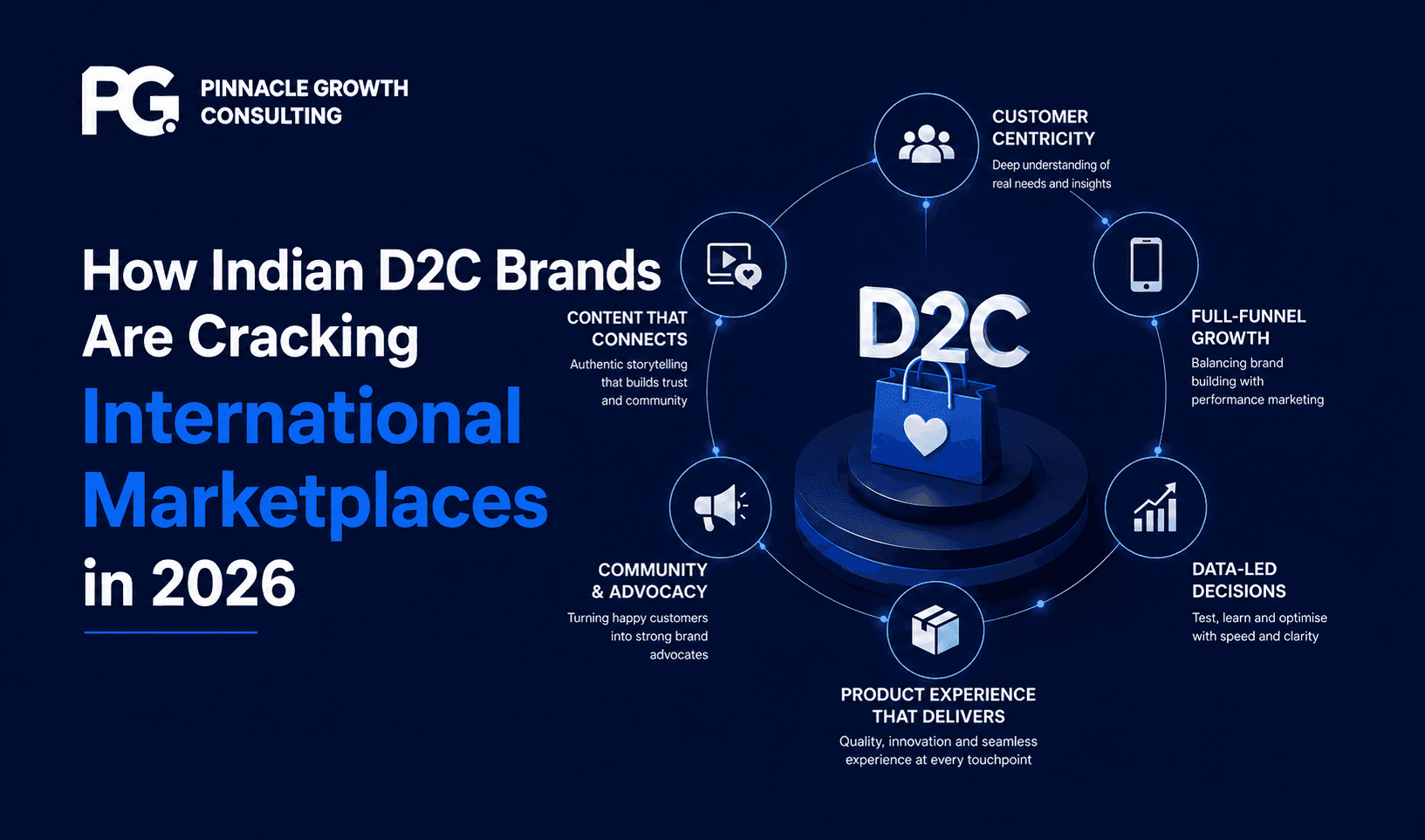
How Indian D2C Brands Are Cracking International Marketplaces in 2026
Discover how Indian D2C brands are winning international marketplaces in 2026. Proven strategies, real-world examples, and a step-by-step expansion framework.
India's D2C sector crossed $60 billion in GMV in 2025. Now, founders are asking a harder question: what happens after you dominate domestically?
The answer, for a growing cohort of ambitious Indian D2C brands, is global expansion. And in 2026, the playbook is finally maturing. Indian D2C brands international expansion is no longer the exclusive territory of large conglomerates with deep pockets. Brands born in Bengaluru, Mumbai, and Delhi are listing on Amazon US, Noon Middle East, Lazada Southeast Asia, and Shopify Markets and winning.
But the path is littered with expensive missteps. Many founders confuse product-market fit at home with international readiness. They underestimate localisation, regulatory compliance, and the unit economics of cross-border logistics. Meanwhile, the brands that crack it like boAt in the audio category do so by treating global expansion as a growth strategy, not an afterthought.
In this guide, you'll learn exactly how Indian D2C brands are succeeding on international marketplaces in 2026, which markets offer the highest opportunity, what the smartest brands are doing differently, and how to build a repeatable international expansion framework whether you are a founder preparing your first global launch or a CMO scaling an existing international presence.
Industry Observation from Pinnacle Growth Consulting: The brands that succeed internationally are those that globalise their operations before they globalise their marketing. Infrastructure first, acquisition second this is the principle that separates sustainable global D2C brands from costly experiments.
WHAT IS INDIAN D2C BRANDS INTERNATIONAL EXPANSION?
Detailed Explanation
Direct-to-consumer (D2C) brands build direct relationships with customers bypassing traditional retail intermediaries. When these brands expand internationally, they leverage global ecommerce platforms (Amazon, Shopify, Noon, Lazada) to reach consumers in new geographies without necessarily setting up physical retail or local supply chains.
For Indian brands, international expansion means:
Marketplace listings on global platforms with localised content
Cross-border logistics via bonded warehouses, fulfilment partners, or direct shipping
Payment localisation to support international currencies and wallets
Brand positioning adapted for cultural and competitive context
Customer service scaled across time zones and languages
The business impact is significant. International revenue diversifies risk, improves brand valuation, extends product lifecycle, and for many D2C categories like wellness, fashion, electronics accessories, and home goods captures growing global demand for quality Indian-origin products at competitive price points.
Why 2026 Is the Breakout Year for Indian D2C Global Expansion
Why It Matters: The confluence of maturing ecommerce infrastructure, post-pandemic demand for value products, India's growing manufacturing capabilities, and the rise of AI-powered marketplace tools means 2026 represents an inflection point not just an incremental step.
Supporting Explanation:
Three structural forces have converged in 2026:
1. Infrastructure Maturity Amazon Global Selling, Shiprocket Cross Border, iThink Logistics, and DHL eCommerce have dramatically reduced the cost and complexity of shipping from India to 50+ countries. Fulfilment by Amazon (FBA) allows Indian sellers to warehouse inventory in the US, UAE, and UK delivering a local experience at competitive cost.
2. AI Marketplace Tools AI-powered listing optimisation, dynamic pricing engines, and automated A/B testing tools have democratised marketplace performance. A 15-person D2C brand in Pune can now run the same data-driven listing strategy as a 200-person Amazon-native brand in the US.
3. India's Manufacturing & Quality Narrative Post-China supply chain diversification has opened doors. Global buyers both B2C and institutional are actively seeking Indian-made alternatives in categories like textiles, electronics accessories, wellness, and personal care. Indian D2C brands that position well benefit from this structural tailwind.
H3: Key Markets Driving Indian D2C International Growth in 2026
Market | Opportunity | Best D2C Categories |
USA | Largest ecommerce market; Indian diaspora + mainstream demand | Electronics accessories, wellness, fashion |
UAE / GCC | High purchasing power; large South Asian population | Fashion, food, personal care, home goods |
UK | Strong Indian heritage brands; premium positioning opportunity | Fashion, food, wellness, homeware |
Southeast Asia | Fast-growing ecommerce; price-sensitive; young demographics | Electronics, fashion, beauty |
Australia | Premium market; India trade agreement momentum | Health & wellness, fashion, homeware |
Germany / EU | Growing cross-border demand; premium product positioning | Wellness, homeware, sustainable fashion |
Expert Insight from Pinnacle Growth Consulting: GCC markets particularly UAE and Saudi Arabia represent the single highest-ROI international expansion opportunity for Indian D2C brands in 2026. The combination of purchasing power, South Asian consumer base, low trade barriers, and underserved premium segments makes this the first market we recommend for most of our clients.
How Indian Brands Selling Globally Are Winning on Marketplaces
Why It Matters: Marketplace success is not accidental. The Indian D2C brands winning internationally are applying systematic, data-driven marketplace growth strategies not simply listing products and hoping for the best.
Supporting Explanation:
The most successful Indian D2C brands on global marketplaces follow a consistent playbook:
Category Authority, Not Just Price: Rather than competing on price alone a race to the bottom winning Indian brands establish category authority. They invest in high-quality listing images, enhanced brand content (Amazon A+ content), and keyword-rich product descriptions that surface organically.
Review Velocity & Social Proof: International buyers are sceptical of unfamiliar brands. Winning brands invest in early review acquisition through follow-up sequences, product insert cards, and Vine programmes to build credibility quickly.
Sponsored Advertising with Margin Discipline: International marketplace advertising (Amazon PPC, Noon Sponsored Ads) requires careful margin management. The brands that survive long-term are those that calculate true landed cost including customs, duties, FBA fees, returns, and currency conversion before setting advertising budgets.
Marketplace Expansion Framework
Stage | Action | Success Metric |
Research | Category analysis, competitor benchmarking, keyword research | Addressable market size, top 10 competitor ASIN analysis |
Listing | Localised content, professional images, A+ content | Listing quality score, keyword coverage |
Launch | Review velocity, launch PPC, influencer seeding | Initial reviews, BSR movement |
Scale | Bid optimisation, catalogue expansion, DSP advertising | ACoS, ROAS, organic rank |
Retain | Email sequences, Subscribe & Save, loyalty | Repeat purchase rate, LTV |
The boAt International Marketplace Strategy — What Indian D2C Founders Can Learn
Why It Matters: boAt is India's most studied D2C success story. Its international marketplace strategy reveals transferable principles that apply across categories from electronics to fashion to wellness.
Supporting Explanation:
boAt's international expansion playbook includes several replicable elements:
Lifestyle-First Brand Positioning: boAt did not position itself as a "budget Indian audio brand." It built a youth lifestyle identity loud, energetic, culturally aspirational that resonates globally. International listings mirror this identity with creative assets designed for local cultural context.
Strategic Category Selection: Rather than attempting to compete across all consumer electronics, boAt focused on audio accessories earphones, headphones, speakers where Indian manufacturing offers genuine quality-to-price advantages. Category focus enables depth of SKU, faster review accumulation, and stronger organic ranking.
Influencer & Community Seeding: In new markets, boAt seeds products with micro-influencers before investing in paid advertising. This generates authentic UGC (user-generated content), social proof, and brand awareness at a fraction of traditional paid media costs.
Localised Content at Scale: boAt invests in market-specific creative content not just translated English copy. Product imagery, lifestyle photography, and ad creatives are adapted for UAE, UK, and Southeast Asian cultural contexts.
Expert Insight: The boAt international marketplace strategy proves that Indian brands do not need to lead with price to win globally. Category authority + brand identity + operational excellence is a more durable and profitable route to international marketplace success.
Cross-Border Ecommerce India — Logistics, Payments & Compliance
Why It Matters: The most common reason Indian D2C brands fail internationally is not product quality or marketing it is operational infrastructure. Getting logistics, payments, and compliance right is the unglamorous prerequisite for global growth.
AEO Answer Block: Cross-border ecommerce from India requires three operational pillars: a reliable international logistics partner (FBA, Shiprocket Cross Border, or DHL eCommerce), a multi-currency payment gateway (Payoneer, Wise, or local acquirers), and compliance with destination country customs, duties, labelling, and consumer protection regulations.
Supporting Explanation:
Logistics Options for Indian D2C Brands
Option | Best For | Pros | Cons |
Fulfilment by Amazon (FBA) | Amazon-first strategy | Prime badge, fast delivery, customer trust | High fees, limited flexibility |
Shiprocket Cross Border | Multi-marketplace | Cost-effective, wide country coverage | Longer delivery windows |
DHL eCommerce | Premium markets | Reliable, trackable, trusted brand | Higher cost per shipment |
Local 3PL Warehouse | High-volume markets | Fastest delivery, lower per-unit cost | Upfront inventory investment |
Payment Localisation: International customers expect local payment methods. Payoneer and Wise handle multi-currency settlements for Indian exporters. Integrating Klarna (Europe), Afterpay (Australia), or local wallets in GCC improves conversion rates significantly.
Regulatory Compliance: Each market has distinct requirements: CE marking in the EU, FCC compliance in the US, ESMA standards in the UAE. Failure to comply leads to listing removal, customs seizures, and reputational damage. Working with a compliance partner or marketplace growth consultant is non-negotiable for high-value categories.
AI-Powered Marketing for Global D2C Expansion
Why It Matters: AI is not just a buzzword in the context of international D2C expansion — it is a practical competitive advantage that allows lean Indian D2C teams to operate at a scale previously reserved for well-funded incumbents.
Supporting Explanation:
Marketplace Listing Optimisation: AI tools like Helium 10, Jungle Scout, and DataHawk analyse competitor listings, keyword trends, and pricing dynamics in real time. Indian D2C brands use these to maintain competitive listings without manual intervention.
Personalised Customer Journeys: Customer Data Platforms (CDPs) like Segment, Klaviyo, or MoEngage enable Indian D2C brands to build unified customer profiles across international touchpoints website, app, marketplace, email and deliver personalised content at scale.
Predictive Retention: AI-driven churn prediction models identify international customers at risk of lapsing and trigger proactive retention flows. In cross-border contexts where re-acquisition costs are high retention ROI is disproportionately valuable.
Pinnacle Growth Consulting works with D2C brands to implement AI-powered marketing stacks and CDP solutions that support international customer acquisition and retention at scale. Explore our AI-Powered Marketing and CDP Solutions services.
Building a Globally Competitive Brand Identity from India
Why It Matters: Indian D2C brands often have exceptional products but underdeveloped brand identities for international audiences. Global marketplace buyers do not buy products they buy brands they trust.
Universal Brand Story: The most globally successful Indian D2C brands anchor their identity in universal values quality, sustainability, craftsmanship, innovation — while weaving in their Indian heritage as a differentiator rather than a limitation.
Visual Identity for International Audiences: Product photography, packaging design, and lifestyle imagery must meet international quality standards. Blurry or staged-looking images signal low quality to international buyers. Investment in professional creative is not optional.
Localisation vs. Glocalisation: True localisation is more than translation. It means adapting tone, imagery, and value propositions to match local cultural contexts. Glocalisation maintaining a consistent global brand while adapting locally relevant elements is the strategic sweet spot.
KEY STATISTICS & INDUSTRY INSIGHTS
Statistic | Insight | Business Impact |
India's cross-border ecommerce exports exceeded $5 billion in FY2024–25 (DGFT estimates) | India is establishing itself as a serious global ecommerce export nation | D2C brands have policy support, logistics infrastructure, and growing brand credibility internationally |
The GCC ecommerce market is projected to reach $50 billion by 2027 (Statista) | GCC is the fastest-growing ecommerce region relevant to Indian brands | High-priority expansion target for Indian D2C brands in fashion, personal care, and food |
70% of Amazon Global Selling India merchants report international revenue growing faster than domestic (Amazon India, 2025) | Marketplace infrastructure is working for Indian sellers | Validates the marketplace-first international expansion approach |
Brands using AI-powered listing optimisation report 30–40% improvement in organic marketplace rank | AI tools materially impact marketplace performance | Justifies investment in AI-powered marketplace management for international listings |
Indian D2C brands with CDPs report 2–3x higher international customer retention rates | Data-driven retention is the difference between sustainable and unsustainable international growth | CDP investment is a priority for internationally expanding Indian D2C brands |
What Businesses Should Do Next: -
These statistics confirm that the opportunity window is open but competitive. The brands that invest now in marketplace infrastructure, AI-powered marketing, and customer retention systems will establish durable international positions. Brands that wait will face higher customer acquisition costs and more entrenched competitors. Acting in 2026 not 2027 is the strategic imperative.
BENEFITS OF INDIAN D2C BRANDS INTERNATIONAL EXPANSION
Benefit | Outcome | Business Impact |
Revenue Diversification | Reduces dependence on Indian market cycles and seasonal fluctuations | More predictable revenue, improved valuation multiple |
Brand Premium | International presence signals global quality and increases perceived brand value | Higher ASP domestically and internationally |
Extended Product Lifecycle | Products at late-cycle domestically can re-launch as new in international markets | Improved inventory utilisation and product ROI |
New Customer Insights | International customers surface new use cases, preferences, and product gaps | Feeds product development and innovation pipeline |
Valuation Uplift | International revenue materially improves D2C brand valuation multiples | Strategic advantage for future fundraising or exit |
Competitive Moat | International market share is harder for domestic-only competitors to replicate | Structural competitive advantage over India-only rivals |
STEP-BY-STEP INTERNATIONAL EXPANSION FRAMEWORK
Step 1: Market Selection & Opportunity Assessment
Analyse international markets by: category demand, competitive density, logistics feasibility, regulatory complexity, and diaspora advantage. Prioritise one primary market (typically GCC or UK) before expanding to secondary markets.
Step 2: Operational Readiness Audit
Audit your current capabilities: export documentation, FSSAI/BIS international compliance, payment gateway setup, international customer service capacity, and returns management. Fix gaps before listing.
Step 3: Marketplace Account Setup & Listing Optimisation
Create seller accounts on target platforms (Amazon Global, Noon, Shopify Markets). Invest in professional product photography, keyword-researched listing copy, A+ content, and competitive pricing based on true landed cost analysis.
Step 4: Launch & Review Velocity Programme
Execute a structured launch: initial inventory shipment, launch PPC campaigns, influencer seeding, and a systematic review acquisition programme. Target 25+ verified reviews on your hero SKU before scaling advertising spend.
Step 5: Performance Marketing Optimisation
Run sponsored advertising with strict ACoS/ROAS discipline. Use AI-powered bidding tools to optimise bids by time of day, device, and keyword. Expand to DSP advertising once organic rank is established.
Step 6: Customer Retention & Lifecycle Management
Implement post-purchase email/SMS sequences, loyalty programmes, and Subscribe & Save (where available). Use a CDP to build unified international customer profiles and deploy personalised retention campaigns.
Step 7: Scale & Multi-Market Expansion
Once the primary market reaches profitability, replicate the playbook in the next target market. Invest in local warehousing (3PL or FBA) in high-volume markets to improve delivery times and conversion rates.
COMMON MISTAKES IN INTERNATIONAL EXPANSION
Mistake | Consequence | Solution |
Premature internationalisation before domestic unit economics are proven | International losses compound domestic instability | Ensure domestic business is profitable and operationally stable before expanding |
Pricing without true landed cost analysis | Selling at a loss due to uncounted customs, duties, FBA fees, and returns | Build a full landed cost model before setting international retail prices |
Direct translation of Indian marketing assets | Low conversion; cultural disconnect with international buyers | Commission market-specific creative with cultural adaptation |
Ignoring regulatory compliance | Listing removal, customs seizures, reputational damage | Engage a compliance specialist for each target market before launch |
Single marketplace dependency | Algorithmic changes or policy shifts can eliminate revenue overnight | Diversify across 2–3 marketplaces per market |
Underinvesting in customer service | Poor international reviews; account suspension risk | Hire or outsource international customer service; set 24-hour response SLA |
Treating returns as an afterthought | High return rates destroy international profitability | Design a clear international returns policy and work with a local returns aggregator |
REAL-WORLD BUSINESS EXAMPLES
Example 1: Indian Wellness Brand Enters the UAE Market
Challenge: A Bengaluru-based Ayurvedic wellness brand with strong domestic D2C sales wanted to enter the UAE market. They had no international logistics setup, no localised content, and no understanding of GCC regulatory requirements for health supplements.
Strategy: Partnered with a cross-border logistics provider for UAE warehousing. Engaged a Dubai-based regulatory consultant to obtain ESMA compliance. Commissioned Arabic-language listing content and UAE-specific lifestyle photography featuring South Asian models.
Implementation: Listed on Noon and Amazon UAE simultaneously. Ran a structured launch with influencer seeding among UAE-based South Asian wellness creators. Deployed post-purchase email flows via Klaviyo for international customers.
Outcome: Within 6 months, the brand achieved top-5 organic rank in their primary Ayurvedic supplement category on Noon UAE, with international revenue representing 18% of total D2C revenue. Average order value in UAE was 40% higher than domestic, validating the premium international positioning strategy.
Example 2: Fashion Accessories Brand Scales on Amazon UK
Challenge: A Jaipur-based sustainable jewellery D2C brand had strong Instagram-driven sales in India but no systematic international marketplace presence. Their handmade product positioning was compelling but their listing quality and logistics setup were not international-standard.
Strategy: Engaged Pinnacle Growth Consulting's Marketplace Growth team to audit and rebuild their Amazon UK presence. Invested in professional product photography with white backgrounds and lifestyle context. Rebuilt listing copy around UK search behaviour prioritising "ethical jewellery," "sustainable accessories," and "handmade silver jewellery" keywords.
Implementation: Shipped FBA inventory to Amazon UK fulfilment centres. Launched with Vine reviews. Ran UK-specific sponsored brand and sponsored product campaigns. Integrated Klaviyo for post-purchase flows targeting UK buyers with repeat purchase incentives.
Outcome: Amazon UK revenue grew from near-zero to a consistent monthly run-rate within 4 months. The brand's "sustainable Indian jewellery" positioning differentiated it clearly from mass-market competitors and commanded a 25–30% price premium.
Example 3: Electronics Accessories Brand Enters Southeast Asia
Challenge: A Mumbai-based phone accessories D2C brand was highly competitive on Amazon India and Flipkart but unsure which Southeast Asian market to enter first and how to compete against entrenched Chinese brands on Lazada and Shopee.
Strategy: Conducted a data-driven market selection analysis. Chose Philippines as the primary entry market based on: strong English-language ecommerce, lower Chinese brand entrenchment relative to Indonesia, and a growing middle class with rising smartphone penetration.
Implementation: Listed on Lazada Philippines and Shopee Philippines. Priced aggressively below Chinese competitors while emphasising quality certifications and warranty. Seeded products with Filipino tech micro-influencers on YouTube and TikTok.
Outcome: Established a profitable Philippines operation within 9 months and used those learnings to accelerate entry into Indonesia and Malaysia. Southeast Asia now contributes a meaningful percentage of total international revenue.
FUTURE TRENDS IN INDIAN D2C INTERNATIONAL EXPANSION
AI Search & AI Overviews: As Google AI Overviews and AI-native search engines (Perplexity, ChatGPT search) capture more international product discovery, Indian D2C brands must optimise not just for traditional SEO but for AI visibility. This means creating structured, entity-rich content that AI systems can extract, cite, and surface in response to product and category queries.
Generative Engine Optimisation (GEO): In 2026, GEO the practice of optimising brand and product content for citation by AI-generated responses is emerging as a distinct discipline alongside SEO. Indian D2C brands that invest in authoritative, well-structured digital content will be cited more frequently in AI-generated product recommendations.
Customer Data Platforms (CDPs) for International Personalisation: As international customer bases grow, CDPs become essential for unifying customer data across markets, platforms, and touchpoints. Indian D2C brands using CDPs will outperform on international customer retention, lifetime value, and personalisation key differentiators as acquisition costs rise.
Social Commerce & TikTok Shop: TikTok Shop's expansion across Southeast Asia, UK, and the US creates a new channel for Indian D2C brands to reach international audiences through creator-driven commerce. Brands that build creator programmes now will have first-mover advantages in this channel.
Marketplace Algorithm Shifts: Amazon, Noon, and Lazada are increasingly favouring brands with strong off-platform signals (social proof, branded search, content authority) in their ranking algorithms. Indian D2C brands must build brand equity alongside marketplace listings not instead of them.
ACTION PLAN
Immediate Actions (This Week)
Audit your current domestic unit economics and confirm international expansion readiness
Identify your primary target market (recommend starting with UAE/GCC or UK)
Research top 5 competitors in your category on target marketplace
Calculate true landed cost for your hero SKU in the target market
Next 30 Days
Register for Amazon Global Selling or target marketplace seller account
Engage a cross-border logistics partner and obtain shipping quotes
Commission international-standard product photography
Research target market regulatory compliance requirements for your category
Begin keyword research for localised listing copy
Next 90 Days
Complete listing setup with optimised content, A+ pages, and professional imagery
Ship initial FBA or 3PL inventory to target market
Launch review velocity programme and initial PPC campaigns
Implement post-purchase email flows via your CDP or email marketing platform
Review performance data; optimise listings, pricing, and ad campaigns
Long-Term Growth Strategy (6–18 Months)
Achieve category authority (top 10 organic rank) in primary market hero SKU
Expand catalogue on primary marketplace
Enter secondary market using refined playbook from primary market learnings
Build brand search volume with influencer partnerships and content marketing
Invest in local warehousing as volume justifies the economics
Explore direct-to-consumer international website via Shopify Markets
CONCLUSION
Indian D2C brands international expansion has moved from aspiration to execution in 2026. The infrastructure is ready, the playbooks are proven, and the global demand for quality Indian-origin products is real and growing.
The brands that win are those that combine operational excellence logistics, compliance, listing quality with brand-first thinking and AI-powered marketing sophistication. boAt's international marketplace strategy demonstrates that Indian brands can compete and win on category authority and brand identity, not just price.
The key recommendations from this guide:
Start with one market, get it right, then replicate
Calculate true landed cost before pricing; protect your margins
Invest in localised creative; international buyers can tell the difference
Build review velocity and organic rank before scaling paid advertising
Use AI tools and a CDP to deliver the personalised customer experience that drives retention and lifetime value
The window is open. The brands that move decisively in 2026 will build durable international market positions. Those that wait will face higher costs, more competition, and a harder climb.
WORK WITH PINNACLE GROWTH CONSULTING
Ready to Take Your D2C Brand Global in 2026?
At Pinnacle Growth Consulting, we have helped Indian D2C brands move from domestic success to sustainable international growth through rigorous marketplace strategy, AI-powered marketing, and data-driven customer retention.
Whether you are preparing your first international marketplace launch or scaling an existing global presence, our team brings the expertise, frameworks, and hands-on execution support to help you win.
Our services for internationally expanding D2C brands include:
Ecommerce Growth Strategy — Market selection, competitive analysis, and expansion roadmapping
Marketplace Growth — End-to-end Amazon, Noon, Shopee, and Lazada listing, launch, and scale programmes
Conversion Rate Optimisation (CRO) — Maximising the revenue from every international visitor and listing view
Customer Retention — Post-purchase flows, loyalty programmes, and lifecycle marketing for international customers
AI-Powered Marketing — Intelligent advertising, personalisation, and marketplace optimisation at scale
Customer Data Platforms (CDP) — Unified customer intelligence across international markets and touchpoints
Digital Transformation — Building the operational and technology infrastructure for sustained global growth
The brands that build their international marketplace presence now will own their categories by 2027.
Get in touch with Pinnacle Growth Consulting to discuss your international expansion strategy.
Frequently Asked Questions
Several Indian D2C brands have built strong international presence. boAt — India's No. 1 audio wearables brand — has expanded into the UAE, targeting young, digitally-enabled consumers across the Middle East. WOW Skin Science is a bestseller on Amazon USA and is available across 3,000+ Walmart stores in the US. Vahdam India is available in 100+ countries and has been endorsed by Oprah Winfrey, Ellen DeGeneres, and Mariah Carey. EcoRight has been selling on Amazon US, UK, EU, and Canada since 2017. Mamaearth, Go DESi, and Slurrp Farm are also active on global marketplaces
The most common route is Amazon Global Selling. It allows Indian businesses to list and sell on Amazon in the US, UK, UAE, Canada, and more — without setting up a foreign office or local operations. Since 2015, Amazon has enabled $20 billion in cumulative e-commerce exports from India and is now targeting $80 billion by 2030. Beyond Amazon, brands use Shopify Markets for direct international websites, and Noon for GCC markets. Specialised support is available for logistics, taxation, export compliance, and regulatory requirements — so brands don't have to manage everything on their own
WOW Skin Science is the standout example. With close to 11,000 reviews and a 4-star average rating, WOW became one of the fastest-growing shampoo brands on Amazon — a natural beauty staple in households worldwide. They joined Amazon Global Selling in 2016, used FBA for logistics, and combined Ayurvedic formulas with Western herbal preparations — their "customer first" approach became the secret to global success. Vahdam India is another strong story — it became one of the fastest-growing tea brands on Amazon USA and Europe by positioning Indian-origin tea as a premium global product. EcoRight projected 3–4x growth during Black Friday and Cyber Monday after expanding to the US, UK, EU, and Canada via Amazon Global Selling.
Amazon Global Selling is the most accessible starting point for most Indian D2C brands, offering established infrastructure, a trusted buyer base, and FBA fulfilment. For GCC expansion, Noon is equally important. Southeast Asian brands should consider Shopee and Lazada. The best marketplace depends on your target market and product category.
Indian D2C brands use three primary options: Fulfilment by Amazon (FBA) for Amazon-centric strategies, third-party cross-border logistics providers (Shiprocket Cross Border, DHL eCommerce) for multi-marketplace strategies, and local 3PL warehousing for high-volume markets. The right choice depends on volume, delivery speed requirements, and margin structure.