
How to Scale Your Amazon India Sales from ₹1Cr to ₹10Cr: A Step-by-Step Growth Blueprint Complete Expansion Playbook
Scale your Amazon India business from ₹1Cr to ₹10Cr with a proven growth blueprint. Learn marketplace expansion strategies, PPC optimization, inventory planning, brand building, and operational tactics to drive sustainable sales and profitability.
The Amazon India opportunity has never been bigger. With over 100 million registered buyers, 10+ lakh active sellers, and eCommerce projected to cross $150 billion by 2030, this is genuinely one of the most exciting growth markets for sellers anywhere in the world.
Yet, here's the reality: most sellers hit ₹1 crore in annual revenue and then stall. They grind through the same product listings, fight the same competitors for the same keywords, and wonder why their growth curve has flattened.
The problem isn't effort it's strategy.
Scaling from ₹1Cr to ₹10Cr through Amazon marketplace expansion India isn't about working harder. It's about building a fundamentally different kind of business one with a deeper catalog, smarter advertising, stronger brand equity, and operational systems that can handle 10X volume without breaking down.
This playbook gives you exactly that. Whether you're a D2C brand, a manufacturer, or a private label seller, you'll find a concrete, phase-by-phase roadmap to reach ₹10Cr in annual Amazon India sales. It's the same framework our team at Pinnacle Growth Consulting has used to scale Amazon India businesses across categories.
Let's get into it.
Understanding the ₹1Cr to ₹10Cr Growth Gap
Common Challenges That Keep Amazon Sellers Stuck
Most sellers between ₹50L–₹1Cr revenue share the same set of problems:
Challenge | Impact |
Limited catalog (1–5 products) | Revenue ceiling, no cross-sell opportunity |
Poor inventory planning | Frequent stockouts, missed peak season sales |
Spray-and-pray advertising | High ACoS, wasted spend |
No brand identity | Competing only on price |
Manual operations | Founder doing everything, no scalability |
Sound familiar? These aren't individual problems they're symptoms of a business still operating at the ₹1Cr mindset.
Why Scaling Requires a Fundamentally Different Strategy
At ₹1Cr, you can succeed through hustle, a good product, and basic listing optimization. At ₹10Cr, you need:
Systems that run without you
Data driving every decision
Brand equity that creates loyal buyers
Catalog depth that captures the full customer journey
Advertising that scales profitably
The shift from ₹1Cr to ₹10Cr isn't linear. It's a business transformation. Let's walk through each step.
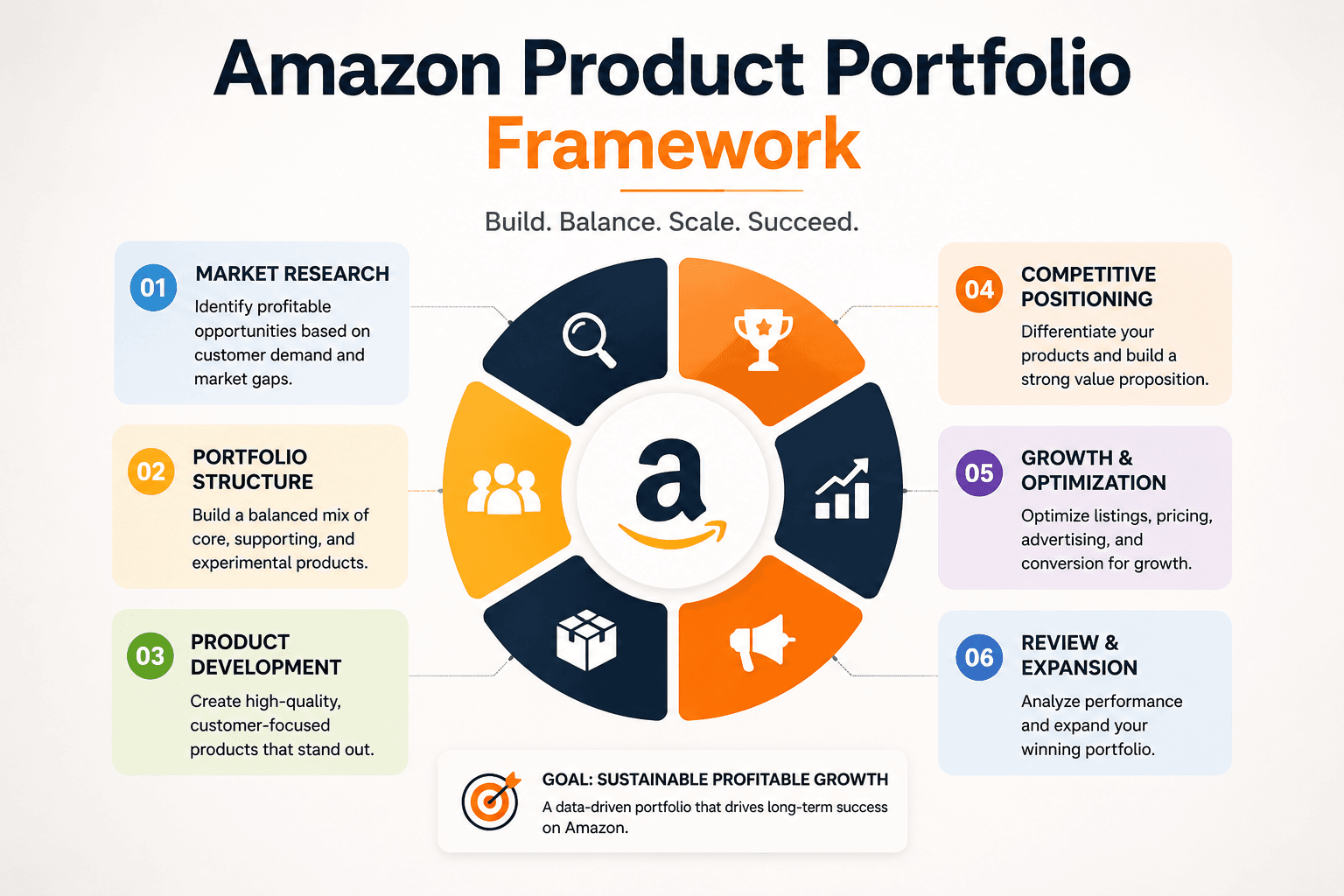
Step 1: Build a Scalable Product Portfolio
Product Expansion Framework
Your product catalog is your revenue engine. A single-product business is a single point of failure.
Here's how to think about your portfolio:
Hero Products (60% of revenue): Your top-performing, high-volume SKUs. Protect them, invest in them, and don't let competitors displace them.
Supporting Products (25% of revenue): Complementary items that increase average order value and basket size.
Bundles & Multi-packs: Boost AOV without adding SKUs. A skincare seller pairing a cleanser + moisturizer bundle often sees 30–40% higher margins.
Variations (colour, size, flavour): One ASIN with 8 size variants beats eight separate listings every time.
Premium Line: A higher-priced, differentiated version of your hero product that captures aspirational buyers and improves brand perception.
Product Opportunity Analysis
Before launching new products, do the homework:
Market demand analysis — Use Amazon's Brand Analytics, search volume data, and third-party tools like Helium 10 or Jungle Scout.
Competitor gap analysis — Identify what top competitors are missing in their catalog. That's your white space.
Review mining — Read 1-star reviews in your category. Customer complaints = product opportunity.
Category growth trends — Amazon Seller Central's category insights show which subcategories are trending. Ride the wave early.
Actionable Takeaway: Target a minimum of 15–20 active SKUs by the time you reach ₹3Cr. Sellers with broader catalogs recover faster from algorithm changes, competitor attacks, and supply disruptions.
Step 2: Optimize Listings for Maximum Conversion
Listing Optimization Checklist
Great products with average listings will always lose to average products with great listings. Here's your full optimization checklist:
Title:
Lead with the primary keyword
Include brand name, key attributes (size, colour, material), and use case
Stay within 150–200 characters
Bullet Points:
5 bullets, each starting with a capitalized feature/benefit pair
Answer the top 5 buyer questions before they think of them
Product Description / A+ Content:
Use A+ Content if you're Brand Registered (mandatory at this scale)
Add comparison charts, lifestyle imagery, and ingredient/material breakdowns
Brand Story module: tells who you are and why you exist
Images:
Main image: white background, product fills 85%+ of frame
Lifestyle images: show the product in context, with aspirational settings
Infographic images: call out key features visually
Size/dimension chart image
Video: 30–60 second product demonstration (reduces returns significantly)
Conversion Rate Optimization
Practical example: A kitchen appliance brand added a comparison infographic image showing their product vs. competitors across 5 attributes. Their conversion rate went from 8% to 14% in 6 weeks without any price change.
Focus on getting your conversion rate above 12–15% before scaling ad spend. Advertising to a poorly converting listing is burning money.
Actionable Takeaway: Audit every listing monthly. Even a 2% lift in conversion rate across 20 SKUs compounds into crores of additional revenue annually.
Step 3: Create an Advanced Amazon Advertising System
Advertising Structure for Scaling
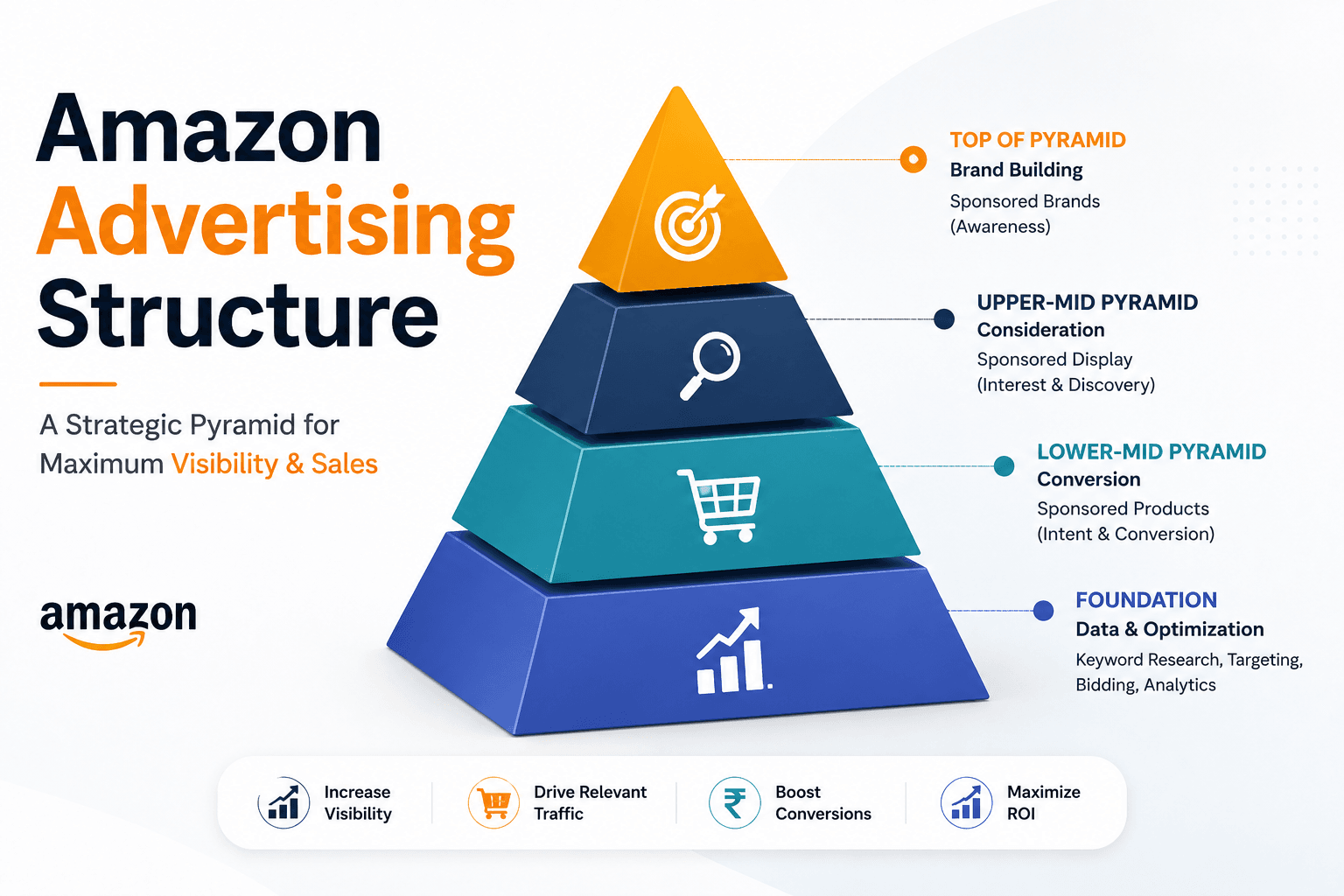
Random ad campaigns won't get you to ₹10Cr. You need a structured advertising architecture:
Sponsored Products (Core of your ad system):
Auto campaigns for discovery (mine search terms weekly)
Manual broad campaigns for volume
Manual exact campaigns for your best-performing keywords
Competitor targeting campaigns (ASIN targeting)
Sponsored Brands:
Drive branded searches with a logo + headline
Use video ads for high-intent keywords
Create category takeover strategies in peak seasons
Sponsored Display:
Retarget product page visitors
Cross-sell to buyers of complementary products
Use audience targeting for top-of-funnel awareness
Amazon DSP (for ₹5Cr+ brands):
Programmatic display and video ads
Reach Amazon and off-Amazon audiences
Re-engage lapsed customers
Budget Allocation Framework
Ad Type | % of Total Ad Budget |
Sponsored Products | 60–70% |
Sponsored Brands | 20–25% |
Sponsored Display | 10–15% |
DSP | Add-on (separate budget) |
TACoS (Total Advertising Cost of Sale) Target by Stage:
Revenue Stage | Target TACoS |
₹1Cr–₹3Cr | 12–18% |
₹3Cr–₹6Cr | 10–15% |
₹6Cr–₹10Cr | 8–12% |
Actionable Takeaway: Review your search term reports every week. Negative keywords are just as important as positive ones. Cutting wasted spend on irrelevant terms often delivers a 15–20% efficiency improvement overnight.
Step 4: Strengthen Inventory and Supply Chain Management
Inventory Forecasting
Stockouts are the #1 silent killer of Amazon growth. Every day out of stock means:
Lost sales (obviously)
Keyword ranking drop
BSR decline that takes weeks to recover
Competitor gains Buy Box share
Build your forecasting around these inputs:
Average daily sales (trailing 30, 60, 90 days)
Seasonal spikes — Great Indian Festival, Diwali, Republic Day sale, Amazon Prime Day
Lead time from supplier to FBA
Amazon's processing time (typically 2–5 days)
Safety Stock Formula: Safety Stock = (Max Daily Sales × Max Lead Time) – (Avg Daily Sales × Avg Lead Time)
Avoiding Stockouts and Overstocking
Set automated reorder alerts in your inventory management tool
Maintain at least 30–45 days of stock at the FBA level during non-peak periods
During peak season (Oct–Dec), plan for 60–90 days of stock
Use Amazon's FBA Inventory Health dashboard to identify overstock and liquidate slow-movers early
Actionable Takeaway: Invest in inventory planning software like RestockPro or SoStocked. The cost of one major stockout during a sale event far exceeds the tool cost for a full year.
Step 5: Expand Across Amazon India Categories and Marketplaces
This is arguably the single biggest lever for Amazon marketplace expansion India — and the most under-utilized one.
Marketplace Expansion Strategy
Most ₹1Cr sellers are stuck in one category. True Amazon marketplace expansion India means thinking beyond your initial niche.
Category Diversification:
Identify adjacent categories where your existing products or manufacturing capability can compete
Example: A home textile brand selling bedsheets can naturally expand into towels, curtains, and cushion covers
Regional Demand Analysis:
Use Amazon's regional seller reports to understand where your customers are located
Pin codes like Tier 2 and Tier 3 cities (Jaipur, Surat, Indore, Coimbatore) are now major growth centres
Customize your catalog and promotional messaging for regional demand patterns
Multi-Market Opportunities:
Once you've optimized India operations, Amazon marketplace expansion India becomes the foundation for global selling — UAE, UK, US, Singapore via Amazon Global Selling
Even ₹3Cr India-based sellers have successfully launched in UAE with existing products
New Customer Acquisition Channels (within Amazon):
Amazon Live (vernacular content drives high engagement in regional markets)
Posts (free, Instagram-style content to grow your brand audience)
Subscribe & Save (builds recurring revenue — game-changer for consumables, personal care, and pet products)
Actionable Takeaway: Map out 3 adjacent categories and evaluate 2–3 product opportunities in each. A structured Amazon India expansion strategy should include at least one new category launch every 6 months.
Step 6: Build a Strong Brand Presence
Brand Building Framework
Price wars are for commodity sellers. Brand equity is how you escape them.
Amazon Brand Registry:
Protect your trademarks (mandatory for serious sellers)
Unlocks A+ Content, Sponsored Brand Ads, Amazon Storefront, Brand Analytics, and Brand Story
Gives you tools to flag counterfeit listings
Amazon Storefront:
Your branded mini-website on Amazon
Creates a destination for brand loyalists
Improves branded search conversion significantly
Brand Story Module:
3–5 modules telling your origin, mission, and values
Customers who engage with Brand Story convert at 10–15% higher rates
Customer Loyalty:
Use "Request a Review" button consistently (within Amazon ToS)
Respond to every negative review within 24 hours
Build a post-purchase email sequence (where allowed via Seller Messaging)
Brand Trust Signals
Consistent visual identity across all images and storefront
4.0+ star average rating (target 4.3+)
50+ reviews on hero products before scaling ad spend
"Amazon's Choice" or "Best Seller" badge on key SKUs
Actionable Takeaway: Brand building isn't optional it's your moat. Invest in professional photography, a compelling brand story, and consistent customer communication from day one.
Step 7: Leverage Data and Analytics for Growth
Key Metrics to Track Weekly
Metric | Why It Matters | Target |
Revenue (by SKU) | Tracks growth & concentration risk | Month-on-month growth |
Conversion Rate | Listing + pricing health | >12% |
Sessions | Traffic quality and volume | Growing MoM |
TACoS | Overall advertising efficiency | <15% (scaling phase) |
Repeat Purchase Rate | Customer satisfaction & LTV | >20% for consumables |
Buy Box % | Pricing and fulfillment health | >90% |
Return Rate | Product quality signal | <5% |
Inventory Health Score | Supply chain efficiency | >500 |
Dashboard Recommendations
Build a weekly dashboard combining:
Amazon Seller Central Reports (Business Reports, Advertising Reports)
Brand Analytics (Search Query Performance, Market Basket Analysis)
Third-party tools: DataHawk, Helium 10 Market Tracker, or Sellerboard for P&L
Actionable Takeaway: What gets measured gets managed. Schedule a weekly 90-minute data review every Monday. This single habit separates ₹1Cr sellers from ₹10Cr businesses.
Step 8: Scale Beyond Amazon
Omnichannel Growth Strategy
At ₹5Cr+, dependence on a single channel becomes a strategic risk. Build your ecosystem:
D2C Website:
Shopify or WooCommerce store with a clean checkout
Drive traffic via Google Shopping, Meta ads, and influencer marketing
Higher margins (no Amazon fees) and direct customer data ownership
Social Commerce:
Instagram and YouTube Shops are growing rapidly in India
Vernacular content (Hindi, Tamil, Marathi) drives 3–5X higher engagement in regional markets
Meesho and Flipkart provide additional marketplace diversification
Retail Partnerships:
Modern trade (Reliance Retail, DMart) for visibility
Kiranas via distributor networks for Bharat penetration
Cross-Border Expansion:
Amazon Global Selling: same Seller Central, export to 18+ countries
UAE and UK are top destinations for Indian Amazon sellers
Amazon marketplace expansion India naturally evolves into a global commerce strategy
Step 9: Automation and Team Building
Processes to Automate First
Process | Tool/Approach |
PPC management | Perpetua, Intentwise, or Sellics |
Inventory alerts | SoStocked, RestockPro |
Review requests | FeedbackWhiz, Jungle Scout |
Reporting | Sellerboard, DataHawk |
Customer support | Freshdesk with Amazon integration |
Building Your Growth Team
Your ₹10Cr team structure:
Account Manager / eCommerce Head — owns overall P&L
Catalog & Listing Specialist — content, SEO, A+ Content
PPC Manager — advertising strategy and execution
Inventory Planner — demand forecasting and supply chain
Customer Support Executive — reviews, returns, queries
Creative Team (in-house or agency) — photography, video, design
Actionable Takeaway: Start hiring before you need help. Every month you delay building your team is a month of growth left on the table.
Step 10: Creating a ₹10Cr Roadmap
Quarterly Growth Framework
Phase 1: ₹1Cr → ₹3Cr (Months 1–12)
Priority Actions:
Expand catalog to 15–20 SKUs
Complete Brand Registry and A+ Content for all listings
Build structured PPC campaigns (SP, SB)
Implement inventory forecasting system
Hire first dedicated team member (catalog/PPC)
Target KPIs:
TACoS: <18%
Conversion Rate: >10%
Buy Box %: >90%
SKU Count: 15–20
Phase 2: ₹3Cr → ₹6Cr (Months 13–24)
Priority Actions:
Launch in 1–2 adjacent categories
Add Sponsored Display and DSP
Build Amazon Storefront and optimize Brand Story
Launch Subscribe & Save for eligible products
Build D2C website and start social commerce
Target KPIs:
TACoS: <14%
Conversion Rate: >13%
Repeat Purchase Rate: >18%
Revenue outside Amazon: 10–15%
Phase 3: ₹6Cr → ₹10Cr (Months 25–36)
Priority Actions:
Full omnichannel presence (Amazon + D2C + social + retail)
Explore Amazon Global Selling (UAE / UK)
Launch premium product line
Build data infrastructure (BI dashboard, weekly reviews)
Senior hire: eCommerce Head or Growth Lead
Target KPIs:
TACoS: <12%
Conversion Rate: >15%
International revenue: 15–20%
Team size: 6–8 people
Common Mistakes That Prevent Amazon Sellers from Scaling
Here are the 10 most expensive mistakes we see sellers make — and how to fix them:
Launching too few products. A 3-SKU business can't reach ₹10Cr. Expand your catalog systematically.
Scaling ads before fixing listings. Advertising to a 6% conversion rate listing is like filling a leaky bucket. Fix conversion first.
Ignoring inventory planning. Stockouts during peak sale events can cost you 3–6 months of ranking recovery time.
Not enrolling in Brand Registry. You're leaving A+ Content, Brand Analytics, and sponsored brand formats on the table.
Setting and forgetting PPC campaigns. Campaigns need weekly optimization. Stale campaigns burn budget and underperform.
Competing purely on price. Price erosion destroys margins. Build brand value so customers choose you, not just your price.
No returns and review strategy. A single product with 200 negative reviews will drag your entire account health down.
Single-channel dependency. If Amazon changes its algorithm or fees, your entire business suffers. Diversify early.
Underinvesting in content. Sellers with professional photography and video consistently outperform on conversion and returns.
Skipping the data. Flying blind is fine at ₹10L. At ₹1Cr and beyond, gut feel isn't a strategy.
Expert Tips for Faster Growth
Use Brand Analytics Search Query Performance weekly — it shows your impression share vs. competitors on top keywords.
Test pricing with automation tools — dynamic repricing within a 5–10% band can lift Buy Box % significantly.
Bundle strategy first, new SKU second — bundles increase AOV with zero additional procurement or listing effort.
Prioritize TACoS, not ACoS — ACoS only measures ad-attributed sales. TACoS measures advertising efficiency across your entire business.
Invest in A/B testing via Manage Experiments- even a better main image can lift conversion 15–25%.
Monitor the "Frequently Bought Together" section — it tells you exactly which cross-sell pairings Amazon is already surfacing.
Engage with Amazon Account Health proactively don't wait for policy strikes. Review health reports weekly.
Use Amazon Live for regional audiences vernacular live selling is massively underutilized and nearly free.
Build a Vine review pipeline for new product launches, Amazon Vine reviews can compress your launch timeline from 6 months to 6 weeks.
Partner with an experienced marketplace consultancy for your Category expansion phase expert guidance during the ₹3Cr–₹6Cr phase can save you 12–18 months of trial and error.
Conclusion
Scaling from ₹1Cr to ₹10Cr on Amazon India is absolutely achievable but it's not automatic. It demands a structured Amazon marketplace expansion India strategy, consistent execution, and a willingness to build systems beyond just your products.
Here's your 3-point summary:
Products: Build a diversified, deep catalog with hero products, bundles, variations, and a premium line.
Operations: Fix your advertising, inventory, and listing quality before scaling spend.
Brand: Invest in Brand Registry, brand content, and customer loyalty these become your competitive moat.
The sellers who reach ₹10Cr aren't smarter. They're more systematic. They treat Amazon as a business platform, not just a sales channel.
🚀 Ready to Implement Your Amazon Marketplace Expansion India Strategy?
If you're serious about scaling your Amazon India business to ₹10Cr and beyond, working with an experienced Amazon marketplace growth partner can dramatically accelerate your journey.
Your ₹10Cr milestone isn't a question of if. It's a question of when and how well-prepared you are.
For more resources on Amazon seller growth, marketplace management, and eCommerce strategy, explore our services or speak with our growth consultants today.
Frequently Asked Questions
Scaling from ₹1Cr to ₹10Cr requires a multi-pronged strategy: expanding your product catalog (15–20+ SKUs), building advanced advertising systems (SP + SB + SD), optimizing listings for conversion, implementing robust inventory planning, enrolling in Brand Registry, and eventually diversifying into adjacent categories and marketplaces. This playbook outlines a 36-month phased roadmap to achieve this goal.
The most effective strategy combines all three ad types: Sponsored Products (60–70% of budget) for direct sales, Sponsored Brands (20–25%) for brand visibility, and Sponsored Display (10–15%) for retargeting. Focus on reducing TACoS below 15% during the scaling phase and improve it to below 12% as you mature. Weekly search term audits and negative keyword management are non-negotiable.
Extremely important. Stockouts are the fastest way to destroy keyword rankings and sales momentum you've spent months building. Every day out of stock can cost 2–3 days of ranking recovery time. At the ₹3Cr+ level, professional inventory forecasting software becomes essential, not optional.
Yes ,category expansion is one of the most powerful levers in any Amazon marketplace expansion India strategy. Identify adjacent categories where your brand has natural relevance. Launch methodically: one or two new categories per 6 months with proper research and listing quality in place before advertising.
Track these weekly: Revenue by SKU, Sessions, Conversion Rate, TACoS, Buy Box Percentage, Return Rate, and Repeat Purchase Rate. Monthly, review Inventory Health Score, Profit Margin by SKU, and Category Market Share. At ₹5Cr+, add a BI dashboard combining Seller Central data with your own P&L model.
Amazon Brand Registry protects your trademarks and unlocks premium growth tools: A+ Content, Brand Story, Amazon Storefront, Sponsored Brand Ads, Amazon Vine, Manage Experiments (A/B testing), and Brand Analytics. Sellers with Brand Registry consistently outperform non-registered sellers on conversion rate and long-term revenue. It's non-negotiable for any serious Amazon seller growth strategy.
Consider expanding beyond Amazon India when you've consistently crossed the ₹5Cr mark, have stable inventory systems, a brand identity, and positive cash flow. Your next steps could include launching a D2C website, listing on Flipkart or Meesho, and exploring Amazon Global Selling (UAE, UK, US). A phased omnichannel strategy reduces platform risk and opens up entirely new customer segments.
Growing your Amazon seller revenue in India requires a structured, multi-step approach. Start by expanding your product catalog beyond 1–2 hero SKUs to at least 15–20 well-researched products. Optimize every listing with keyword-rich titles, professional images, A+ Content, and videos. Build a structured advertising system using Sponsored Products, Sponsored Brands, and Sponsored Display — and track TACoS weekly to ensure profitable scaling. Enroll in Amazon Brand Registry to unlock premium tools, protect your brand, and build customer trust. Strengthen your inventory planning to avoid costly stockouts during peak sale events. As you grow, diversify into adjacent categories and explore omnichannel channels like a D2C website and social commerce. If you want expert guidance tailored to your business, Pinnacle Growth Consulting works with Amazon India sellers across all growth stages — from ₹50L to ₹10Cr+.