
What Is Amazon Marketing Cloud: A Guide for UK Brand Owners
Amazon Marketing Cloud gives UK brands advertising insights standard reporting cannot, path to conversion, audience overlap, and custom attribution. This guide explains what AMC is, how to access it, and how to use it.
Amazon's standard reporting tells you what happened. Your ACoS, your impressions, your conversion rate- all visible, all useful, all incomplete.
What it cannot tell you is:
Why a shopper who saw your Sponsored Products ad three times still did not convert.
Or how many of your ad-driven sales went to customers who would have bought anyway.
Or whether your DSP spend and your Sponsored Ads spend are reaching the same audience twice
And what you are losing by doing so.
Amazon Marketing Cloud answers these questions. And for UK brands running meaningful ad budgets, the gap between what standard reporting shows and what AMC reveals is often where the most significant optimisation opportunity lives.
What Is Amazon Marketing Cloud and How Does It Work?
Amazon Marketing Cloud (AMC) is Amazon's privacy-safe, cloud-based data clean room. It allows advertisers to combine their own first-party data with Amazon's pseudonymised signal data including ad exposure events, shopping behaviour, and conversion data, and run queries against the combined dataset to generate insights that no other Amazon reporting tool can produce.
The "clean room" framing matters. Individual-level data is never exposed. Neither Amazon's data to the advertiser nor the advertiser's data to Amazon. Queries return aggregated, anonymised outputs only. Any result with fewer than 100 matching users is suppressed entirely, which is Amazon's privacy threshold.
In plain terms: AMC is a secure environment where your advertising data and Amazon's shopper data can be analysed together, without either party seeing the other's raw records. The outputs are insights like audience segments, attribution paths, frequency patterns, that you use to make better campaign decisions.
What Can Amazon Marketing Cloud Tell You That Standard Amazon Reporting Cannot?
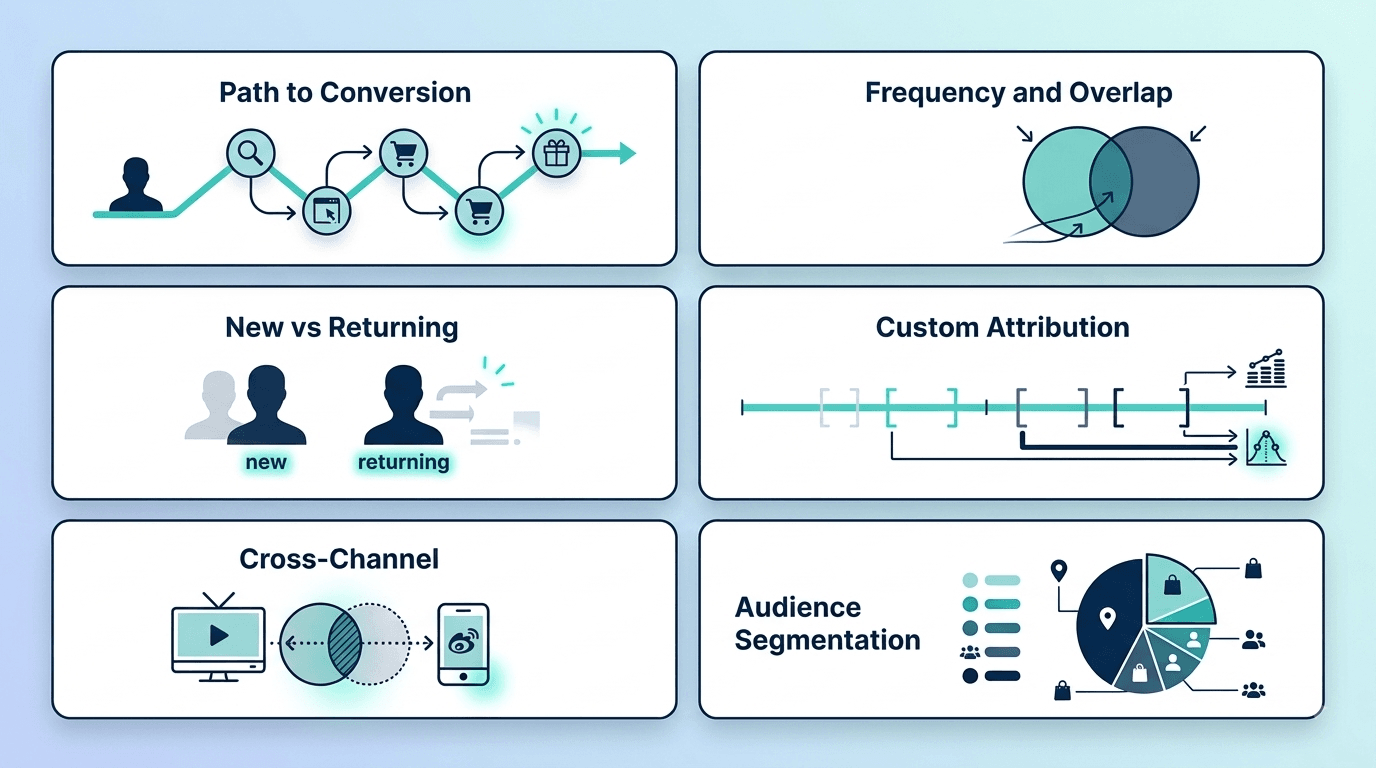
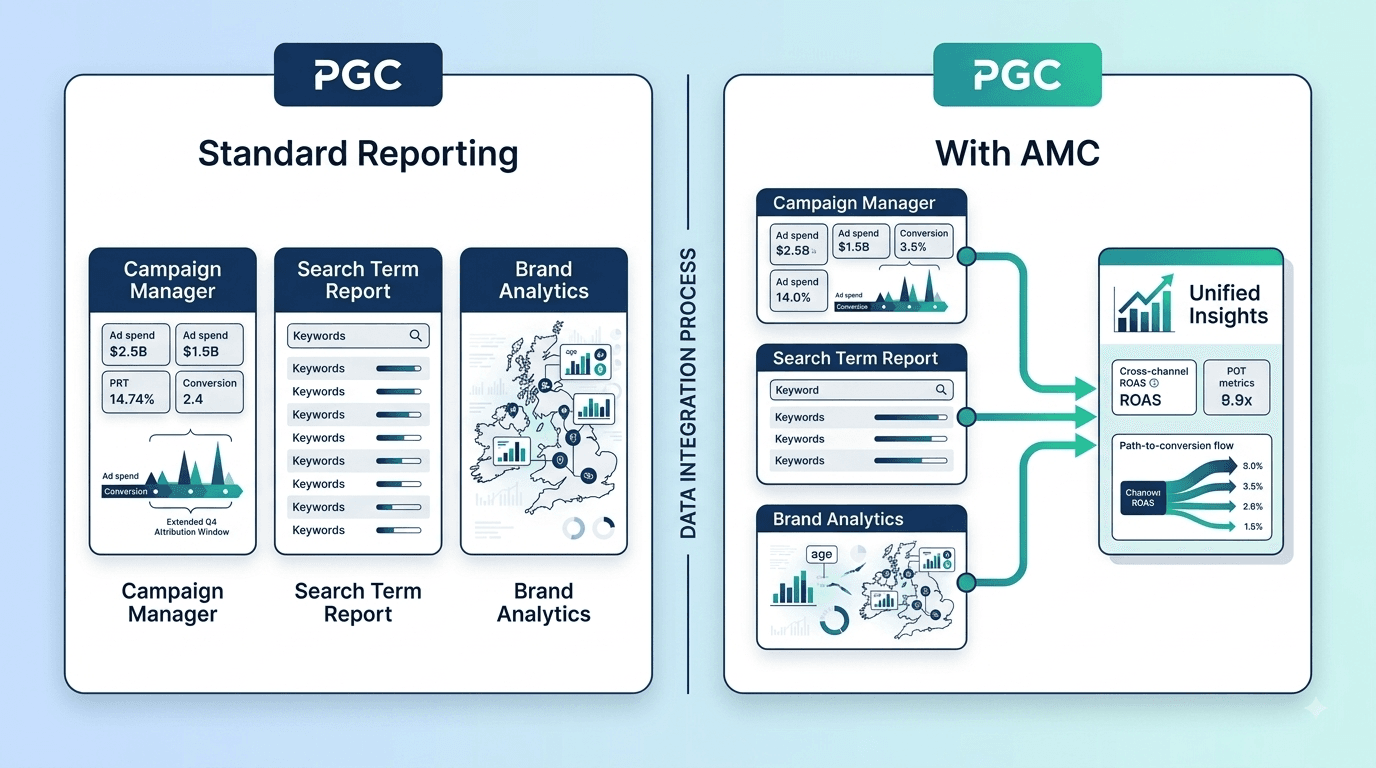
Standard Amazon reporting operates in silos. Campaign Manager shows campaign data. The search term report shows keyword data. Brand Analytics shows purchase behaviour. None of these talk to each other natively which means the connections between them are invisible unless you are using AMC.
Path to conversion analysis:
How many ad touchpoints does a shopper have before purchasing? A customer may have seen a Sponsored Products ad, then a Sponsored Brands Video, then a Sponsored Display retargeting unit before converting. Standard reporting credits the last click. AMC shows the full sequence of which ad types contributed, in what order, across what timeframe. This tells you which channels are genuinely driving purchase decisions versus which are taking credit for conversions that would have happened anyway.New versus returning customer analysis
What percentage of your ad spend is acquiring genuinely new customers versus re-purchasing existing ones? AMC answers this at the ASIN level, critical for brands trying to measure true customer acquisition cost rather than blended revenue figures that mix new and repeat buyers.Frequency and audience overlap analysis
Are you reaching the same audience across multiple ad types simultaneously? AMC identifies which segments are being exposed to your ads at disproportionate frequency- audiences you are over-saturating while potentially missing others. For brands running both Sponsored Ads and DSP, this is where significant budget waste typically lives.Custom attribution windows
Amazon's standard attribution is 14-day click, 1-day view. AMC lets you model custom windows — 7-day, 30-day, 90-day — to understand how longer consideration cycles affect your category. For higher-ticket products or categories with extended research phases, standard attribution systematically undercounts the impact of upper-funnel advertising.Cross-channel attribution
For brands running Amazon DSP alongside Sponsored Ads, AMC shows the incremental contribution of each channel, which sales DSP drove that Sponsored Ads would not have captured, and where the two channels are overlapping without incremental benefit.Audience segmentation by behaviour
Which customer segments convert best on which ad types, at which frequency, in which time windows? AMC breaks ROAS and conversion rates down by audience cohort in ways that inform both creative strategy and budget allocation decisions.
Who Can Access Amazon Marketing Cloud and How Do You Get Started?
This is where most brands are working from outdated information. AMC is now directly accessible to brands; you do not need Amazon DSP or an Advanced Partner agency to get in.
Access is available through the Amazon Ads console. Any brand with an active Amazon Ads account can request AMC access and begin working with the platform.
The barrier is not access. It is knowing what to do once you are in.
AMC's built-in templates (covered in the next section) make basic use cases accessible without technical expertise.
Custom queries, which is where the most valuable and differentiated insights live, require SQL capability.
Writing, validating, and interpreting SQL queries against Amazon's data schema is where most brand teams hit a ceiling. The outputs are only as good as the questions you know to ask and your ability to structure those questions correctly in SQL.
This is the agency value proposition for AMC: not getting you access, but knowing how to use it effectively once you are there.
Amazon Marketing Cloud Use Cases: Built-In Templates and Custom Queries Explained
AMC operates across two levels of sophistication. Both built-in no-code templates and custom SQL queries are genuinely useful; the right level depends on your team's technical capability and the complexity of the insight you need.
Amazon Marketing Cloud No-Code Templates
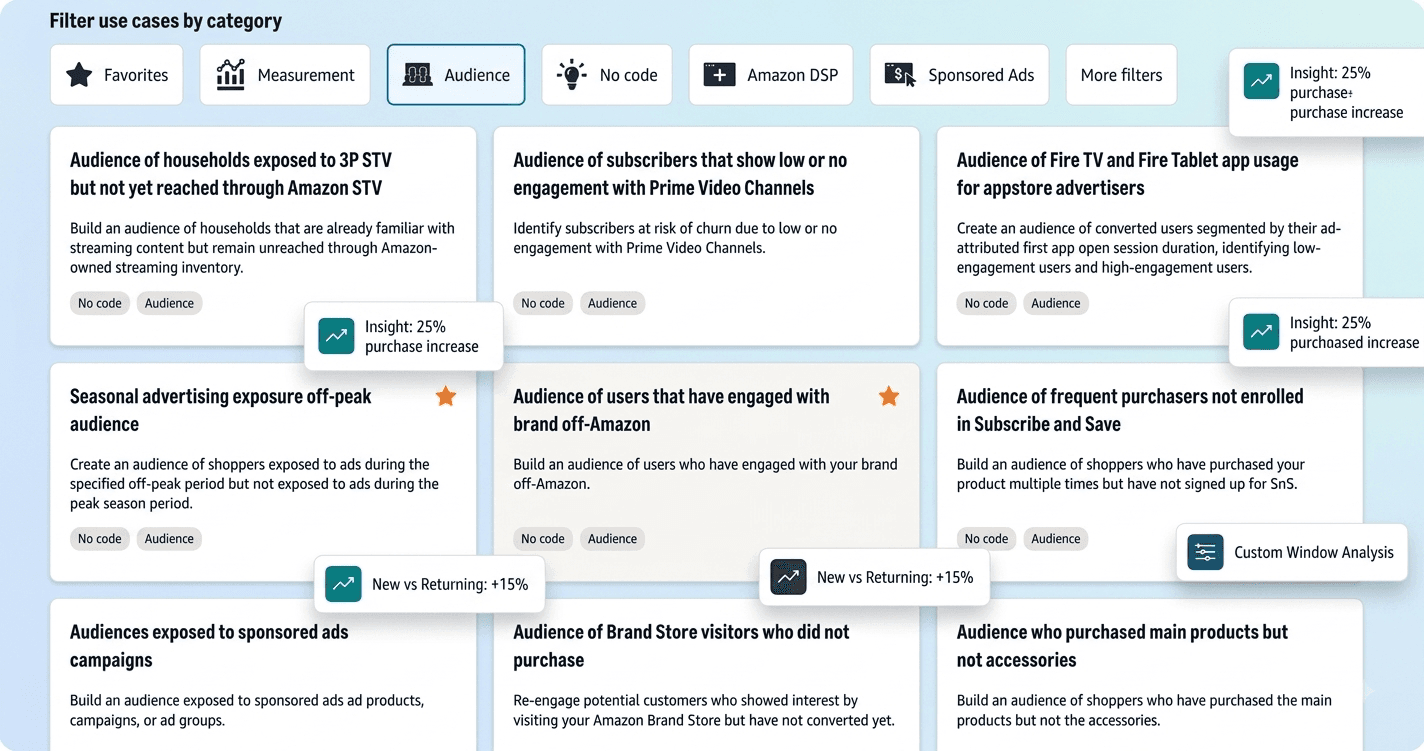
Amazon provides a library of pre-built use case templates within AMC that require no SQL knowledge. These are grouped by category: Audience, Measurement, Sponsored Ads, Amazon DSP, and more. UK brands can activate these without writing a single line of code.
Some of the most practically useful audience templates visible in AMC's use case library:
Brand Store visitors who did not purchase: re-engage shoppers who visited your Brand Store but left without buying. A high-intent audience that has already demonstrated brand interest.
Frequent purchasers not enrolled in Subscribe and Save identify repeat buyers who have not yet opted into subscription, and target them with Subscribe and Save messaging to increase customer lifetime value.
Audiences exposed to Sponsored Ads campaigns build a retargeting audience from shoppers who were exposed to your Sponsored Ads without converting, and re-engage them through DSP.
For UK brands wanting to understand how Amazon Sponsored Ads and DSP work together before layering AMC analysis on top:
Read our full guide on Amazon Sponsored Ads →
Seasonal advertising exposure: off-peak audience identifies shoppers exposed to your ads during off-peak periods but not during peak season, allowing you to build targeted peak-season campaigns toward this warm audience.
Audience of users who have engaged with your brand off-Amazon connect off-Amazon brand engagement signals to Amazon shopping behaviour, building audiences based on cross-platform intent signals.
Audience who purchased main products but not accessories: identify buyers of hero SKUs who have not yet purchased complementary products, enabling cross-sell campaigns with high purchase probability.
These templates make AMC accessible as a starting point. For brands that have not used AMC before, beginning with two or three of these audience use cases produces immediate, actionable outputs without requiring technical resources.
Custom SQL Queries
Beyond templates, AMC supports fully custom SQL queries; this is where the platform's real depth lives. Custom queries allow brands and their agency partners to ask questions that Amazon's pre-built templates do not cover.
Path to conversion modelling across custom timeframes, frequency capping analysis by audience segment, incrementality measurement across ad types, and multi-touch attribution models that reflect how your specific category's purchase cycle actually works- none of these are available as standard templates. They require query design, testing, and interpretation by someone who understands both SQL and Amazon's data schema.
The combination of no-code templates for rapid insight and custom queries for deep analysis is what makes AMC a genuinely powerful tool rather than a checkbox feature.
How UK Brands Can Use Amazon Marketing Cloud in Practice
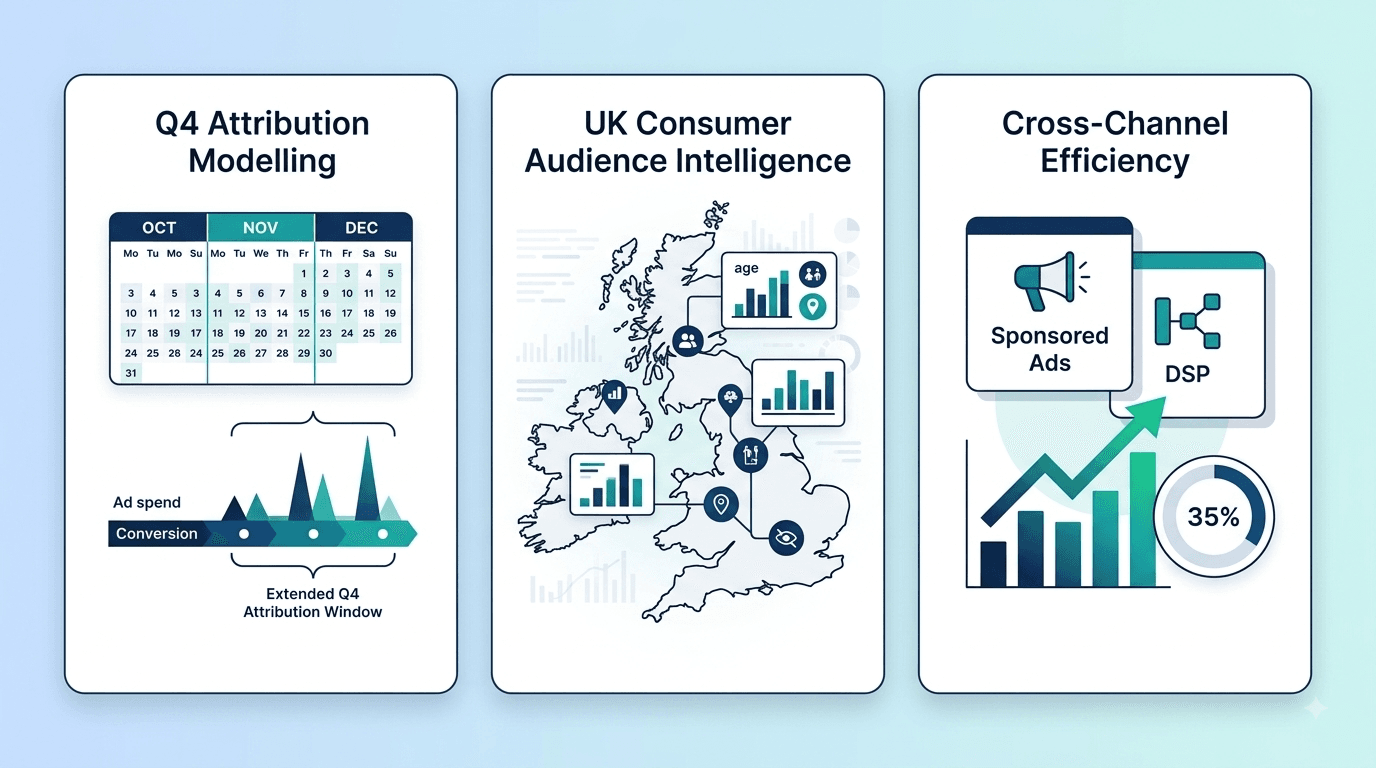
Three applications are particularly relevant for UK brands given the specific dynamics of the Amazon UK marketplace.
Q4 Attribution Modelling
Q4 represents 35 to 40% of annual revenue for many UK Amazon sellers. Standard attribution (14-day click) systematically undercounts the impact of upper-funnel advertising during the pre-Christmas research phase; a shopper exposed to a Sponsored Brands Video in early November who purchases in late November falls outside the standard attribution window entirely.
AMC's custom attribution windows let UK brands model their full Q4 advertising impact accurately. For brands investing in awareness advertising ahead of peak, this is the difference between seeing a complete picture of what drove Christmas sales and significantly undervaluing the campaigns that built the pipeline.
For a complete breakdown of Amazon UK growth strategy, including Q4 preparation and festive season advertising:
Read our full guide on How to Scale on Amazon UK →
Audience Intelligence for UK Consumer Behaviour
Post-Brexit, UK consumer shopping patterns on Amazon have shifted. AMC's audience analysis tools let UK brands understand which segments are responding to their advertising, at what frequency, and through which ad types, without the geographic assumptions baked into global audience data.
For brands selling across both Amazon UK and Amazon EU, AMC can also help identify audience overlap and differential behaviour between UK and European shoppers, informing whether creative, messaging, and budget allocation should differ between markets.
DSP and Sponsored Ads Cross-Channel Efficiency
For UK brands running Amazon DSP alongside Sponsored Ads, AMC answers the question that standard reporting cannot: how much of your DSP spend is reaching audiences already being captured by Sponsored Ads, and what is the incremental contribution of each channel?
Identifying this overlap prevents double-spend on the same shopper across channels and allows budget to be reallocated toward genuinely incremental reach, improving overall efficiency without reducing total advertising investment.
For more on how Amazon PPC management works and what continuous optimisation looks like in practice:
Read our full guide on Amazon Ads Management →
How Pinnacle Growth Consulting Uses Amazon Marketing Cloud for UK Advertising Clients
Access to AMC is available to all brands. Knowing how to extract meaningful insight from it is a different matter.
Pinnacle Growth Consulting holds Amazon Ads Advanced Partner status and works with AMC as an active component of managed advertising services for UK brands. Our AMC work covers both no-code template deployment for rapid audience building and custom SQL query development for deeper attribution and frequency analysis.
In practice, this means UK brands working with Pinnacle get AMC insights translated into campaign decisions, not data outputs that sit in a spreadsheet. Path to conversion analysis informs where the budget should concentrate across ad types. Frequency analysis prevents audience saturation. Attribution modelling ensures Q4 investment is correctly evaluated. Audience segments built in AMC feed directly into DSP campaign targeting.
For UK brands spending meaningfully on Amazon advertising and wanting insight beyond what Campaign Manager provides, AMC is the layer that makes the invisible visible. For those who want it activated and working on their account:
Explore our Amazon Ads Management services for UK brands →
Frequently Asked Questions
Amazon Marketing Cloud (AMC) is Amazon's privacy-safe, cloud-based data clean room. It allows advertisers to combine their own first-party data with Amazon's pseudonymised signal data and run queries to generate advertising insights not available through standard Amazon reporting tools. Individual-level data is never exposed, AMC returns aggregated, anonymised outputs only.
AMC is directly accessible to any brand with an active Amazon Ads account. Access is requested through the Amazon Ads console. The barrier to using AMC effectively is not access but technical capability basic use cases are available through Amazon's no-code template library, while custom queries require SQL expertise.
AMC use cases fall into two categories. Amazon's built-in no-code templates cover audience building (Brand Store visitors who did not purchase, frequent buyers not on Subscribe and Save, audiences exposed to Sponsored Ads), measurement, and cross-channel analysis. Custom SQL queries go deeper, path to conversion modelling, frequency analysis by audience segment, custom attribution windows, and incrementality measurement.
The AMC API allows agencies and technology partners to access AMC programmatically, running queries, retrieving results, and integrating AMC outputs into broader reporting and activation workflows without using the AMC console interface directly. It is primarily used by agencies managing AMC at scale across multiple advertiser accounts.
Yes. Amazon Ads offers an Amazon Marketing Cloud certification through its certification programme, accessible via the Amazon Ads Partner Network portal. The certification covers AMC fundamentals, query writing, use case activation, and output interpretation.
Amazon Brand Analytics shows aggregated search and purchase behaviour data within Seller Central, useful for keyword research, competitive benchmarking, and category trends. AMC is a data clean room that combines your advertising exposure data with Amazon's shopper signals to answer questions about your specific campaign performance, audience behaviour, and attribution. Brand Analytics is descriptive. AMC is analytical and actionable at the campaign level.
Amazon maintains official AMC documentation through the Amazon Ads developer portal, covering query syntax, data schema, privacy thresholds, API integration, and use case guidance. For brands working with an agency partner, the agency typically handles query development and documentation navigation on the brand's behalf.