
Amazon Account Health Explained: 2026 Guide for UK Sellers
Everything UK Amazon sellers need to know about Account Health Rating, performance metrics, policy violations, suspension recovery, and the weekly routine that keeps your account protected in 2026.
Your Amazon listings can be optimised. Your PPC can be profitable. Your inventory can be perfectly managed. None of it matters if your account health is deteriorating in the background.
Most importantly, leading to your Amazon seller account suspension.
Amazon Account Health is the operational foundation everything else sits on. A declining Account Health Rating affects your Buy Box eligibility, your listing visibility, and ultimately your ability to sell on Amazon UK at all. Most UK sellers only pay attention to it when something goes wrong. By then, the damage is already in progress.
This guide covers everything UK sellers need to understand about Amazon Account Health in 2026, what it measures, what puts it at risk, what the UK-specific threats are, and how to protect it before it becomes a crisis.
What Is Amazon Account Health and How Is It Measured?
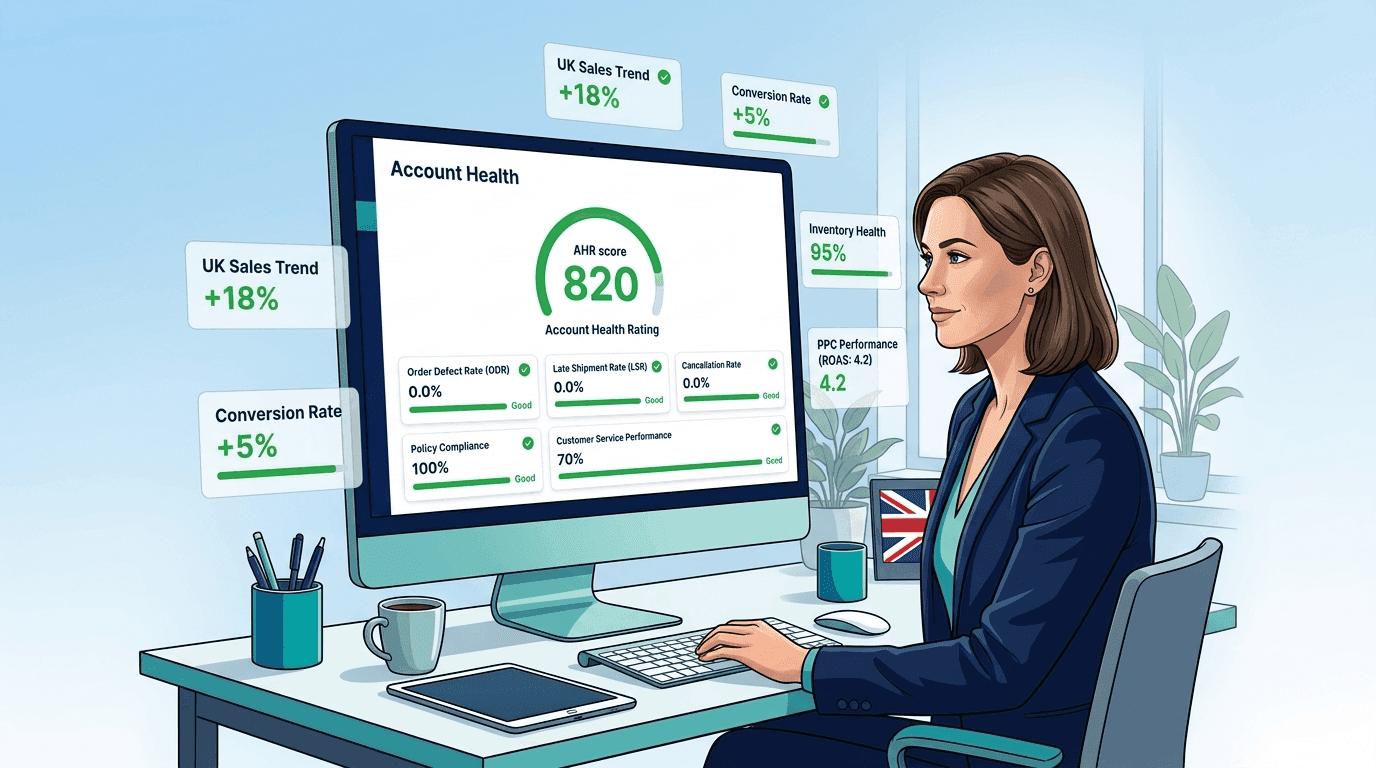
Amazon Account Health is a performance measurement system that tracks how consistently a seller meets Amazon's policies and service standards. It is represented by an Account Health Rating (AHR), a score out of 1,000 visible in Seller Central under the Account Health dashboard.
Three rating bands determine your account status:
Good (200–1,000): Your account is in good standing. Amazon considers your performance and compliance acceptable for continued selling.
At Risk (100–199): Your account has accumulated enough issues to flag for potential deactivation. Amazon may reach out with a warning, but action is required quickly.
Critical (below 100): Immediate risk of deactivation. At this point, selling privileges can be removed with limited notice.
The AHR is calculated from a combination of performance metrics and policy violation points. Policy violations carry negative point values that reduce your score. Resolving violations restores points. Performance metrics are tracked as percentages against Amazon's defined thresholds, breaching them consistently pushes the score down regardless of your violation history.
Finding Your Account Health Dashboard Right Now
Log into Seller Central, navigate to the Performance tab in the top menu, and click Account Health. Your AHR score, active policy violations, and flagged performance metrics are all visible on one page. Bookmark it, checking it takes two minutes and catching a developing issue early costs significantly less than recovering from a suspension.
Understanding which of these two levers is driving your score is the starting point for any account health recovery.
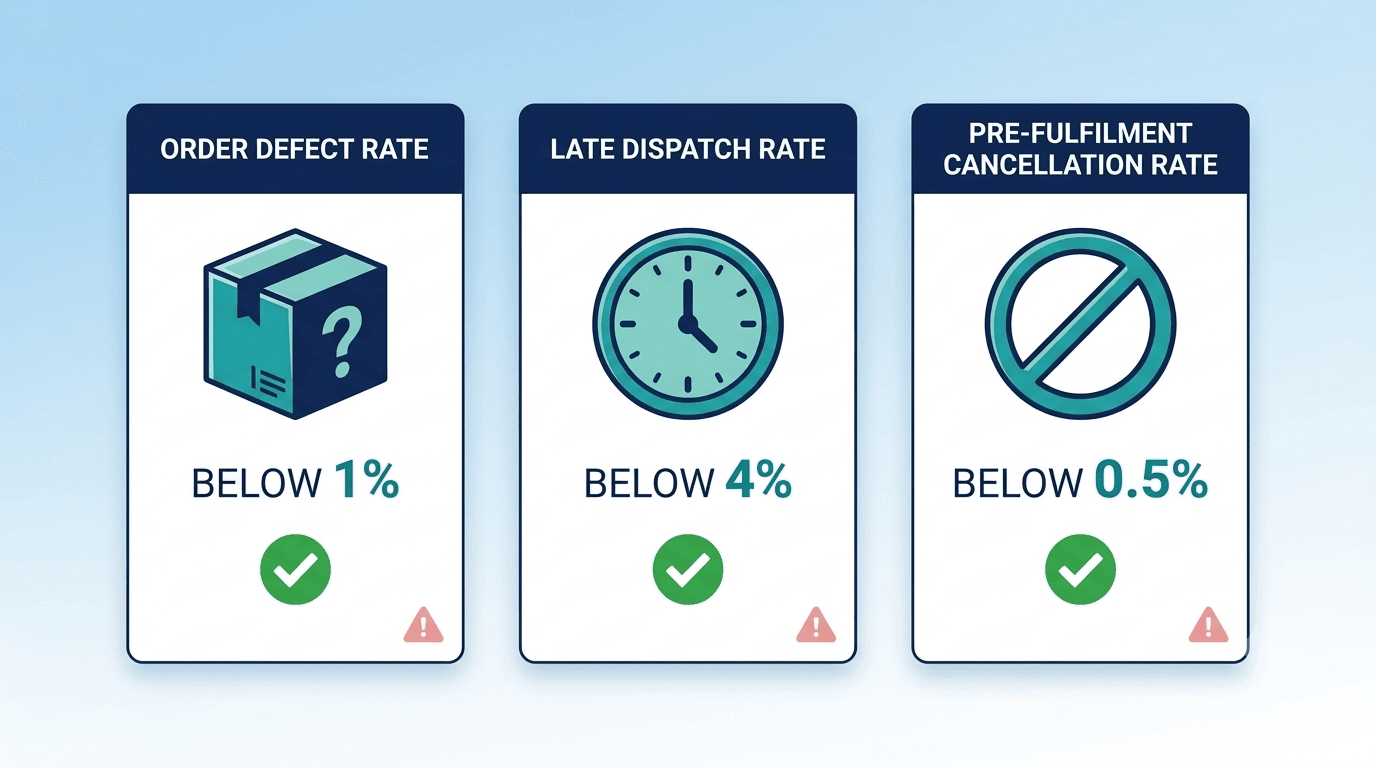
The Three Performance Metrics That Determine Your Amazon UK Account Health
Order Defect Rate
Order Defect Rate (ODR) measures the percentage of orders that resulted in a negative customer experience, including negative seller feedback, A-to-Z Guarantee claims, and credit card chargebacks.
Target: below 1%
ODR is the single most watched performance metric on Amazon UK. An ODR above 1% sustained over a rolling 60-day period triggers a performance warning. UK consumers are highly review-sensitive and have straightforward access to A-to-Z claims, a product quality issue or a customer service gap that might go unnoticed on other platforms will show up in ODR on Amazon UK.
The most common causes: products not matching listing descriptions, slow or unresponsive customer service, and packaging failures causing damage in transit.
Late Dispatch Rate
Late Dispatch Rate measures the percentage of orders not confirmed as dispatched by the promised dispatch date.
Target: below 4%
UK consumers have delivery expectations shaped by Amazon Prime. FBM sellers who set aggressive dispatch windows their operations cannot consistently meet are the most common offenders. A single warehouse staffing issue or supplier delay, if not managed with a temporary dispatch window extension, can spike this metric across dozens of orders simultaneously.
Post-Brexit, cross-border shipments into the UK from EU suppliers can cause late dispatch flags when customs processing delays prevent sellers from confirming dispatch within their promised window. Building realistic dispatch windows that account for this is essential for any UK seller receiving stock from EU-based manufacturers.
Pre-fulfilment Cancellation Rate
Pre-fulfilment Cancellation Rate measures the percentage of orders cancelled by the seller before shipment.
Target: below 0.5%
This threshold is low enough that even a handful of cancellations on a modest-volume account can breach it. The primary cause is inventory mismanagement, listing products as in stock when they are not, or failing to update inventory levels after a stockout. For UK sellers managing both FBA and FBM channels simultaneously, a stock sync failure between the two can generate cancellations before anyone catches the discrepancy.
Additional Account Health Indicators UK Sellers Need to Track
Beyond the three primary metrics, Amazon UK tracks several additional performance indicators that affect account standing and Buy Box eligibility.
Valid Tracking Rate: The percentage of shipments with valid tracking numbers uploaded before the estimated delivery date. Target above 95% for most categories. UK sellers using untracked Royal Mail services on FBM shipments frequently breach this without realising it counts against them.
Late Delivery Rate: Separate from Late Dispatch Rate, this measures whether orders actually arrived by the promised delivery date. FBA handles delivery performance for Amazon, FBM sellers are fully responsible for their carrier's delivery consistency.
Return Dissatisfaction Rate: The percentage of return requests not handled satisfactorily, including late responses, incorrect resolutions, or rejected returns that should have been accepted. Target below 10%.
Invoice Defect Rate: Relevant for UK sellers with business buyers on Amazon Business. Measures the percentage of B2B orders where a valid VAT invoice was not provided within the required timeframe. Target below 5%. VAT invoicing compliance is a specific UK regulatory requirement that adds an additional account health dimension for sellers serving business customers.
Policy Violations That Damage Amazon Account Health
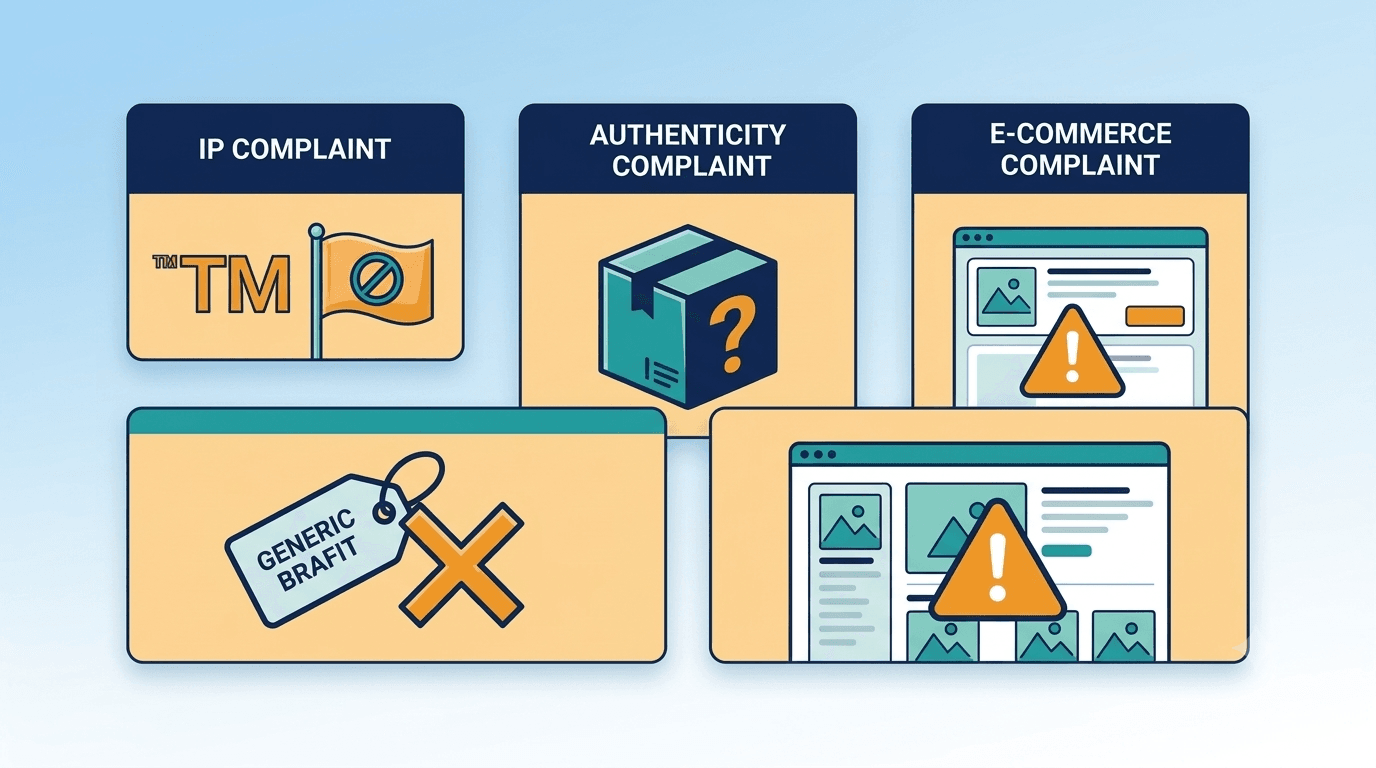
Performance metrics are one half of the account health equation. Policy violations are the other, and they can move the AHR score more dramatically and more quickly than metric drift.
Intellectual Property Complaints
A competitor or brand owner files a complaint claiming your listing infringes their trademark, copyright, or patent. These are common in competitive UK categories, particularly beauty, electronics accessories, and apparel, where established brands actively monitor for unauthorised use of their IP.
Each unresolved IP complaint reduces your AHR significantly. Multiple complaints can push an account from Good to At Risk within days. The resolution process requires either demonstrating you have the right to use the IP in question or removing the affected listing.
Product Authenticity Complaints
Claims that products sold are counterfeit or inauthentic are among the most serious Amazon UK account health threats. They can trigger immediate listing removal and, in repeat cases, account suspension without the warning period that performance-based issues typically carry.
UK consumers and brand protection teams are active on Amazon.co.uk. Sellers sourcing products from grey market channels or unauthorised distributors are particularly exposed.
Restricted Product Violations
Amazon UK has specific restricted categories and products that require approval or are outright prohibited. These include certain health and wellness products, items with age restrictions, weapons and related accessories, and products regulated under UK law that differ from EU or US regulations post-Brexit.
Listing a restricted product without approval, even unintentionally during a catalogue migration from another marketplace, generates an immediate policy violation.
Listing Policy Violations
Amazon UK has tightened enforcement on listing content quality since 2023. Keyword stuffing in titles, misleading claims in bullet points, incorrect product categorisation, and promotional language in restricted fields all generate listing violations that feed into the AHR score.
What Is Amazon Account Health Assurance and Do You Qualify?
Amazon Account Health Assurance (AHA) is a programme that protects eligible sellers from account deactivation while they work to resolve account health issues, provided they engage with an Amazon account health specialist within 72 hours of being notified.
For UK sellers who qualify, AHA is genuinely valuable. It provides a safety net that prevents the immediate revenue loss of a deactivation while the resolution process runs, a window that unprotected sellers do not have.
Eligibility requirements:
Account Health Rating of 250 or above maintained for at least six consecutive months
No more than one active policy violation at the time of notification
AHA is not guaranteed protection, it is conditional on timely engagement with Amazon's resolution process. But for sellers who maintain consistently good account health, it is one of the most underutilised protections available on Amazon UK.
What Happens When Your Amazon UK Account Gets Suspended
Amazon UK account suspensions fall into three categories, each with a different resolution pathway.
Performance-based suspension is triggered when performance metrics breach thresholds over a sustained period. The suspension notice will specify which metric caused the issue. Resolution requires a structured Plan of Action (POA) demonstrating the root cause has been identified and addressed.
Policy violation suspension is triggered by specific policy breaches, IP complaints, authenticity issues, and restricted product violations. These are typically tied to specific ASINs and require either evidence of compliance or removal of the affected listings alongside a POA.
Inauthentic item suspension is one of the most common and most serious suspension types on Amazon UK. It is triggered by customer complaints or Amazon's own detection systems and requires supply chain documentation, invoices, authorisation letters from brand owners, or certificates of authenticity, to resolve.
How to Reinstate a Suspended Amazon UK Account: The Step-by-Step Process
Read our blog on ‘Pinnaclegrowth.ai vs Top Amazon Ads Platforms: Which Is Right for You?’ to find the right fit for you.
Identify the root cause precisely. Amazon's suspension notice specifies the metric or violation; the POA must address the exact cause stated, not a general account improvement plan.
Write a structured Plan of Action covering three elements: what caused the issue, what immediate corrective steps were taken, and what systemic changes prevent recurrence. Vague or defensive POAs are rejected. Specific, accountable POAs with documented evidence are reinstated significantly faster.
Submit via the Performance Notifications section of Seller Central. Amazon UK typically responds within 48–72 hours for performance-based suspensions, though policy violation cases can take longer depending on complexity.
Amazon rejects POAs that are vague, defensive, or promise future action without evidence of immediate steps already taken. Specificity is what gets accounts reinstated.
UK-Specific Account Health Risks Most Sellers Overlook
Post-Brexit Customs and Delivery Delays
Cross-border shipments involving UK and EU now pass through customs in both directions. Sellers shipping from EU-based manufacturers into UK FBA centres, or FBM sellers delivering to customers who ordered from cross-border inventory, face customs processing delays that were not a factor pre-2021.
These delays directly cause Late Delivery Rate flags. Building delivery windows that realistically account for customs processing, rather than using pre-Brexit delivery estimates, is a straightforward fix that most sellers have not made.
Post-Brexit supply chains and cross-border expansion introduce complex variables that directly impact your operational metrics. To see how these fit into a broader multi-channel playbook, read our guide on scaling your UK growth strategy
VAT Compliance as an Account Health Issue
Amazon UK has increased enforcement on VAT compliance significantly since 2022. Sellers without correct VAT registration, with incorrect VAT numbers on file, or with VAT numbers that do not match their registered business entity face listing suppression across their entire catalogue, not just individual ASINs.
VAT registration is mandatory once turnover crosses £90,000 on Amazon UK. Sellers approaching this threshold who have not registered are taking a significant account health risk that is entirely preventable.
Buy Box Eligibility and Account Health
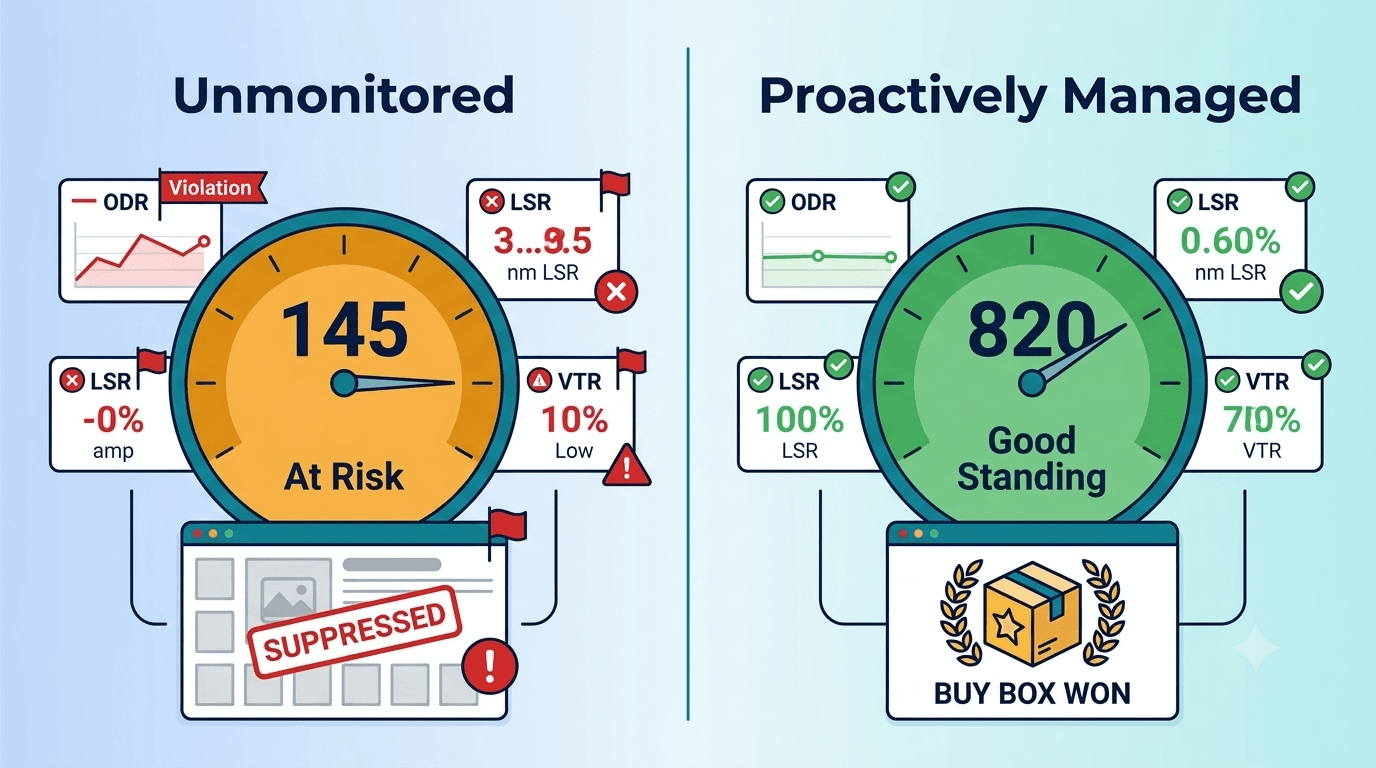
Account health directly affects Buy Box eligibility, a connection that most UK sellers underestimate. Sellers with At Risk or Critical AHR scores lose Buy Box priority even on well-priced, well-reviewed listings. A competitor with a lower price but worse reviews can win the Buy Box consistently over a seller with superior listing quality simply because that seller's account health score is depressed.
The Buy Box impact of poor account health is often the first commercially visible sign that something is wrong, but by the time it shows up in revenue, the account health issue has usually been building for weeks.
How Pinnacle Growth Consulting Monitors and Protects Account Health for UK Brands
Account health monitoring is not a weekly task. By the time a weekly review catches a developing issue, the metric has already been moving in the wrong direction for days.
Pinnacle Growth Consulting manages Amazon UK account health for brands through continuous daily monitoring, listing status, performance metric trends, policy notification alerts, and Buy Box eligibility tracking, powered by Pinnaclegrowth.ai, our AI-driven Amazon management platform that surfaces account health signals alongside campaign performance data in real time.
Pack8, a UK-based seller specialising in protective packaging, manages their Amazon UK presence through Pinnacle. The same continuous execution model that produced AI-managed campaign ACoS of 38.6% against 54.7% for manually managed campaigns over 30 days runs account health monitoring with the same logic, catching issues as they appear rather than after a review cycle surfaces them.
For UK sellers, this matters most during Q4 when account health risks and PPC performance pressures peak simultaneously. The brands that navigate Q4 profitably are the ones with both managed proactively, not reactively.
The 5-Minute Weekly Account Health Routine for UK Sellers
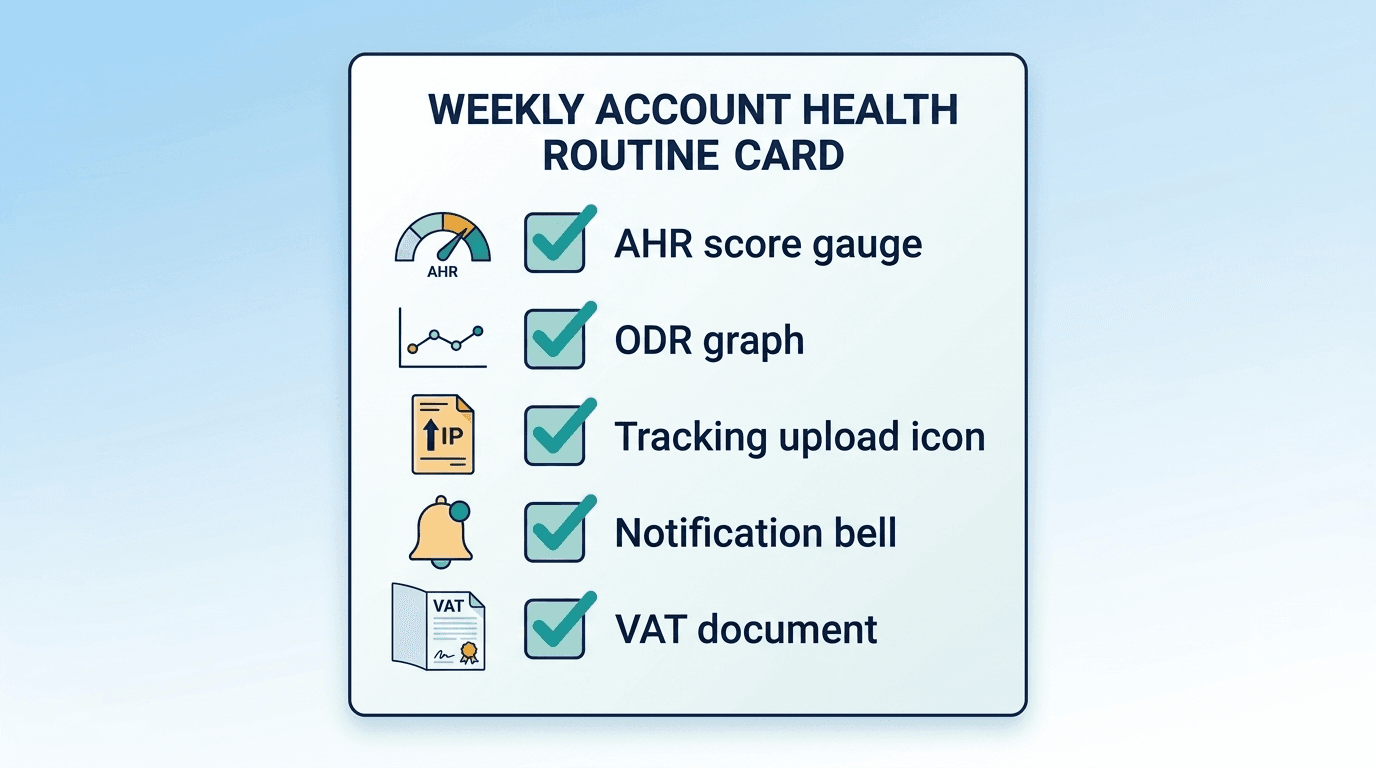
Most account health crises are preventable with a consistent weekly check that takes less time than a coffee break.
Check your AHR score; it should sit well above 200, ideally 600 or higher
Review Order Defect Rate for any sudden negative feedback clusters or new A-to-Z claims
Verify FBM tracking numbers are uploading correctly before delivery windows close
Check Performance Notifications for any unread policy warnings or violation notices
Confirm VAT registration details and business information match your current UK registration data
If any item flags a concern, act the same day. Account health issues do not resolve themselves; they compound until they become a suspension.
Managing account health, inventory sync, and compliance while trying to scale revenue is a heavy lift for any in-house team. For brands looking for complete, hands-off oversight, partnering with a dedicated Amazon Account Management Service in London
Pinnacle Growth Consulting is an Amazon SPN verified partner formally assessed by Amazon for compliance standards and marketplace expertise. For UK brands that want their account health protected as a managed function rather than an afterthought, that verification matters.
Frequently Asked Questions
Amazon Account Health is a performance and compliance measurement system that tracks how well a seller meets Amazon's standards on Amazon.co.uk. It is represented by an Account Health Rating (AHR) scored out of 1,000 in Seller Central. Scores above 200 are considered Good, 100–199 are At Risk, and below 100 are Critical with immediate deactivation risk. The score is affected by three primary performance metrics, Order Defect Rate, Late Dispatch Rate, and Pre-fulfilment Cancellation Rate, as well as policy violations.
A score of 200 or above means your account is in Good standing. For access to Account Health Assurance, which protects eligible sellers from deactivation while resolving issues, you need to maintain 250 or above for at least six consecutive months. Most well-managed UK accounts run between 600 and 1,000 with no active violations.
An At Risk account health rating means either one or more performance metrics have breached Amazon's thresholds, active policy violations are reducing your AHR score, or both. Log into Seller Central, go to Account Health, and check which specific metrics are flagged and whether any policy notifications are outstanding. Each flagged item will show the impact on your score and the steps required to resolve it.
Resolving policy violations and improving flagged performance metrics are the two levers. For policy violations, follow the resolution pathway specified in the notification, this usually involves submitting documentation, removing an affected listing, or writing a Plan of Action. For performance metrics, identify the operational root cause: late dispatch rate issues usually trace to dispatch window settings or fulfilment processes, high ODR usually traces to product quality or customer service gaps, and high cancellation rate usually traces to inventory management.
Amazon Account Health Assurance (AHA) is a programme that protects eligible sellers from account deactivation while they work to resolve account health issues, provided they engage with an Amazon account health specialist within 72 hours of notification. Eligibility requires maintaining an AHR of 250 or above for at least six consecutive months with no more than one active violation at the time of notification.
Poor account health affects sales through two primary mechanisms. First, Buy Box eligibility, sellers with At Risk or Critical AHR scores lose Buy Box priority, meaning competitors win the sale even when your price and reviews are competitive. Second, listing suppression, severe account health issues can result in individual ASINs or entire catalogues being suppressed, stopping all traffic instantly. Both effects compound over time if the underlying issues are not resolved.
Yes, in most cases. The reinstatement process requires submitting a Plan of Action (POA) via Seller Central's Performance Notifications section. The POA must specifically address the root cause of the suspension, the immediate corrective actions taken, and the systemic changes made to prevent recurrence. Amazon UK typically responds within 48–72 hours for performance-based suspensions. Working with an experienced Amazon account management agency significantly improves POA quality and reinstatement speed.