
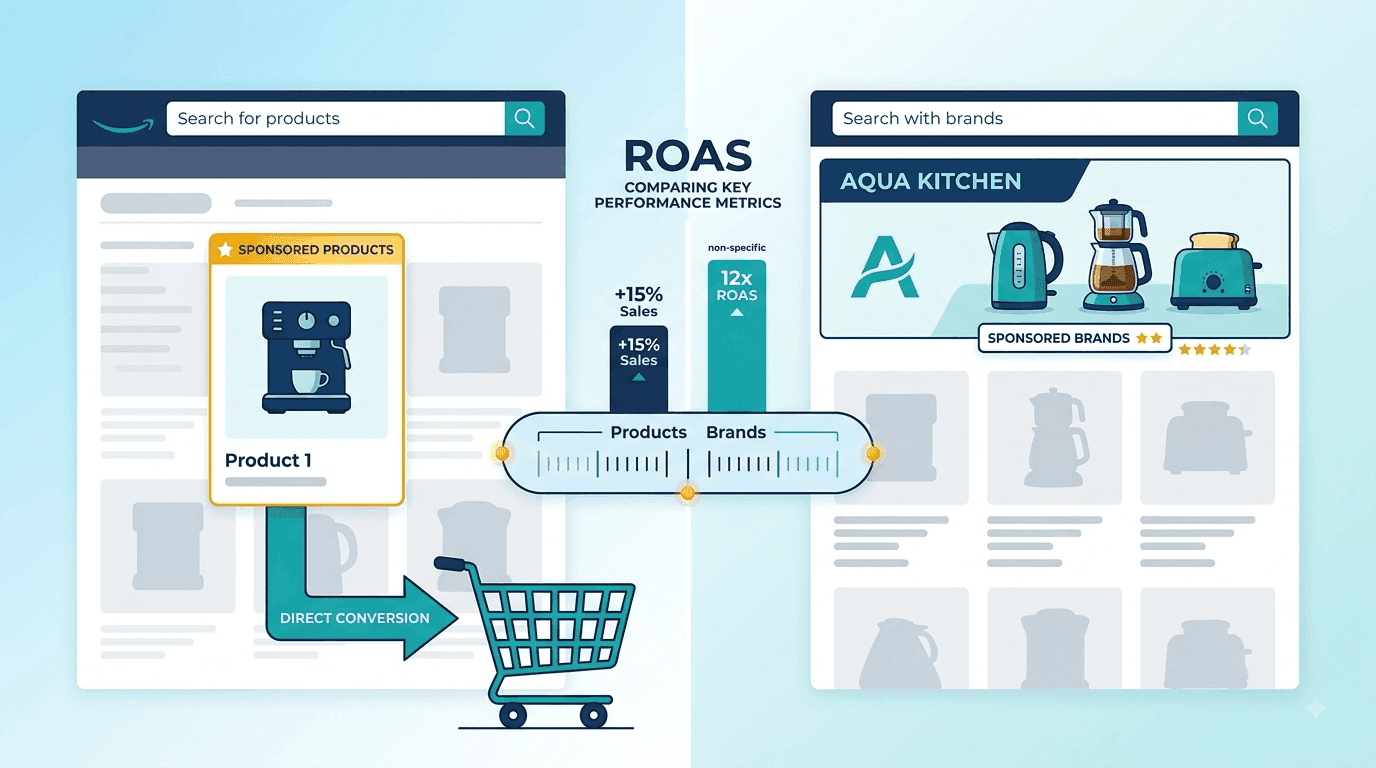
Sponsored Products vs Sponsored Brands: Which Drives Better ROAS in 2026?
Sponsored Products wins on direct ROAS. Sponsored Brands wins on brand growth and new customer acquisition. This guide covers ROAS benchmarks, when to prioritise each format, and how to split budget across both for UK Amazon brands in 2026.
Most Amazon brands running both Sponsored Products and Sponsored Brands are measuring them the same way and drawing the wrong conclusions.
Sponsored Brands looks like it underperforms. So the budget gets cut. Sponsored Products gets more. ROAS looks better on paper for a few weeks. Then organic rank softens, branded search volume drops, and Sponsored Products conversion rates quietly decline.
The two formats are not interchangeable. They serve different objectives at different funnel stages. The brands winning on Amazon UK in 2026 are not choosing one over the other. They are running both with different ROAS expectations and different success metrics for each.
This guide tells you which format serves which objective, what the data shows, and how to split the budget between them.
What Is the Difference Between Amazon Sponsored Products and Sponsored Brands?
Sponsored Products are keyword-targeted, pay-per-click ads appearing in search results and on product detail pages. They capture bottom-funnel shoppers actively searching for a specific product. Available to all sellers, no Brand Registry required. This is the highest-volume, most directly measurable Amazon ad type.
Sponsored Brands are banner ads appearing at the top of search results, showing your brand logo, a custom headline, and up to three products. Brand Registry is required. Two formats exist: the static banner and Sponsored Brands Video, an autoplay format appearing in search results with significantly higher click-through rates. Sponsored Brands can link to a brand store or a custom landing page rather than a single product listing.
The fundamental difference: Sponsored Products converts existing demand. Sponsored Brands creates and captures brand-level demand.
Which Amazon Ad Format Drives Better ROAS: Sponsored Products or Sponsored Brands?
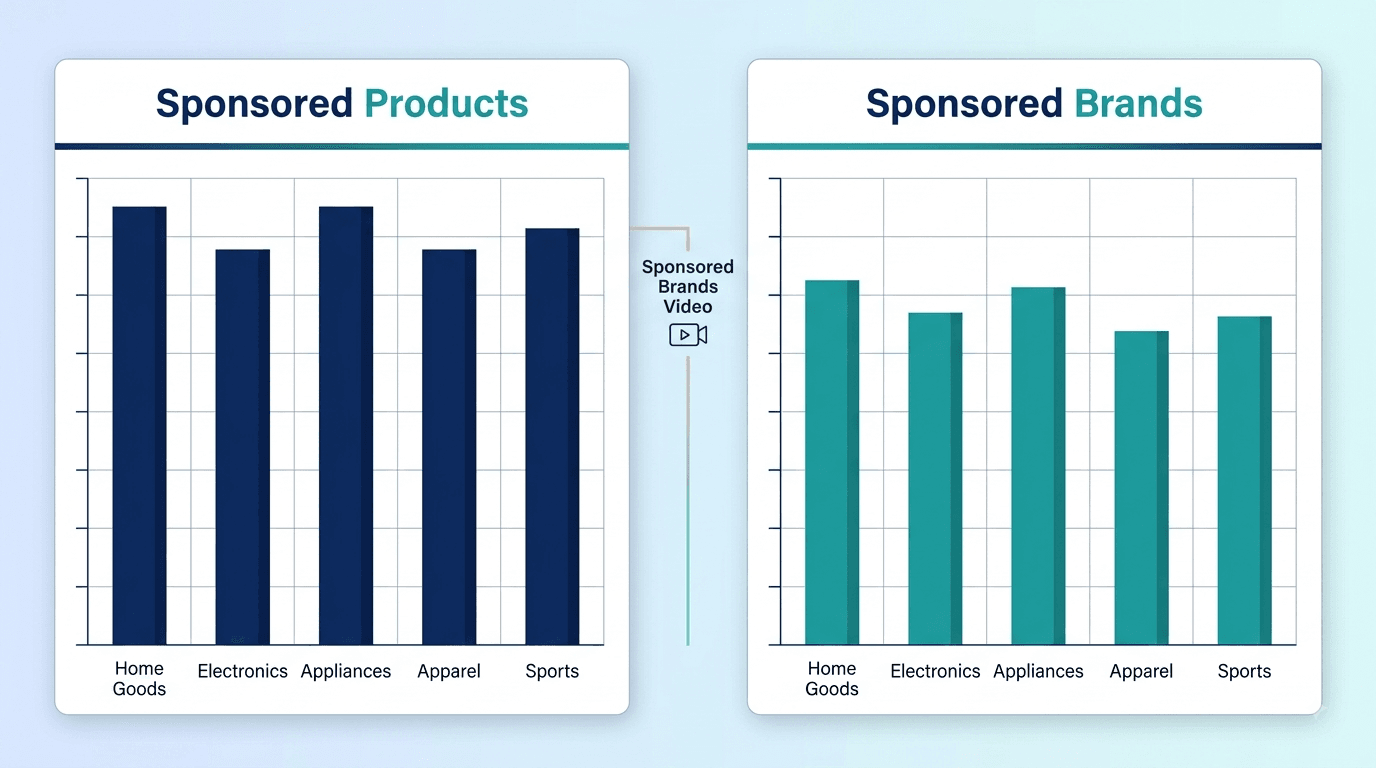
The direct answer: Sponsored Products typically drives higher direct ROAS. Sponsored Brands drives higher long-term brand value that shows up in TACoS, not direct ROAS.
Sponsored Products captures shoppers already in purchase mode. The conversion path is short: search, click, buy. That efficiency produces stronger direct return on ad spend in most categories.
Sponsored Brands operates higher in the funnel. A shopper who sees your brand banner on a category search page may not convert on that visit, but they are more likely to convert on a subsequent Sponsored Products click because they have seen the brand before. Standard ROAS reporting misses this interaction entirely.
ROAS benchmarks by format (Amazon UK, 2026):
Category | Sponsored Products ROAS | Sponsored Brands ROAS |
FMCG and consumables | 3.0 to 5.0 | 2.0 to 3.5 |
Beauty and personal care | 2.5 to 4.0 | 1.8 to 3.0 |
Health and supplements | 2.0 to 3.5 | 1.5 to 2.8 |
Electronics accessories | 2.5 to 4.0 | 1.8 to 3.0 |
Fashion and apparel | 2.0 to 3.5 | 1.5 to 2.8 |
Sponsored Brands Video is the exception. It approaches Sponsored Products ROAS in most categories while also building brand recognition. It generates 2 to 3 times higher CTR than static Sponsored Brands according to Amazon Advertising benchmarks, making it the single most underused high-performing placement on Amazon UK.
Why measuring Sponsored Brands on ROAS alone is misleading:
TACoS (total ad spend divided by total revenue including organic sales) tells a different story. Brands running consistent Sponsored Brands see increased branded keyword search volume, higher organic CTR as brand recognition grows, and improved Sponsored Products conversion rates over time. These contributions appear in TACoS, not in ROAS calculations that only credit ad-attributed sales. Brands that cut Sponsored Brands to improve headline ROAS systematically undervalue it and often see Sponsored Products performance soften in the weeks that follow.
For a complete breakdown of TACoS vs ACoS and why UK brands should track both, read our full guide on reducing Amazon ACoS.
When Should You Prioritise Sponsored Products Over Sponsored Brands?
Sponsored Products should be your primary format when:
Your goal is immediate, measurable sales. Sponsored Products converts bottom-funnel purchase intent directly. If the objective is driving orders this week, Sponsored Products is the format.
You are in a launch phase. New products need reviews and organic rank before brand awareness advertising makes economic sense. Sponsored Products builds the ranking signals and review velocity that make subsequent Sponsored Brands investment more efficient. Launch on Sponsored Products, add Sponsored Brands once you have 15 or more reviews and proven conversion rate.
Your budget is constrained. When total ad budget is limited, Sponsored Products delivers more measurable return per pound than Sponsored Brands. Every pound goes directly toward conversion rather than awareness.
You are building keyword intelligence. Sponsored Products automatic campaigns are the best source of converting search term data on Amazon. Running them first generates the keyword intelligence that informs manual campaign builds and Sponsored Brands targeting strategy. Do not skip this step.
For a complete breakdown of how to structure Sponsored Products campaigns from automatic discovery through to manual exact match, read our full guide on Amazon Sponsored Ads.
When Should You Prioritise Sponsored Brands Over Sponsored Products?
Sponsored Brands should be your primary format when:
Your goal is category ownership. Sponsored Brands banner placement appears above all Sponsored Products results at the top of a search page. No competitor can appear above your banner. When the objective is owning a category search page, Sponsored Brands is the only format that achieves this.
You need new customer acquisition. Sponsored Brands consistently generates 40 to 60% higher New to Brand order percentages than Sponsored Products in most categories. For brands prioritising customer acquisition over immediate ROAS, Sponsored Brands outperforms on the metric that matters.
You have product video content. Sponsored Brands Video generates 2 to 3 times higher CTR than static formats across most Amazon UK categories. For brands with existing product video, not running Sponsored Brands Video is leaving one of the highest-performing placements in Amazon UK's inventory unused. If you have video, activate this format immediately.
You want to defend brand search terms. Sponsored Brands prevents competitors from occupying the top of search for your branded and category keywords. Running Sponsored Brands on branded terms at moderate bids is one of the most cost-effective defensive moves available on Amazon UK. Without it, a competitor can appear above your own product listings when shoppers search your brand name.
How Should UK Brands Split Budget Between Sponsored Products and Sponsored Brands?
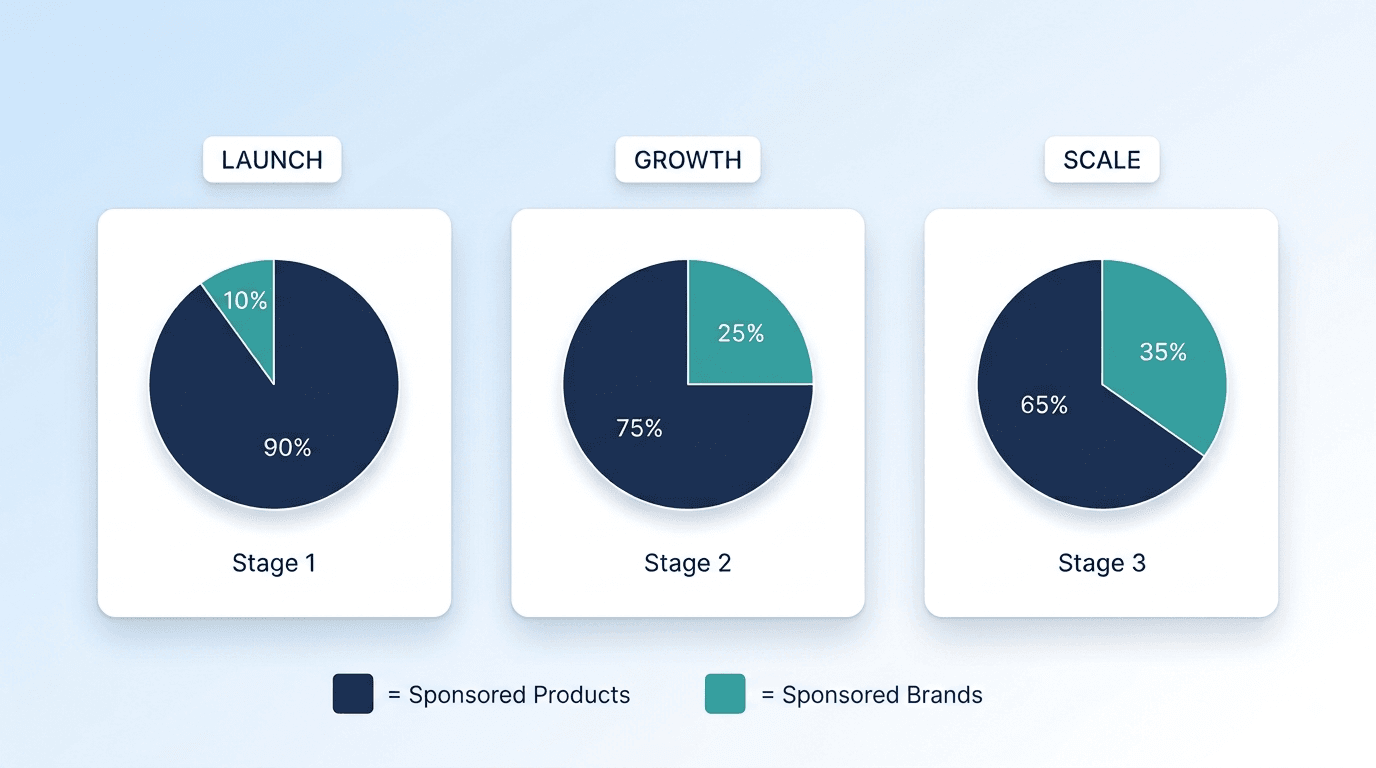
Budget allocation between the two formats should reflect your brand's maturity stage on Amazon, not a fixed universal percentage.
Launch stage (fewer than 50 reviews, under six months live):
Sponsored Products: 90 to 95% of total ad budget
Sponsored Brands: 5 to 10%, limited to brand name defensive terms only
Rationale: Build rank and reviews first. Awareness advertising on a listing with limited social proof converts poorly.
Growth stage (50 to 200 reviews, six to eighteen months live):
Sponsored Products: 75 to 80% of total ad budget
Sponsored Brands: 20 to 25%, including category keywords and Sponsored Brands Video
Rationale: Proven conversion rate justifies brand awareness investment. Sponsored Brands Video activated as a priority.
Scale stage (200 or more reviews, established organic rank):
Sponsored Products: 65 to 75% of total ad budget
Sponsored Brands: 25 to 35%, including category ownership and brand store traffic
Rationale: Strong organic foundation means Sponsored Brands investment compounds rather than subsidises. TACoS becomes the primary efficiency metric.
Q4 adjustment for Amazon UK: During October and November when UK CPCs spike 2 to 3 times across categories, increase Sponsored Brands allocation by 5 to 10 percentage points above your standard split. Owning the top of search during peak season prevents competitors from dominating high-intent category searches during the highest-revenue period of the year. The investment in Sponsored Brands banner placement is proportionally more valuable when category CPCs are elevated and conversion rates are at their seasonal peak.
How the Two Formats Work Together: The Combined Strategy That Wins
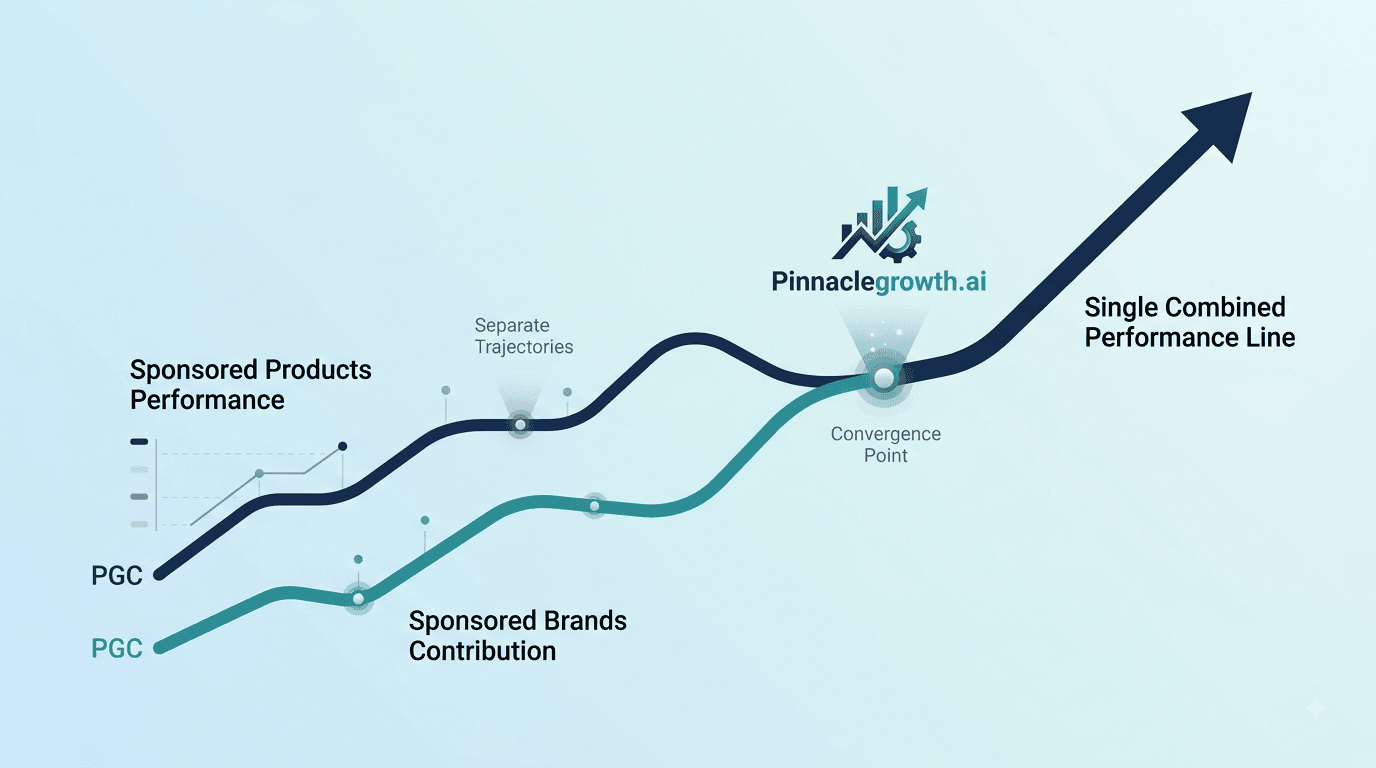
The interaction between Sponsored Products and Sponsored Brands is where the real compounding happens, and where standard reporting fails to capture it.
A shopper who sees your Sponsored Brands banner on a category search is more likely to convert on a subsequent Sponsored Products click. They have seen the brand. They recognise it. The barrier to purchase is lower. This interaction effect is visible in Amazon Marketing Cloud path-to-conversion analysis but invisible in standard ROAS reporting. For a complete breakdown of what Amazon Marketing Cloud reveals and how UK brands use it, read our full guide on Amazon Marketing Cloud.
The combined structure that consistently outperforms single-format approaches:
Sponsored Products (primary): Exact match campaigns for proven converters, phrase match for category expansion, automatic campaigns for continuous search term discovery, negative keyword management running weekly. TACoS is the governing metric.
Sponsored Brands (secondary): Category keyword banner placement, Sponsored Brands Video for CTR-led awareness, branded keyword defensive campaigns, brand store traffic for multi-product discovery.
Budget flow: Start with the maturity-stage split above, review TACoS monthly, adjust Sponsored Brands allocation upward as organic rank improves and brand search volume grows.
For UK brands managing both formats across multiple marketplaces simultaneously, continuous AI-driven optimisation removes the manual overhead of maintaining this structure at scale. For more on how AI management compares to manual across both formats, read our full guide on AI vs Manual Amazon PPC Management.
For expert management of both Sponsored Products and Sponsored Brands on Amazon UK, our Amazon PPC Agency in London and Amazon Ads Management Agency in the UK handle coordinated multi-format campaign management continuously.
How Pinnaclegrowth.ai Manages Sponsored Products and Sponsored Brands for UK Brands
Managing both formats simultaneously , with different objectives, different bid strategies, and different attribution models, across a multi-marketplace account is where manual review cycles fall apart. The weekly review that works for a single-format, single-marketplace account does not scale to coordinated Sponsored Products and Sponsored Brands management across Amazon UK, Germany, France, and beyond.
Pinnaclegrowth.ai is Pinnacle Growth Consulting's AI-powered Amazon Ads automation platform, built for exactly this. It manages Sponsored Products toward TACoS targets and Sponsored Brands toward New to Brand and brand awareness objectives simultaneously, without periodic manual reviews.
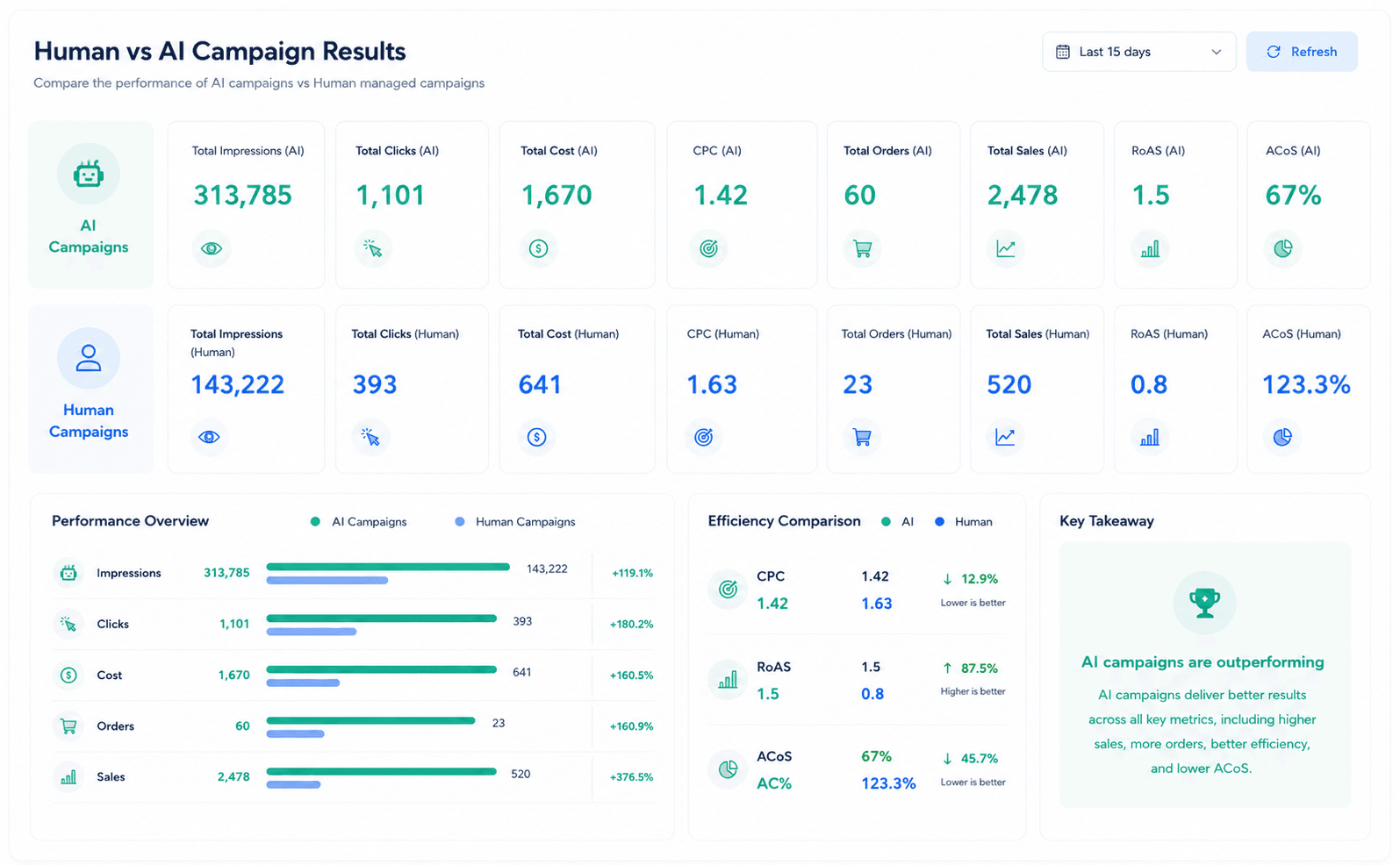
The Mocemsa account comparison over 15 days: AI-managed campaigns running alongside human-managed campaigns on the same account, same products, same marketplace:
Metric | AI Campaigns | Human Campaigns | Difference |
Impressions | 3,13,785 | 1,43,222 | +119.1% |
Clicks | 1,101 | 393 | +180.2% |
Orders | 60 | 23 | +160.9% |
Sales | Rs 2,478 | Rs 520 | +376.5% |
CPC | Rs 1.42 | Rs 1.63 | -12.9% |
ROAS | 1.5 | 0.8 | +87.5% |
ACoS | 67% | 123.3% | -45.7 percentage points |
Same account. Same products. Same marketplace. The difference was execution speed and consistency across both format types, not strategy.
Pinnacle Growth Consulting is an Amazon Ads Advanced Partner and Amazon SPN verified partner with a London presence, managing Amazon advertising for UK brands across 13 marketplaces globally. For brands that want full-stack Amazon management beyond advertising, our Amazon Account Management services in London cover listings, inventory, account health, and marketplace expansion alongside PPC.
For UK brands wanting expert management of both Sponsored Products and Sponsored Brands with AI-powered continuous optimisation:
Explore our Amazon PPC Agency services in London →
Frequently Asked Questions
Products typically drive higher direct ROAS because it captures bottom-funnel purchase intent. In most UK Amazon categories, Sponsored Products ROAS runs 15 to 30% higher than Sponsored Brands ROAS on a direct attribution basis. However, measuring Sponsored Brands purely on direct ROAS understates its contribution. It builds brand search volume and organic conversion rates that show up in TACoS rather than ad-attributed ROAS. Sponsored Brands Video is the exception, approaching Sponsored Products ROAS while also building brand recognition.
Start with Sponsored Products. New products need reviews, organic rank, and proven conversion rate before brand awareness advertising makes economic sense. Run Sponsored Products automatic campaigns first to build keyword intelligence and ranking signals. Add Sponsored Brands once you have at least 15 reviews and a demonstrated conversion rate on the listing.
Brands Video is an autoplay video format appearing directly in Amazon search results. It generates 2 to 3 times higher CTR than static Sponsored Brands formats according to Amazon Advertising benchmarks, and approaches Sponsored Products ROAS in many categories while also building brand recognition. For UK brands that have product video content, not running Sponsored Brands Video is one of the most common missed opportunities in Amazon UK advertising.
The split depends on your brand's maturity stage. At launch, 90 to 95% Sponsored Products and 5 to 10% Sponsored Brands. At growth stage, 75 to 80% Sponsored Products and 20 to 25% Sponsored Brands. At scale, 65 to 75% Sponsored Products and 25 to 35% Sponsored Brands. During UK Q4, increase Sponsored Brands allocation by 5 to 10 percentage points above your standard split to defend top-of-search placement during peak-season CPC spikes.
Yes. Sponsored Brands is available only to brand-registered sellers. Brand Registry on Amazon UK requires a registered trademark in the UK. Post-Brexit, Amazon UK and Amazon EU Brand Registry are separate. A UK Brand Registry does not automatically extend to EU marketplaces. UK brands expanding to Amazon DE, FR, or ES need separate EU trademark registration for Sponsored Brands on those marketplaces.
Sponsored Brands exposure increases the probability that a subsequent Sponsored Products click converts. Shoppers who have seen your brand banner are more likely to buy when they encounter your product in search results. This interaction effect is visible in Amazon Marketing Cloud path-to-conversion analysis but invisible in standard ROAS reporting. Brands that cut Sponsored Brands to improve headline ROAS often see Sponsored Products conversion rates decline in the following weeks as the brand awareness effect wears off. The strongest Amazon advertising strategies run both formats in a coordinated structure with separate objectives and budget allocations.