
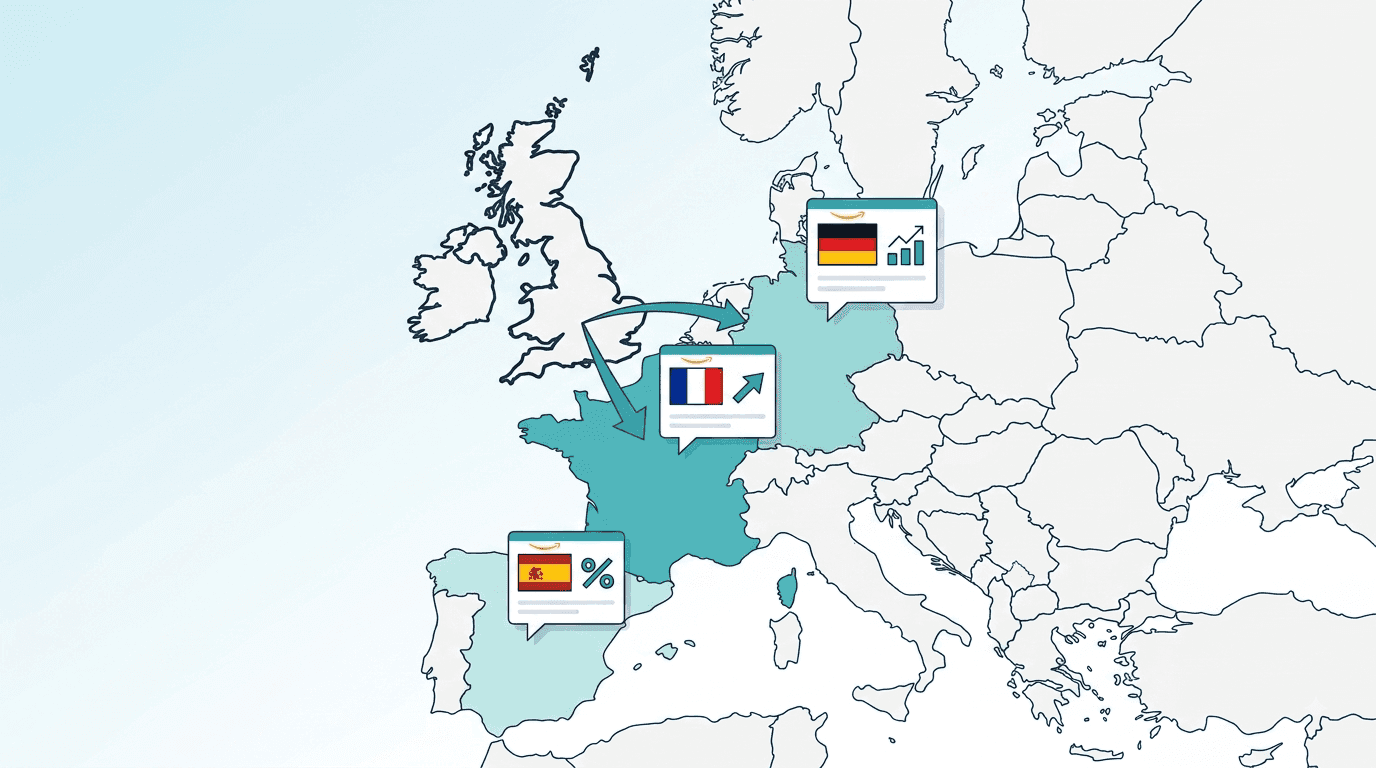
How to Expand from Amazon UK to EU Marketplaces: A Step-by-Step Guide
Expanding from Amazon UK to EU requires separate VAT registrations, an EU EORI number, GPSR compliance, and EU-specific FBA setup. This step-by-step guide covers everything UK brands need before their first EU shipment.
Amazon EU is not a natural extension of Amazon UK. Post-Brexit, it is a separate system with separate compliance requirements, separate FBA infrastructure, separate VAT obligations, and separate consumer behaviour patterns.
That complexity is also what makes it an opportunity. Most UK brands have not made the move yet, meaning category competition on Amazon DE, FR, and ES is often significantly lower than on Amazon UK, and the consumer base is substantially larger.
This guide covers exactly what EU expansion from Amazon UK involves in 2026: step by step, compliance requirement by compliance requirement, so you can plan and execute it properly rather than discovering the hard parts after your first shipment crosses the Channel.
For UK brands that want expert support managing the full expansion process, our Amazon Marketplace Management Agency for UK brands covers everything from compliance coordination to multi-marketplace campaign management.
Why UK Brands Are Expanding to Amazon EU Marketplaces in 2026
Three factors are driving UK brands toward EU Amazon expansion right now.
Amazon Germany Alone Is the World's Second Largest Marketplace:
Amazon Germany is the second-largest Amazon marketplace in the world after the US. Amazon France and Amazon Spain together add tens of millions of additional active shoppers. For a UK brand that has reached meaningful penetration on Amazon UK, EU expansion is the most direct path to the next significant revenue layer.
For a complete breakdown of what a scaled Amazon UK presence looks like before expanding further, read our full guide on how to scale on Amazon UK.
The Categories Saturated on Amazon UK Are Wide Open on Amazon EU:
Many categories that are saturated on Amazon UK, including beauty, supplements, home and kitchen, and sports and outdoors, have materially fewer competing listings on Amazon DE, FR, and ES. Brands that were tenth on page one of Amazon UK search results are frequently in the top three on the equivalent EU marketplace search. The organic ranking opportunity is disproportionately large relative to the effort of expansion.
Selling in EUR Reduces Your Dependence on a Single Currency and a Single Marketplace:
Selling across GBP and EUR provides natural currency hedging, a structural benefit that has become increasingly relevant since Brexit-related sterling volatility. EUR revenue also diversifies the risk concentration of operating exclusively on a single marketplace in a single currency.
The Three Priority EU Amazon Marketplaces for UK Brands
Amazon Germany (amazon.de): The Largest and Most Demanding
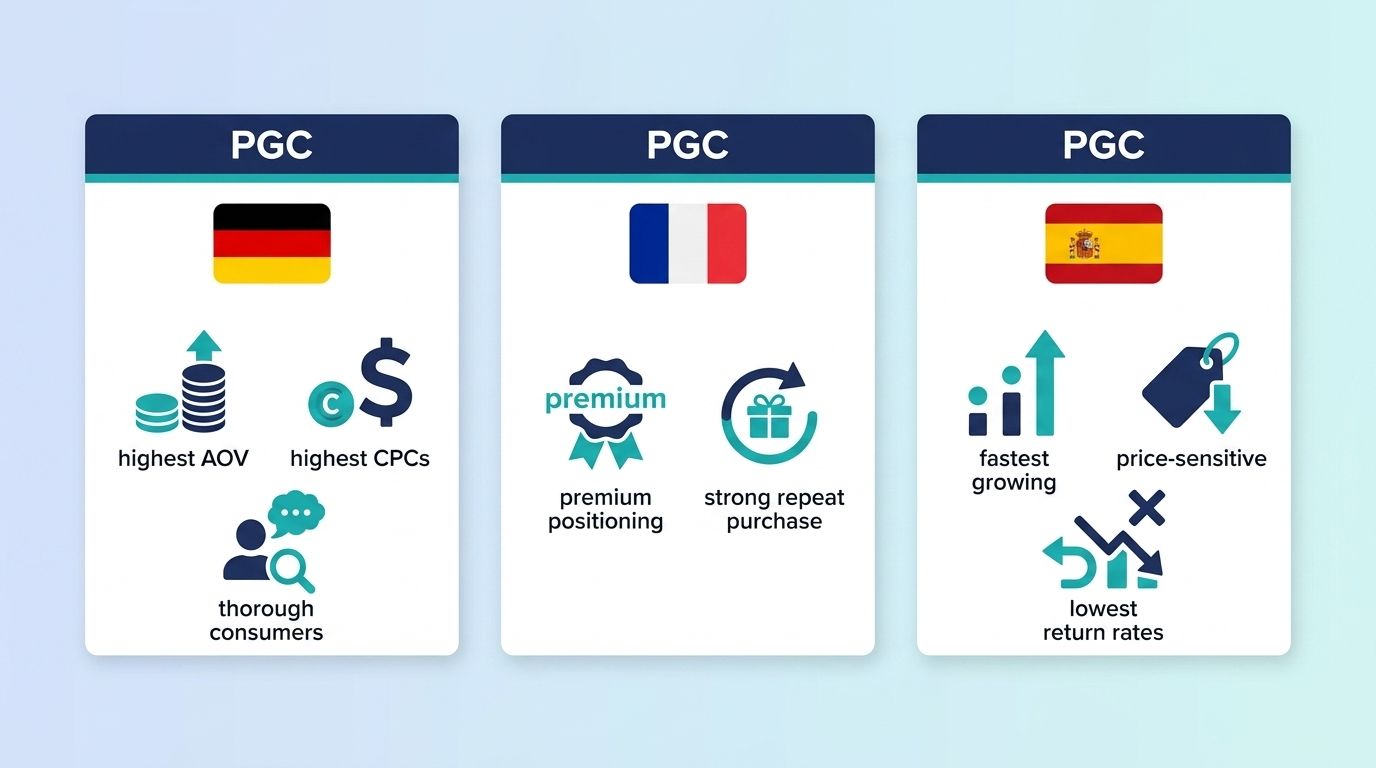
Germany is the highest-priority EU marketplace for most UK brands expanding to Europe. It has the largest consumer base, the highest average order values, and the strongest organic ranking opportunity.
What UK brands need to know about German consumers: German shoppers are thorough. They read product descriptions in full, compare listings carefully, and have low tolerance for poor translation or vague product information. Listings need to be detailed, technically accurate, and in natural German, not machine-translated English.
Return rates in Germany are the highest in the EU. German consumers frequently order multiple variants to compare and return the rest. This affects your FBA inventory planning, your effective margin calculations, and your ACoS targets significantly. Factor a higher return rate into unit economics before setting pricing or advertising targets.
VAT: The German VAT standard rate is 19%. VAT registration is mandatory before storing inventory in German FBA warehouses or exceeding the German distance selling threshold.
Compliance specifics: WEEE registration is required for electronics. German packaging regulations require specific labelling and recycling information. CE marking, which is the EU's mandatory product safety certification, indicated by the CE symbol on applicable products, must be current and correctly documented for applicable product categories.
Amazon France (amazon.fr): What UK Brands Need to Know Before Selling
France is the second-priority EU marketplace. French consumers skew toward premium products and have strong brand loyalty once trust is established, making it an excellent market for brands with a clear quality or provenance story.
What UK brands need to know about French consumers: French shoppers convert at lower initial rates than German or Spanish shoppers but have strong repeat purchase behaviour. Getting the first sale right, through listing quality, delivery speed, and product experience, pays dividends in repeat orders. French consumers are brand-aware and respond well to brand store content and A+ Content that tells a coherent brand story.
VAT: The French VAT standard rate is 20%. VAT registration required before selling into France via FBA.
Compliance specifics: France has specific environmental regulations including DEEE registration (the French equivalent of WEEE for electronics) and eco-participation fees on packaging for certain product categories. French product traceability requirements apply to food and certain consumer goods.
Amazon Spain (amazon.es): The Fastest Growing EU Marketplace for UK Brands
Spain is the third priority EU marketplace, and one of the fastest-growing Amazon markets in Europe. Spanish consumers are more price-sensitive than German or French shoppers, which affects pricing strategy, but return rates are significantly lower than in Germany, which improves effective margin.
What UK brands need to know about Spanish consumers: Mobile-first purchasing is more pronounced in Spain than in other EU markets. Strong seasonal buying patterns around January sales and summer periods create predictable demand spikes worth planning campaigns around. Competitive pricing is a stronger conversion driver here than detailed technical specifications.
VAT: Spanish VAT standard rate is 21%. VAT registration required.
Compliance specifics: Spain follows EU-wide product regulations without many additional national requirements, making it generally the most straightforward of the three for compliance. A good market to use as a validation test before committing to full Pan-European Fulfilment by Amazon(Pan-EU FBA).
The 7-Step Process: How to Expand from Amazon UK to EU Marketplaces
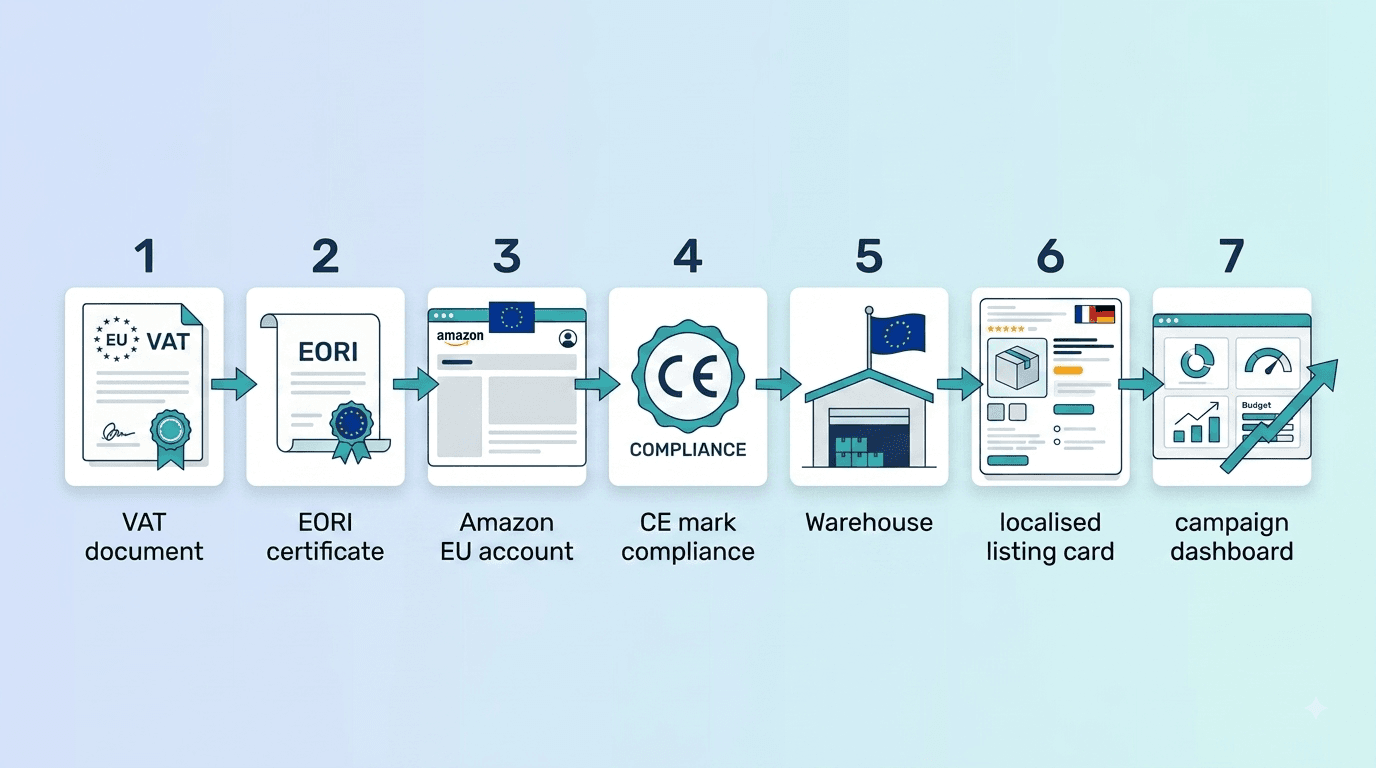
Step 1: Register for VAT in Each EU Country You Plan to Sell In
VAT registration is the first and most time-consuming step. It must be completed before any inventory enters an EU FBA warehouse or any sales are made above the local distance selling threshold.
Post-Brexit, UK businesses cannot use the EU's One Stop Shop (OSS) scheme, which is available only to EU-established businesses. UK brands must register for VAT individually in each EU country where they store FBA inventory or sell above the local threshold. Expanding to Germany, France, and Spain simultaneously means three separate VAT registrations.
Practical timelines to plan around:
Germany: four to six weeks
France: six to eight weeks
Spain: eight to twelve weeks (allow extra time)
The EU's Import One Stop Shop (IOSS) is relevant for UK brands shipping goods valued below €150 directly to EU consumers from the UK rather than from EU FBA warehouses. IOSS registration simplifies VAT on these lower-value imports.
Start VAT registration before any other step. Everything else depends on having the registration numbers in place.
For UK brands already familiar with cross-border compliance from selling on Amazon UAE, many of the same documentation principles apply to EU expansion. For a refresher on cross-border compliance fundamentals, read our full guide on selling on Amazon UAE from India.
Step 2: Get Your EU Import Registration Number
An Economic Operators Registration and Identification (EORI) number is required for any UK business importing goods into the EU. Your UK EORI number is not valid for EU customs procedures post-Brexit. You need a separate EU EORI number.
EU EORI numbers are issued by the customs authority of any EU member state. Most UK brands expanding to Germany register their EU EORI through German customs (Zoll) since Germany is the primary FBA inventory location. This can be done in parallel with VAT registration.
Without an EU EORI number, your inventory cannot clear EU customs. This is the step most UK brands discover they missed only when a shipment is held at the border.
Step 3: Set Up a Separate European Amazon Seller Central Account
Amazon EU operates on a unified European account: a single Seller Central account managing listings across Germany, France, Spain, Italy, the Netherlands, and other EU marketplaces. This is completely separate from your Amazon UK Seller Central account. Your UK performance history, reviews, and rankings do not transfer.
What you need to register:
Business registration documents
Valid EU EORI number
EU VAT registration number (at least one EU country)
Bank account for EUR payouts
Product compliance documentation
Once registered, your European account lets you list once and syndicate across all EU marketplaces. Listing content still needs to be localised for each language. Syndication handles distribution, not translation.
Setting up and managing a European Seller Central account alongside your existing Amazon UK account is one of the areas where working with an experienced Amazon Account Management agency in London saves significant time and prevents early structural mistakes.
Step 4: What EU Compliance Rules Apply to Your Products
This is the step that catches the most UK brands off guard. UKCA marking (UK's own product safety certification after Brexit) replaced CE marking for products sold in the UK. But for EU marketplaces, CE marking is still required for applicable product categories, and the two are not interchangeable.
Product categories requiring CE marking for EU sales include: electronics and electrical equipment, toys, medical devices, personal protective equipment, and machinery. If your products carry UKCA marking for UK sales, verify that CE marking documentation is current and correctly in place before listing on EU marketplaces.
The EU General Product Safety Regulation (GPSR) came into full effect in December 2024. It requires all products sold to EU consumers to have a responsible person established within the EU. For UK brands without an EU entity, this means appointing an EU-based responsible person: an importer, distributor, or authorised representative physically located in an EU member state. Selling on EU Amazon marketplaces without a correctly appointed EU responsible person puts your listings at risk of removal.
For a complete breakdown of how Amazon account health works and how compliance issues affect selling privileges, read our full guide on Amazon account health for UK sellers.
Step 5: How to Store and Fulfil Your Inventory Across EU Markets
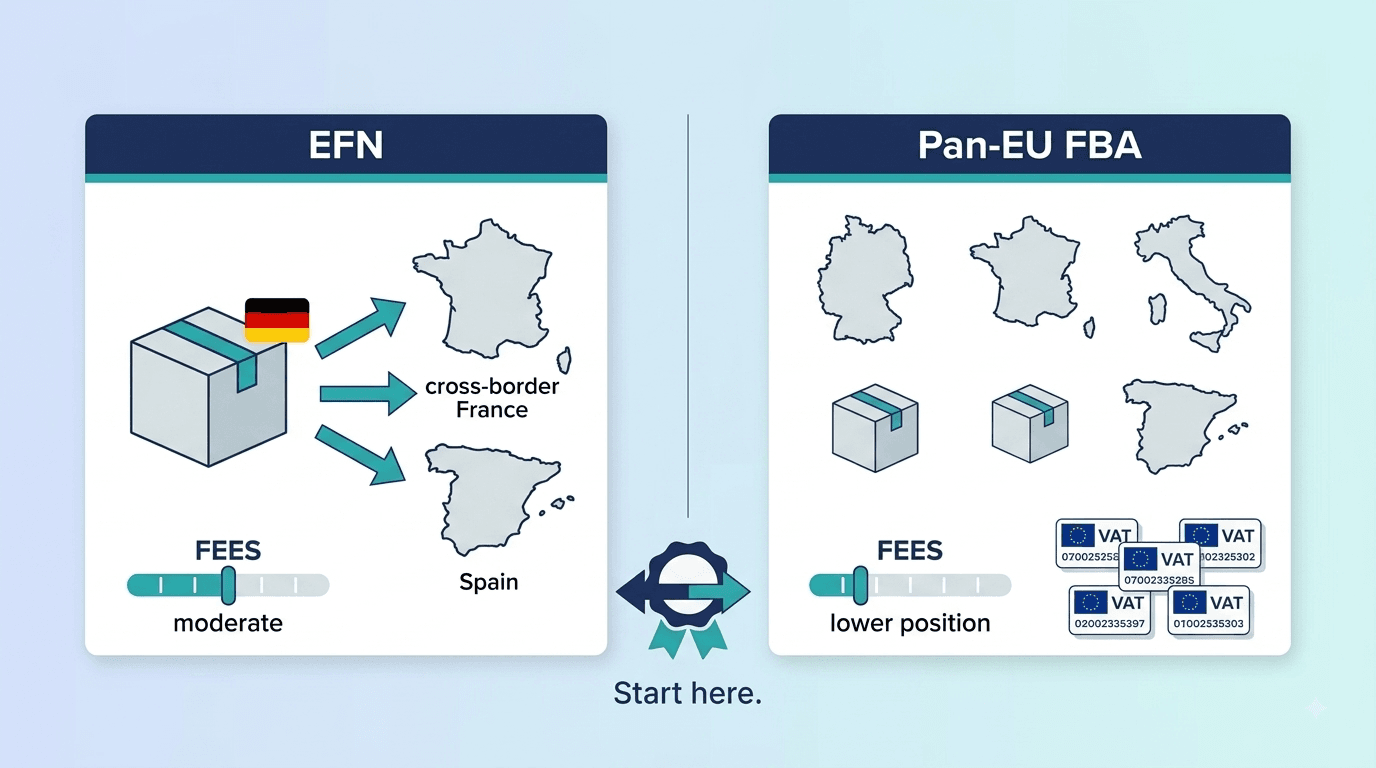
Post-Brexit, UK FBA and EU FBA are entirely separate systems. UK inventory in Amazon's UK warehouses cannot fulfil EU orders. EU expansion requires separate inventory shipped to Amazon's EU fulfillment network.
Two structural options:
European Fulfilment Network (EFN): Ship inventory to one EU country's FBA warehouse, typically Germany, and Amazon fulfils cross-border EU orders from that location. Higher per-order fulfilment fees than Pan-European FBA, but requires VAT registration only in the country where inventory is stored. Lower compliance burden. The right starting structure for most UK brands testing EU demand.
Pan-European FBA (Pan-EU FBA): Enrol ASINs (Amazon Standard Identification Number) in Pan-EU FBA and Amazon distributes inventory across its EU warehouse network automatically, covering Germany, France, Spain, Poland, and others. Lower fulfilment fees per order than EFN, but requires VAT registration in all countries where Amazon may store your inventory, typically five or more EU countries simultaneously.
The recommended approach for UK brands: Start with EFN using Germany as the primary inventory location. Validate which EU marketplaces generate meaningful demand and at what margin. Once volume justifies the additional VAT registrations, transition to Pan-EU FBA to reduce per-unit fulfilment costs.
Step 6: Localise Your Product Listings for Each EU Market
Translating UK English listings into German, French, and Spanish is not optional. It is a conversion requirement. Machine-translated listings are immediately identifiable to native speakers and convert significantly below professionally localised equivalents.
For each market, localisation covers:
Product title and bullet points: Translated and rewritten for natural reading in the target language, not a word-for-word conversion of the UK English original
Product description and A+ Content: Localised with market-specific benefit framing, not translated brand store copy
Backend keywords: In the local language. German shoppers search in German; French shoppers search in French. English backend keywords do not surface listings for local-language searches
Images: Any UK-specific visual references, including Royal Mail imagery, UK plug sockets, UKCA regulatory marks, and UK pricing in GBP, should be updated for EU audiences
German listings in particular benefit from greater technical detail than UK listings. German consumers expect specificity: dimensions, materials, certifications, compatibility, stated clearly rather than implied.
Step 7: Set Up Amazon Advertising Campaigns for Each EU Marketplace
Amazon advertising on EU marketplaces is managed through a separate EU advertising account linked to your European Seller Central. UK campaigns do not transfer to EU marketplaces. Each marketplace requires its own campaigns with local-language keywords and market-calibrated bids.
CPC benchmarks by EU market:
Amazon Germany: highest CPCs of the three markets, but also highest average order values and conversion rates
Amazon France: mid-range CPCs, strong ROAS potential for premium-positioned products
Amazon Spain: lowest CPCs of the three, lower average order values but lower return rates
Setting the right ACoS targets for each EU market requires knowing your break-even ACoS per product. For a complete breakdown of how to calculate break-even ACoS and reduce wasted ad spend, read our full guide on Amazon ACoS optimisation.
Start with Sponsored Products only in each market. Use automatic campaigns to discover which local-language search terms convert before building manual exact match campaigns from proven terms. The same auto-to-manual graduation flow that works on Amazon UK applies on EU marketplaces, with the additional requirement that search term reports will surface queries in the local language. For a complete breakdown of Amazon Sponsored Ads campaign structure and match types, read our full guide on Amazon Sponsored Ads.
For brands managing campaigns across three EU marketplaces simultaneously alongside Amazon UK, continuous AI-driven optimisation becomes significantly more valuable than manual weekly reviews. The volume of campaigns, keywords, and search terms across four marketplaces simultaneously exceeds what any manual review cycle can manage efficiently.
For expert multi-marketplace PPC management, our Amazon PPC Agency in London and Amazon Ads Management Agency in the UK handle campaign architecture, keyword localisation, and continuous bid optimisation across all active marketplaces.
For more on how AI-driven Amazon PPC management compares to manual management across multiple marketplaces, read our full guide on AI vs Manual Amazon PPC Management.
Common Mistakes UK Brands Make When Expanding to Amazon EU
Underestimating VAT registration timelines. Three separate VAT registrations across Germany, France, and Spain can take three to four months in total. Brands that start this process late delay their entire launch timeline. Start VAT registration before any other step.
Launching with machine-translated listings. Google Translate produces listings that native speakers recognise immediately as non-native. Conversion rates on machine-translated listings are materially lower than professionally localised equivalents. Budget for professional translation as a launch cost, not an optional upgrade.
Choosing Pan-European FBA before validating demand. Pan-EU FBA requires VAT registrations across five or more European countries simultaneously, a significant compliance commitment before knowing whether EU demand justifies it. Start with EFN, validate, then transition.
Ignoring the General Product Safety Regulation (GPSR). The EU General Product Safety Regulation came into force in December 2024. UK brands without a correctly appointed EU responsible person are at risk of listing removal across all EU marketplaces. This is not a legacy requirement. It is actively enforced.
Copying UK pricing directly into EUR. EUR pricing needs to reflect EU market competitive dynamics, not GBP converted at the current exchange rate. German consumers in particular expect detailed product information alongside competitive pricing. Neither UK-calibrated pricing nor UK-calibrated listing depth translates directly.
Treating the EU as one market. Germany, France, and Spain have meaningfully different consumer behaviours, return rate profiles, and CPC benchmarks. A strategy that works on Amazon DE does not automatically work on Amazon ES. Each marketplace warrants its own pricing, listing, and advertising approach.
Avoiding these mistakes is significantly easier with an experienced partner managing the expansion. Our Amazon Marketplace Management Agency for UK brands covers the full process from compliance through to live multi-marketplace management.
How Pinnacle Growth Consulting Manages EU Marketplace Expansion for UK Brands
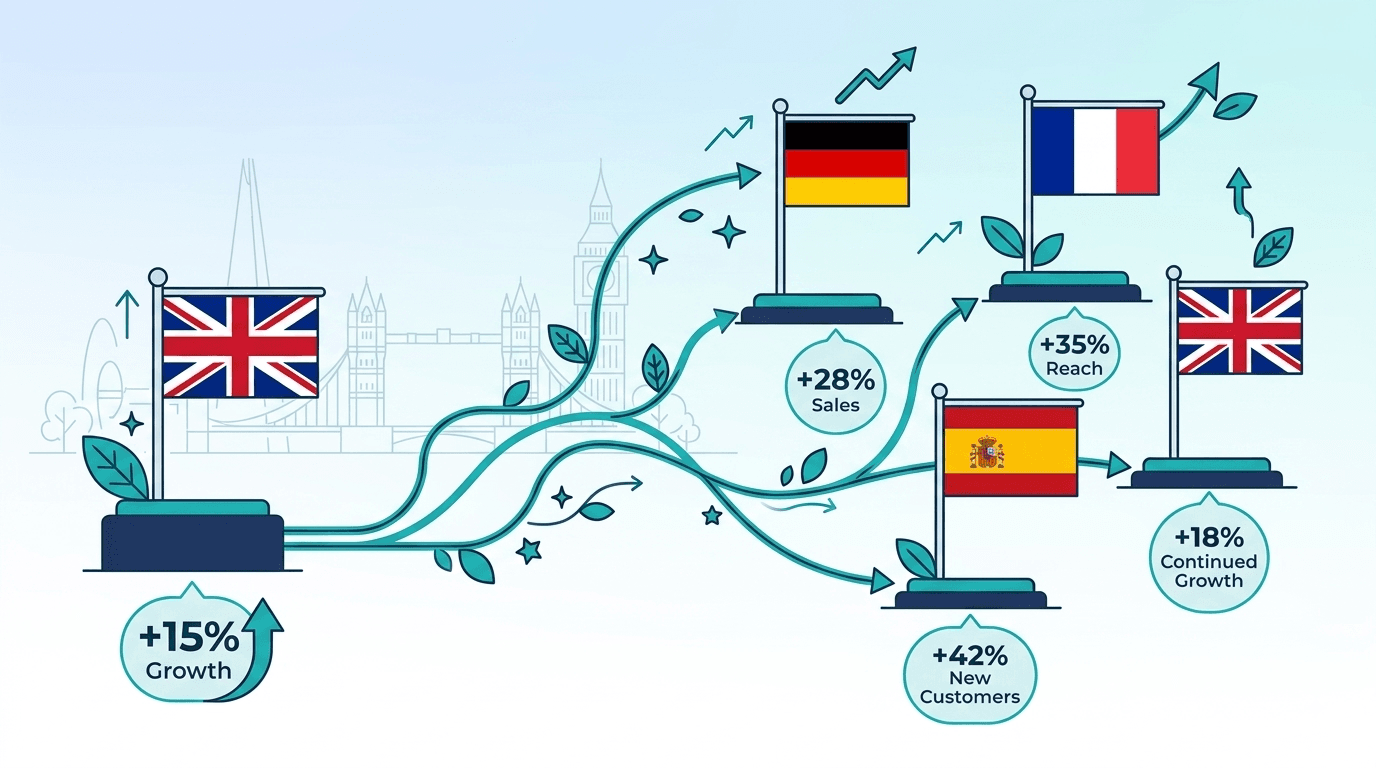
Understanding the EU expansion process is one thing. Executing VAT registrations across three countries, obtaining an EU EORI, navigating GPSR responsible person requirements, localising listings in three languages, setting up EU FBA, and managing PPC campaigns across four marketplaces simultaneously is another.
Pinnacle Growth Consulting is an Amazon SPN verified partner and Amazon Ads Advanced Partner with a London presence, managing brands across 13 Amazon marketplaces globally, including Amazon UK, Germany, France, Spain, and nine other markets. For UK brands expanding to the EU, we manage the full process: compliance coordination, listing localisation, FBA setup, and multi-marketplace campaign management through Pinnaclegrowth.ai, our AI-powered ads automation platform running continuous optimisation across all active marketplaces simultaneously.
For brands that want to expand to EU Amazon marketplaces without building the compliance and operational infrastructure from scratch:
Explore our Amazon Marketplace Management services for UK brands →
Frequently Asked Questions
Yes. UK brands can sell on Amazon EU marketplaces including Germany, France, and Spain. Brexit changed the operational requirements. UK sellers now need EU VAT registrations, an EU EORI number, CE marking compliance (not UKCA), and an EU-established responsible person under GPSR. The marketplaces themselves remain fully accessible to UK businesses.
Amazon UK (amazon.co.uk) and Amazon EU operate on completely separate Seller Central accounts. Your UK account, performance history, reviews, and FBA inventory are entirely separate from your European account. Amazon EU operates as a unified account covering Germany, France, Spain, Italy, the Netherlands, and other EU marketplaces from one Seller Central login.
UK brands must register for VAT in each EU country where they store FBA inventory or exceed the local distance selling threshold. The EU One Stop Shop (OSS) scheme is not available to UK businesses post-Brexit. For most UK brands expanding to Germany, France, and Spain simultaneously, this means three separate VAT registrations. If using Pan-EU FBA, VAT registrations across five or more EU countries are typically required.3
Pan-European FBA allows Amazon to distribute your inventory across its EU warehouse network automatically, covering multiple EU countries from a single inbound shipment. It reduces per-order fulfilment fees but requires VAT registration in all countries where Amazon may store your inventory, typically five or more simultaneously. Most UK brands starting EU expansion should begin with the European Fulfilment Network (EFN) using Germany as the primary warehouse location, validate EU demand, and transition to Pan-EU FBA once volume justifies the additional VAT registrations.
The EU GPSR came into full effect in December 2024. It requires all products sold to EU consumers to have a responsible person physically established within the EU: an importer, distributor, or authorised representative. UK brands without an EU entity must appoint an EU-based responsible person before selling on EU Amazon marketplaces. Non-compliance risks listing removal across all EU marketplaces.
For most UK brands, Amazon Germany is the highest-priority first market. It is the largest EU Amazon marketplace, has the highest average order values, and offers significant organic ranking opportunities for brands that are competitive on Amazon UK. Amazon France and Amazon Spain are typically the second and third priority markets, added once German market operations are stable.
The timeline is driven primarily by VAT registration, which takes three to four months for simultaneous registrations across Germany, France, and Spain. EU EORI registration, GPSR responsible person appointment, listing localisation, and FBA setup can run in parallel with VAT registration. A realistic timeline from the start of the process to first EU sales is four to six months, assuming no compliance complications.