
How AI Is Changing Amazon Advertising for Indian Sellers in 2026
What AI performance marketing actually does in Amazon advertising, what it cannot replace, and real account data showing the performance gap.
Amazon advertising in India is not the same game it was three years ago.
CPCs (cost per click) in competitive categories have risen 40–60% since 2022. The number of brand-registered sellers on Amazon India has crossed 1.2 lakh. Category competition in beauty, supplements, electronics, apparel, and home has intensified to a point where the margin for operational error is thin.
The manual playbook, weekly campaign reviews, batch keyword audits, periodic bid adjustments, was built for a slower environment. Amazon's auction moves by the minute. Human review cycles move by the week. The gap between those two timescales is where margin goes.
AI did not enter Amazon advertising as a feature. It entered as a structural response to a speed problem that manual management can no longer solve.
Why Manual Amazon Advertising Is No Longer Enough for Indian Sellers
A capable team reviewing campaigns weekly is still working with data that is seven days old. In that week, search terms that stopped converting continued to receive budget. Bids that were overpaying continued to overpay. A budget that should have been shifted to a better-performing campaign continued to fund an underperforming one.
These are small, continuous leaks, and they compound. An account with a 20% keyword waste rate, flat bids across non-uniform conversion windows, and no budget reallocation between campaigns is not a badly managed account by conventional standards. It is just an account that is slower than the market it operates in.
For Indian sellers specifically, the stakes are higher than aggregate numbers suggest. COD orders run 50–65% of total orders across many categories. RTO rates in fashion average 20–30%. Every rejected delivery means the ad spend that generated that click is gone with no revenue to show for it. Real effective ACoS is routinely 5–8 points higher than the dashboard shows, and a weekly review cycle catches this a week too late.
What AI Actually Does in Amazon Advertising, Not the Buzzword Version

AI in Amazon advertising has become a phrase that covers everything from basic rule-based automation to genuine machine learning. Here is what it actually means when it works properly.
Bid optimisation at keyword level, continuously. Traditional bid management reviews performance weekly and adjusts bids based on last week's data. AI bid optimisation recalculates bids continuously based on real-time conversion signals, hour of day, placement performance, search term quality, day of week, without anyone needing to log in.
Keyword harvesting from live search data. AI systems scan Amazon's live search results continuously, identify new converting search terms not yet in the campaign, and add them automatically. A human team doing this manually pulls search term reports weekly, identifies opportunities, cross-references current keyword lists, and adds them in batches. By the time that cycle runs, the opportunity window may have already closed.
Negative keyword filtering, continuously. New irrelevant search terms enter campaigns every day through Amazon's matching behaviour. AI systems identify zero-purchase, high-spend queries and exclude them as they appear, not after a monthly audit. The gap between waste appearing and waste being eliminated goes from weeks to hours.
Budget reallocation, automatically. AI monitors campaign performance continuously and shifts budget from underperforming campaigns to overperforming ones without manual intervention. A human team does this during a weekly review by which time the underperforming campaign has already consumed budget it should not have.
Dayparting, automatically. Bids adjust by hour and day of week based on conversion patterns, concentrating spend in high-converting windows and pulling back during low-converting periods. For most Indian categories, the 7–10pm window converts 2–3x better than overnight. Manual dayparting requires adjusting bids at specific times throughout the day, every day, operationally impossible to sustain consistently at scale.
ACoS training over time. AI systems learn a product's ACoS history and train bid logic to converge on a target profitability level faster over time. Each week the system gets more precise about that specific product in that specific category, something no weekly human review cycle can replicate at the same granularity or speed.
The Performance Gap Between AI-Managed and Human-Managed Amazon Campaigns
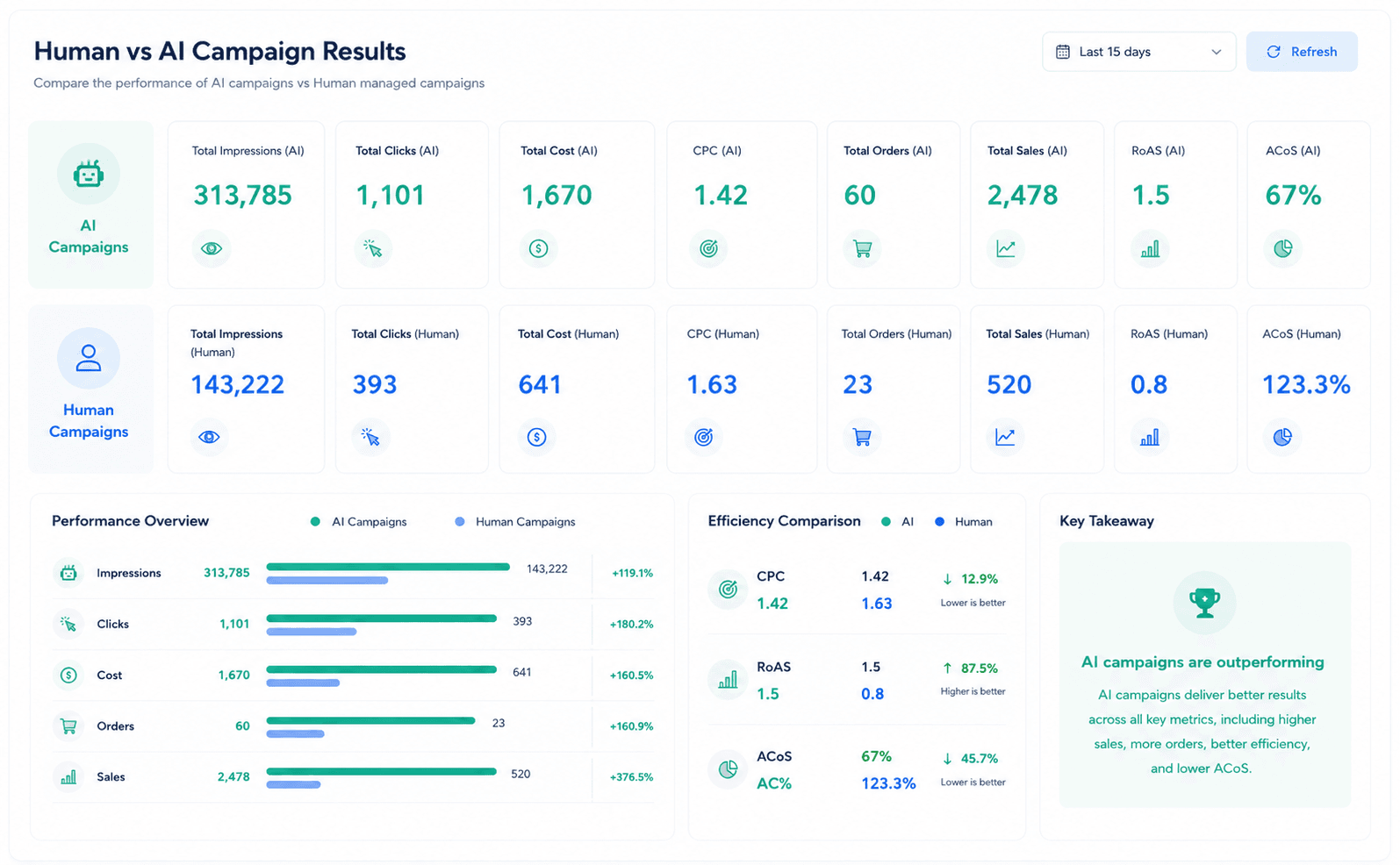
Claims about AI performance are common. Account-level data is less common.
Here is a 15-day comparison from a live account on Pinnaclegrowth.ai, showing AI-managed campaigns against human-managed campaigns running in parallel on the same account, same products, same time window.
Metric | AI Campaigns | Human Campaigns | Difference |
Impressions | 3,13,785 | 1,43,222 | +119.1% |
Clicks | 1,101 | 393 | +180.2% |
Orders | 60 | 23 | +160.9% |
Sales | Rs 2,478 | Rs 520 | +376.5% |
CPC | Rs 1.42 | Rs 1.63 | -12.9% |
ROAS | 1.5 | 0.8 | +87.5% |
ACoS | 67% | 123.3% | -45.7 percentage points |
The AI-managed campaigns generated more than four times the sales at a lower cost per click and a dramatically lower ACoS. The difference was not strategy, both sets of campaigns were running on the same account with the same products. The difference was execution speed and continuous optimisation.
This is what closing the gap between Amazon's signal and your account's response actually produces in numbers.
What AI Cannot Replace in Amazon Advertising

Credibility requires honesty. AI in Amazon advertising has genuine limits that are worth understanding before making any platform or partner decision.
Strategy and brand positioning. AI optimises within a campaign architecture. It does not decide which categories to enter, which products to lead with, or how to position a brand against competitors with different pricing and trust signals. These are human judgment calls that require category knowledge and business context.
Listing quality. AI can optimise traffic to a listing. It cannot fix a weak main image, thin bullet points, or a 3.2-star rating. If the listing does not convert, AI sends more traffic to a broken page, efficiently. The conversion foundation has to be built by people who understand what makes a listing perform.
Category intelligence. AI reads signals within your account. It does not read competitor launch strategies, seasonal demand shifts outside your current catalogue, or emerging category opportunities. A human account manager with category depth sees things the data alone does not surface.
Account health and escalation. Listing suspensions, brand registry disputes, FBA escalations, and authenticity complaints require human judgment and Amazon relationship management. No AI system handles these autonomously, and the brands that recover fastest from account health crises are the ones with experienced humans in their corner.
The right model is human strategy combined with AI execution. The brands winning on Amazon India in 2026 are not choosing one over the other. They are running both simultaneously.
Why the Indian Market Makes AI Performance Marketing More Important, Not Less
A few dynamics specific to Amazon India make continuous AI optimisation more valuable here than in markets with cleaner operational conditions.
The COD and RTO blind spot. As noted, real effective ACoS for Indian sellers is routinely higher than what the dashboard shows because ad spend is fixed at the click but revenue is not guaranteed until delivery. AI systems that govern to a TACoS target, total ad spend against total revenue, account for this more accurately than systems optimising to a raw ACoS figure.
Festive season CPC spikes. October and November CPCs spike 2–3x on Amazon India during the Great Indian Festival and Diwali periods. Brands without automated bid management see ACoS double during their highest-volume period of the year, winning in sales volume but losing on margin. AI systems that adjust bids continuously handle these spikes in real time rather than after the weekly review catches them.
Tier-2 and tier-3 demand expansion. As Indian consumers in smaller cities come online in larger numbers, new search terms and demand patterns emerge faster than manual keyword research cycles can track. AI systems surfacing new converting terms from this expanding audience give brands a first-mover advantage in demand pockets that competitors running manual processes will discover weeks later.
What to Look for in an AI-Powered Amazon Advertising Partner in India

Not all AI Amazon advertising platforms or agencies are built the same way. Here is what actually separates the ones worth working with.
Continuous optimisation, not rule-based automation. Rule-based systems execute if-this-then-that logic, they do not learn or adapt. Genuine AI systems recalculate bids, keywords, and budgets continuously based on live performance signals. Ask any platform or agency you evaluate to explain precisely how their optimisation works and how frequently it runs.
Profitability governance, not just performance metrics. A platform that optimises to ACoS alone can produce campaigns that look good on a dashboard while losing money per unit once FBA fees, referral fees, and COGS are accounted for. The right partner governs to a Target TACoS that reflects your real margin, and shows you per-ASIN profitability before you commit budget, not after.
Human oversight alongside AI execution. AI executes faster and more consistently than any human team. But strategy, category intelligence, and account health management still require people. The strongest setups pair continuous AI optimisation with a dedicated account manager who is accountable for your outcomes, not just a support desk you reach out to when something goes wrong.
Multi-marketplace capability. If Amazon UAE, US, UK, or any other international marketplace is in your growth plan, the partner managing your India account should be able to take you there without a handover. Managing campaigns across 13 marketplaces from one unified system is structurally more efficient than managing each market separately.
Pinnaclegrowth.ai is built around all four of these principles, continuous AI optimisation, TACoS-governed profitability modeling, a dedicated account manager included as standard, and a single dashboard covering 13 Amazon marketplaces. If you want to see what it looks like on your account specifically, the platform is available to explore at https://www.pinnaclegrowthconsulting.com/amazon-ads-automation-tool
The Shift Has Already Started
The brands winning on Amazon India in 2026 are not spending more. They are not running fundamentally different strategies. They have closed the gap between what Amazon signals and when their account acts on it.
That gap between signal and response is the compounding advantage that builds every week it runs. The brands that closed it are separating. The ones that haven't are funding the difference out of their margins.
AI performance marketing is not the future of Amazon advertising in India. It is the present. The question for every Indian seller right now is not whether to adopt it, it is how quickly, and with whom.
Book a Free Growth Call with Pinnacle Growth Consulting
Frequently Asked Questions
An Amazon Ads AI agent is an automated system that manages campaign decisions, bids, keywords, budgets, and negative keywords, continuously without human intervention. Unlike rule-based automation that follows fixed logic, an AI agent learns from your account's performance history and adapts decisions in real time. Pinnaclegrowth.ai operates as an AI agent across your Amazon campaigns, running a continuous optimisation loop across bids, keywords, and budget allocation 24 hours a day across 13 Amazon marketplaces.
The best Amazon ads AI tools for Indian sellers combine continuous bid optimisation, automated keyword harvesting, negative keyword filtering, and profitability governance in one system. Standalone tools that handle only one or two of these functions are partial solutions. Pinnaclegrowth.ai is purpose-built for Indian and global Amazon sellers, pairing AI-driven campaign automation with per-ASIN profitability modeling and a dedicated account manager, so the technology runs alongside human strategy rather than replacing it.
AI is changing Amazon advertising by closing the gap between marketplace signals and account response. Traditionally, campaign reviews happened weekly by which time data was already outdated. AI systems recalculate bids, add converting keywords, exclude wasteful queries, and reallocate budgets continuously. The result is campaigns that respond to what is happening in Amazon's auction right now, not what happened last Tuesday. For Indian sellers specifically, this matters more because CPC volatility, COD/RTO complexity, and festive season spikes all move faster than any manual review cycle can track.
Practical examples of AI in Amazon marketing include: automatic bid adjustments by hour and day of week based on conversion rate patterns (dayparting), continuous search term analysis that identifies converting queries and adds them as active keywords before a human team would catch them, negative keyword filtering that excludes irrelevant queries as they appear rather than after a monthly audit, budget reallocation that shifts spend from underperforming campaigns to overperforming ones automatically, and ACoS training that learns a product's profitability history and converges on a target TACoS faster over time.
Amazon agentic AI refers to AI systems that take autonomous action on your behalf rather than just surfacing recommendations for a human to act on. In Amazon advertising, this means an AI agent that not only identifies that a keyword is wasting budget but excludes it automatically without waiting for a human to review and approve the action. Pinnaclegrowth.ai operates on this agentic model: bids, keywords, negatives, and budgets update continuously without manual intervention, while a dedicated account manager oversees strategy and handles decisions that require human judgment.
Amazon AI marketing uses machine learning to manage advertising decisions continuously and at a granularity no human team can match. Traditional Amazon advertising relies on periodic human reviews, typically weekly, where a manager pulls reports, identifies issues, and makes adjustments manually. AI marketing replaces the periodic review cycle with a continuous optimisation loop that acts on signals in real time. The practical difference shows up in outcomes: lower wasted spend, faster convergence on target ACoS, better budget allocation across campaigns, and the ability to manage accounts at a scale and speed that manual processes cannot sustain.