

Amazon UAE Compliance Checklist for Indian Sellers in 2026
Indian brands have a 0% duty advantage on Amazon UAE that Chinese sellers don't. Here's the complete compliance checklist to launch on Amazon.ae from India in 2026
In 2022, India and the UAE signed the CEPA (Comprehensive Economic Partnership Agreement), which resulted in 0% import duty on hundreds of Indian product categories entering the UAE. Chinese sellers on Amazon.ae don't have this. Indian brands do.
UAE's e-commerce market is worth $9.2 billion. Internet penetration sits over a 90% threshold. 3.5 million Indians are living in the UAE, making it the largest expat community in the country and a ready-made first audience for Indian brands going cross-border.
The opportunity is not coming. It is here. Most Indian brands aren't moving on it because the UAE market compliance feels like a wall nobody has mapped for them.
In this article, we give you that map.
Why Amazon UAE Is the Right Market for Indian Brands Right Now
The UAE is India's second-largest export destination after the US. Bilateral trade crossed $85 billion in FY2023-24. CEPA reduced or eliminated duties on the majority of Indian goods, a structural cost advantage that compounds every month you're selling while your competitors aren't.
Amazon.ae is the dominant e-commerce platform in the UAE, serving a consumer base that is young, urban, digitally native, and high-spending. And unlike most international markets, the UAE gives Indian brands a diaspora tailwind from Day One. 3.5 million potential customers who already know Indian brands, trust Indian quality, and are actively looking for products they recognise.
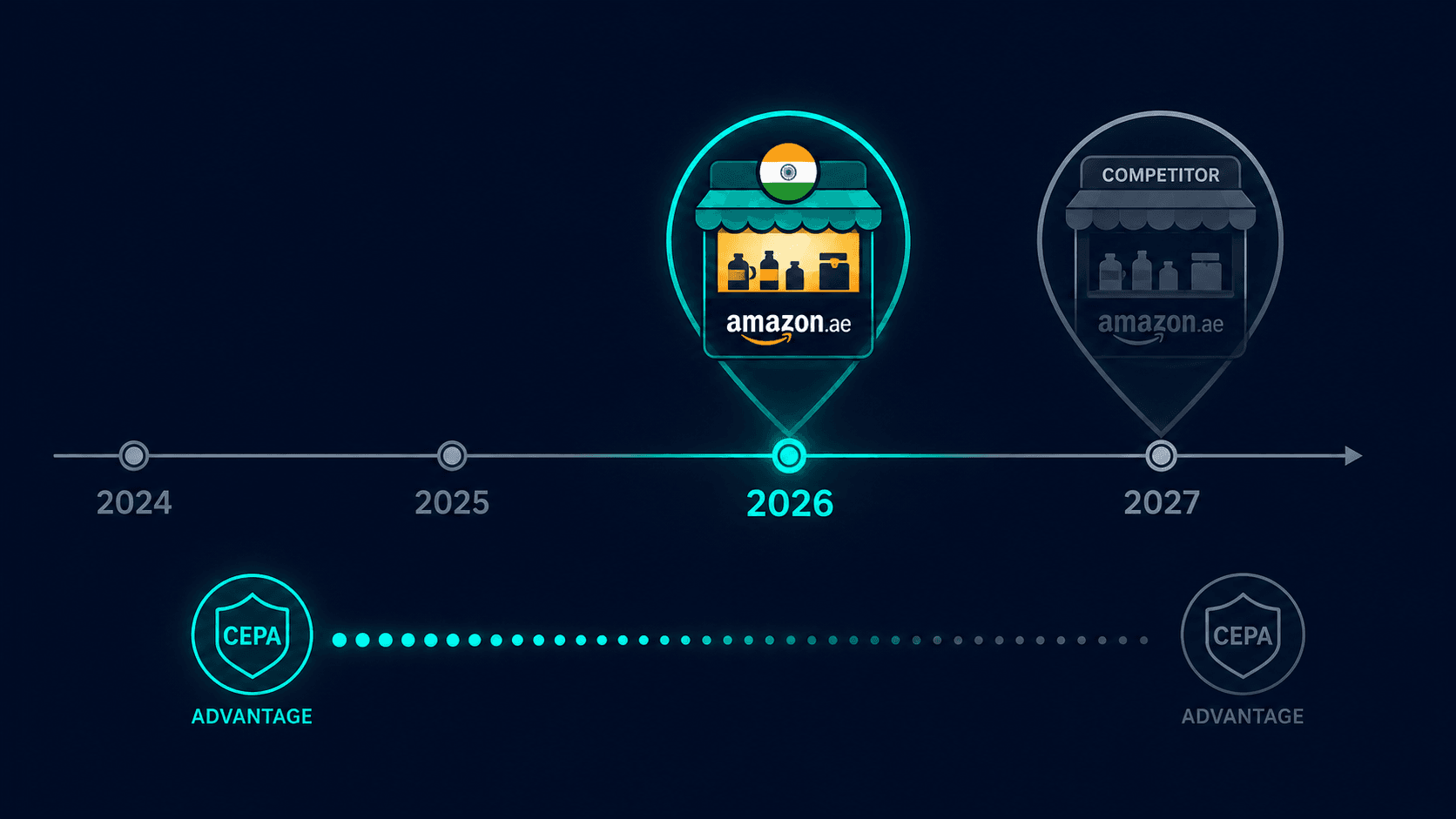
The CEPA window is an advantage now. It will not be a differentiator forever. The brands that move in 2026 will own the shelf space, reviews, and brand recognition that late movers will have to pay to compete against.
What Compliance Actually Covers and Why Brands Get Stuck

Compliance for selling on Amazon UAE from India spans five distinct areas:
Indian export documentation
UAE customs and duties
Amazon Global Selling account setup
Product and packaging regulations
Product listing standards on Amazon.ae.
Most Indian brands stall because they don't know which of these to tackle first, or they start in the wrong place and hit a wall mid-process. Getting the compliance process wrong looks something like a shipment being rejected at Dubai customs, meaning you pay forward freight and return freight on inventory that never got sold
An Amazon.ae account flagged for listing violations in the first 90 days is significantly harder to recover than to prevent. A product pulled for Arabic labelling non-compliance means a relaunch delay of weeks, not days, during which a competitor is capturing the demand you identified.
Compliance is not the barrier. Unstructured compliance is.
The Amazon UAE Compliance Checklist: 5 Things You Need to Get Right
1. Indian Export Setup
Before anything leaves India, three documents need to be in place.
IEC (Import Export Code)
Mandatory for any Indian entity exporting goods. Issued by DGFT in 2–3 working days at ₹500. Without it, customs won’t clear your shipment.
LUT (Letter of Undertaking)
Filed annually with your GST department. Exports from India are zero-rated under GST, but without an LUT, you pay GST upfront on exported goods and claim it back later. The LUT removes that cash flow drag entirely.AD Code Registration
Your bank's Authorised Dealer code is registered at your port of export. Required for customs clearance. Often overlooked by first-time exporters and responsible for last-minute shipping delays.
These three are non-negotiable and largely procedural. Get them done before you touch anything else.
2. UAE Customs, Duties, and Your CEPA Advantage
Standard UAE customs duty is 5% on CIF value ( Cost plus Insurance plus Freight). Under CEPA, eligible Indian-origin goods attract 0% duty. The document that unlocks this is a Certificate of Origin, issued by the Indian Chambers of Commerce, including FIEO and EEPC. Without it, you pay the standard 5% and lose your cost advantage against non-Indian competitors.
UAE VAT is 5% and applies to most goods sold in the country. VAT registration becomes mandatory once your annual UAE sales cross AED 375,000. Factor this into your pricing and P&L from the start, not after you've crossed the threshold.
HS Code accuracy is where most Indian shipments get delayed. Every product requires the correct Harmonised System classification code on export documentation. An incorrect HS code triggers customs queries, delays clearance, and in some cases results in shipment rejection. Classification varies by product category and is not always straightforward.
This is precisely what Pinnacle's Compliance Readiness Audit covers before your first shipment leaves India.
3. Amazon Global Selling Account Setup
Amazon.ae operates entirely separately from Amazon.in. Separate Seller Central account, separate product catalogue, separate inventory, separate pricing. Your Amazon India history, reviews, and rankings do not transfer.
Registration requires your Indian business documents, IEC code, and product compliance paperwork. The process runs through Amazon Global Selling, the programme built specifically for cross-border sellers.
FBA UAE vs FBM. Fulfilment by Amazon UAE means your inventory is stored in Amazon's UAE warehouse, your listings carry the Prime badge, delivery is faster, and conversion rates are meaningfully higher. Fulfilled by Merchant means each order ships from India, with longer delivery windows and no Prime eligibility. For serious market entry, FBA UAE is the right structure. FBM works for low-volume testing only.
One variable most Indian sellers underestimate: payouts from Amazon.ae are in AED, converted to INR. Exchange rate fluctuation is a real P&L input. Build it into your unit economics before you set pricing.
4. Product and Packaging Compliance
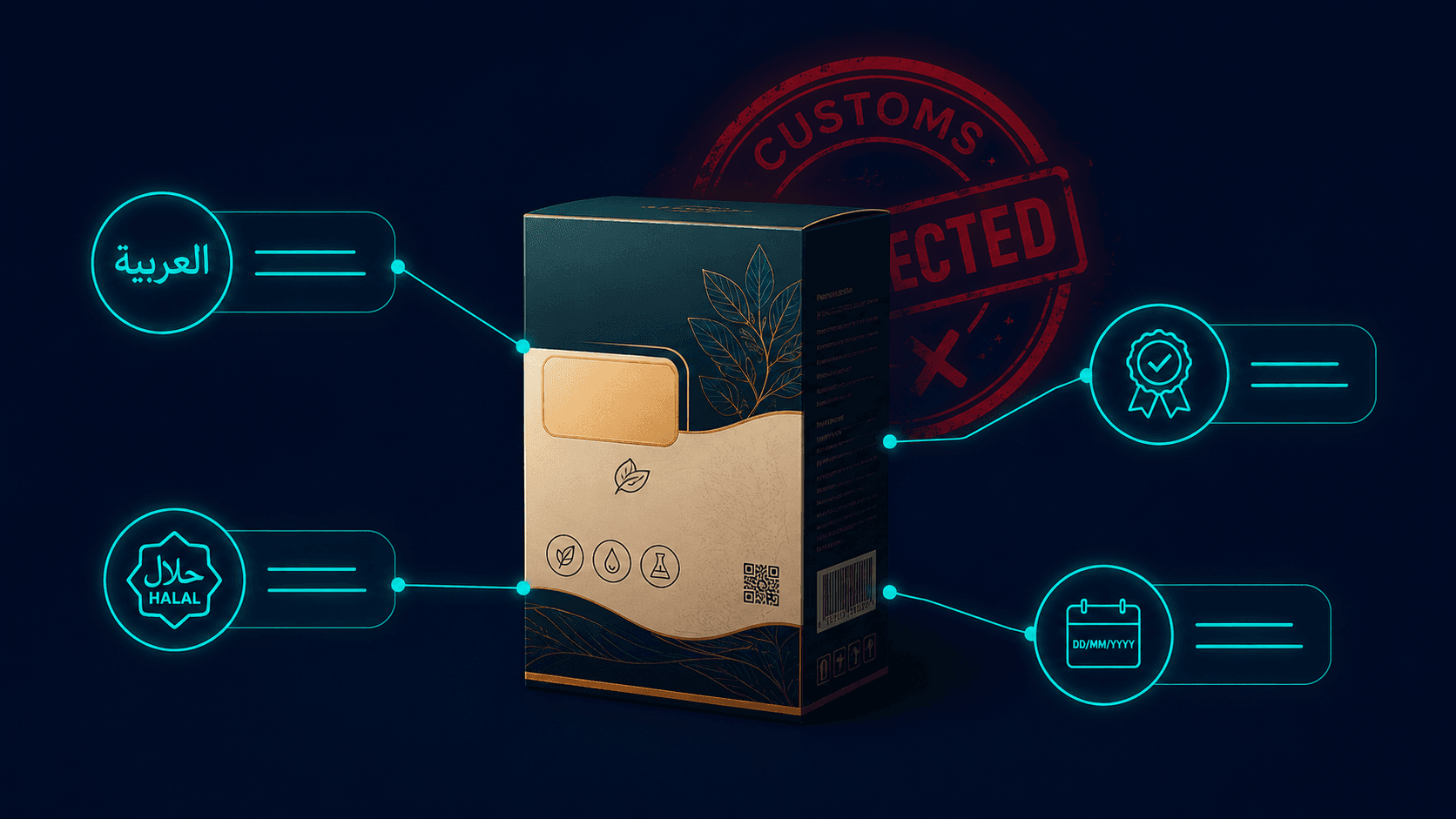
This is where most Indian sellers get rejected at Dubai customs, and it is almost entirely avoidable.
Arabic labelling
Most product categories sold in the UAE require Arabic on packaging alongside English. For food, personal care, and electronics accessories, bilingual labelling is mandatory. Packaging produced for the Indian market will not pass UAE customs inspection.ESMA certification
The Emirates Authority for Standardisation and Metrology regulates product safety standards across electronics, electrical appliances, toys, food products, and personal care. If your product falls into a regulated category, ESMA certification is required before you can legally sell in the UAE. This takes time. Factor it into your launch timeline, not as an afterthought.Halal certification
Required for food, beverage, and applicable personal care products. A recognised Halal certification body approval is non-negotiable for these categories.Expiry date format
Must appear as DD/MM/YYYY and be clearly visible on packaging. Many Indian manufacturers default to MM/YYYY. This fails UAE customs inspection, a fixable detail that stops shipments with otherwise complete documentation.
5. Amazon.ae Listing Optimisation
Your Amazon.in listing is not your Amazon.ae listing. Copying it across is one of the most common and most costly mistakes Indian sellers make on their first UAE launch.
Pricing must be set in AED and anchored to the UAE market, not converted from Indian pricing. UAE consumers have different purchasing power, competitive benchmarks, and price expectations. Mispricing on Day 1 sets the wrong baseline and is difficult to correct without affecting ranking.
A+ content in Arabic significantly improves conversion with UAE-native shoppers. English-only listings are eligible but underperform. Bilingual A+ content, English and Arabic, covers both the diaspora audience and the local consumer base.
Amazon.ae's performance metrics apply from your first sale. UAE consumers expect fast response times and clear return policies. Account health on Amazon.ae is harder to rebuild than to maintain. Set your customer service standards before launch, not after your first negative feedback.
Every Month You Wait, Someone Else Is Capturing Your Market
The CEPA advantage exists today. It will not be a point of differentiation indefinitely as more Indian sellers discover it and the playing field levels. The brands entering Amazon UAE in 2026 are building review counts, brand recognition, and search rank that will be expensive to displace in 2027 and beyond.
Every month of delay is not neutral. It is a month of lost diaspora sales, lost organic rank building, and lost first-mover positioning in a market where Indian brands have a structural cost advantage that their Chinese competitors simply do not.
The compliance checklist is not what's stopping you. Not having someone to run it with you is.
Not Sure Where You Stand on Compliance?
Pinnacle Growth Consulting offers a free Compliance Readiness Audit, a complete diagnostic of your export setup, product compliance status, and Amazon.ae account readiness. We map exactly what's in place, what isn't, and what needs to happen before your first shipment leaves India.
Book a Free Compliance Readiness Audit
Giving you clarity on what it actually takes to launch, and a partner who has done it end-to-end.