
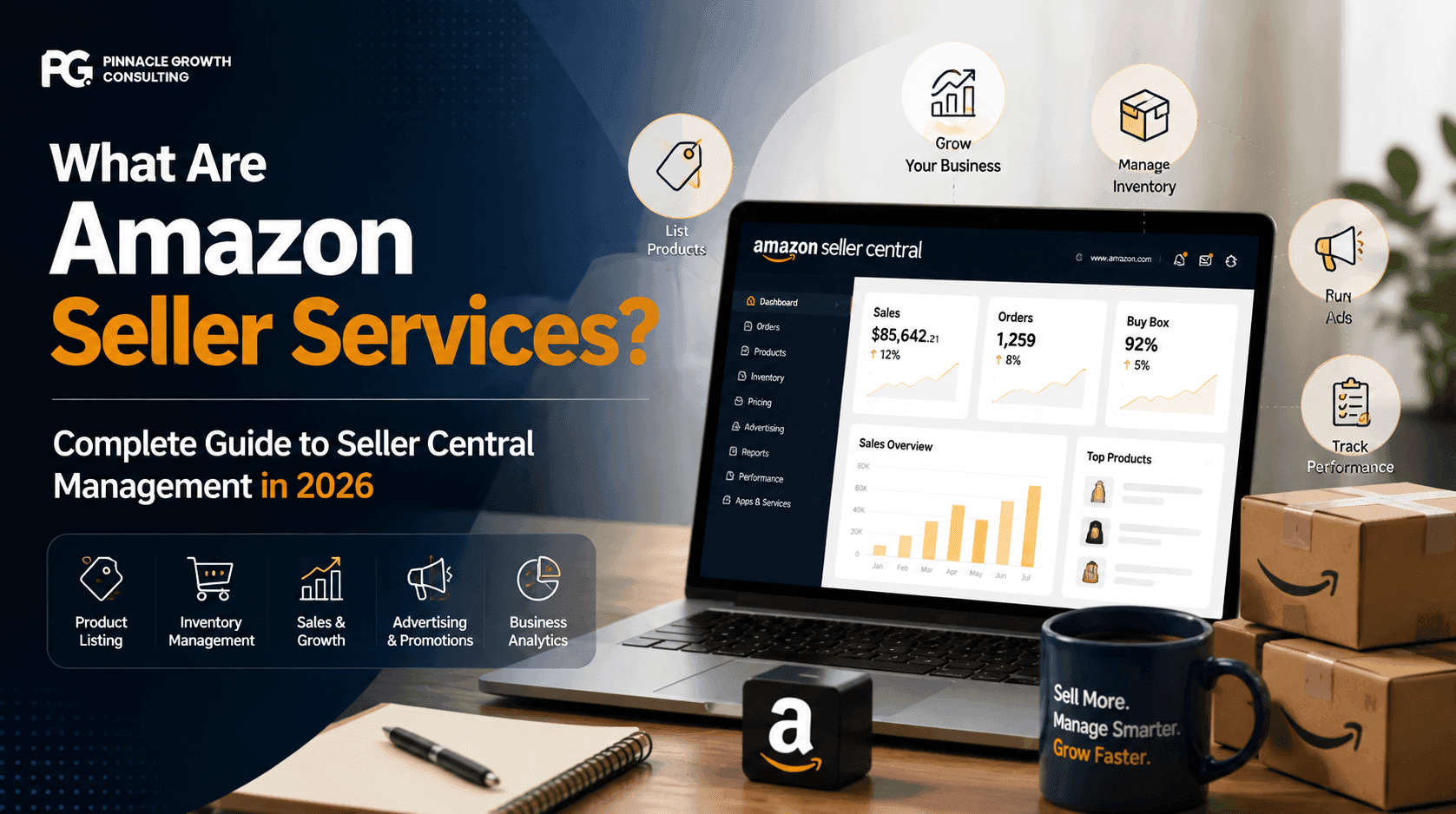
What Are Amazon Seller Services? Complete Guide to Seller Central Management in 2026
Discover what Amazon Seller Services are and how Seller Central management works in 2026. Learn about account setup, product listings, advertising, inventory, and growth strategies to boost sales and succeed on Amazon.
Amazon seller services is an umbrella term for the range of specialised support catalog and listing management, advertising, inventory and FBA management, brand registry, account health, and reporting that helps a business run and grow its Amazon Seller Central account. Few brands need every single service from day one; the right mix depends on your catalog size, category, and how much you're managing in-house versus outsourcing.
This guide breaks down each core service category so you know exactly what you're evaluating when a provider pitches you a scope of work.
The Core Categories of Amazon Seller Services
Catalog and Listing Management
Creating and maintaining product listings titles, bullet points, descriptions, backend search terms, images, and variations (size/colour groupings). This is foundational: even the best advertising strategy underperforms on a poorly optimised listing.
Amazon PPC / Advertising Management
Planning, building, and continuously optimising Sponsored Products, Sponsored Brands, and Sponsored Display campaigns, along with bid management, keyword research, and negative keyword maintenance. This is usually the most ongoing, hands-on service category since campaigns need regular adjustment. For a deeper look at how these campaigns are structured and optimised, see our complete guide to Amazon PPC management.
Inventory and FBA Management
Forecasting demand, planning replenishment shipments, monitoring FBA fee changes, and avoiding stockouts or long-term storage penalties. Poor inventory management is one of the most common and most damaging reasons a listing loses ranking, since Amazon's algorithm penalises sellers who go out of stock repeatedly. We go into forecasting and replenishment planning in more detail in our Amazon FBA and inventory management guide.
Brand Registry and A+ Content
Enrolling a trademarked brand into Amazon Brand Registry unlocks A+ Content (enhanced product descriptions with rich media), Brand Story modules, and access to Sponsored Brands ads. It also provides stronger tools to report and remove counterfeit or unauthorised listings. If your brand isn't enrolled yet, our Amazon Brand Registry and A+ Content guide walks through the enrolment process and what it unlocks.
Account Health and Compliance
Monitoring performance metrics (order defect rate, late shipment rate, policy violations) and responding quickly to any warnings or suspensions. This is a largely preventative service the goal is catching issues before they escalate into a listing or account suspension. See our guide to Amazon account health and suspension recovery for a closer look at what triggers these warnings and how to respond.
Reviews and Reputation Management
Running compliant review-generation programs (such as Amazon's Vine program for new listings), monitoring for policy-violating reviews, and managing customer Q&A on listings.
Reporting and Analytics
Consolidating performance data sales, ad metrics, inventory health, session and conversion data into a format that's actually usable for decision-making, rather than raw exports from multiple disconnected Seller Central reports.
Do You Need All of These Services?
Almost never at the same intensity. A brand just launching on Amazon typically needs heavy investment in catalog setup, initial PPC structure, and Brand Registry enrolment, with lighter ongoing reporting needs. A brand with an established catalog and steady sales usually shifts focus toward inventory forecasting, ongoing PPC optimisation, and account health monitoring, with listing work becoming more occasional (refreshes, new launches, seasonal updates).
The right approach is to map your current stage against these categories and prioritise the one or two that are actually limiting growth right now, rather than paying for a full-scope retainer covering services you don't yet need.
In-House vs Agency vs Freelancer Who Should Handle Seller Services?
In-house team: makes sense once your Amazon revenue is large enough to justify a dedicated hire (or team), and you want full control over strategy and reporting cadence.
Agency: typically the right fit when you need multiple service categories covered (PPC + catalog + compliance) without hiring several specialists, or when you lack the internal bandwidth to manage day-to-day execution.
Freelancer: can work well for a narrow, well-defined task (a one-time listing overhaul, for example) but is often a weaker fit for ongoing, multi-category management where continuity and accountability matter.
If you're specifically trying to understand what a full-service agency does day-to-day and how that differs from managing things in-house, we've covered that comparison in more depth in our earlier piece on what an Amazon account management agency in India actually does for businesses.
Conclusion
Amazon seller services cover a lot of ground catalog and listings, PPC, inventory and FBA, brand registry, account health, reviews, and reporting but no brand needs all of it running at full intensity at once. The smarter starting point is to identify whichever category is currently holding your account back, whether that's a weak listing, an underperforming ad account, or repeated stockouts, and fix that first rather than signing up for a full-scope retainer upfront.
As your catalog and revenue grow, your mix of services will naturally shift from heavy setup work early on to ongoing optimisation and account health monitoring later. Revisiting this mix every few months, rather than locking into one scope indefinitely, is what keeps spend aligned with what your account actually needs at each stage.
If you're unsure where you currently stand, an account audit is usually the fastest way to find out it's far cheaper to spend an hour identifying the real bottleneck than to pay for months of a service category that isn't actually your problem.
Not sure which seller services your business actually needs right now? Pinnacle's marketplace management team can audit your account and tell you exactly where the biggest gaps are.
Book a Growth Call → https://www.pinnaclegrowthconsulting.com/contact
Frequently Asked Questions
Pricing varies widely by scope a narrow PPC-only retainer costs far less than a full-scope engagement covering catalog, advertising, inventory, and compliance. Most providers price either as a flat monthly retainer, a percentage of ad spend or sales, or a hybrid of both.
Yes, and it's often the smarter approach start with whichever service is currently your biggest bottleneck (commonly PPC or catalog optimisation), prove the value, then expand scope.
Some providers offer this as a specialised add-on, but it's not standard across all services confirm explicitly if B2B/Amazon Business is part of your requirement, since the listing and pricing mechanics differ from standard B2C selling.
Amazon seller services is the general category of work being done; SPN is specifically Amazon's own directory of vetted third-party providers offering those services. A provider can offer full seller services without being SPN-listed, and vice versa.