
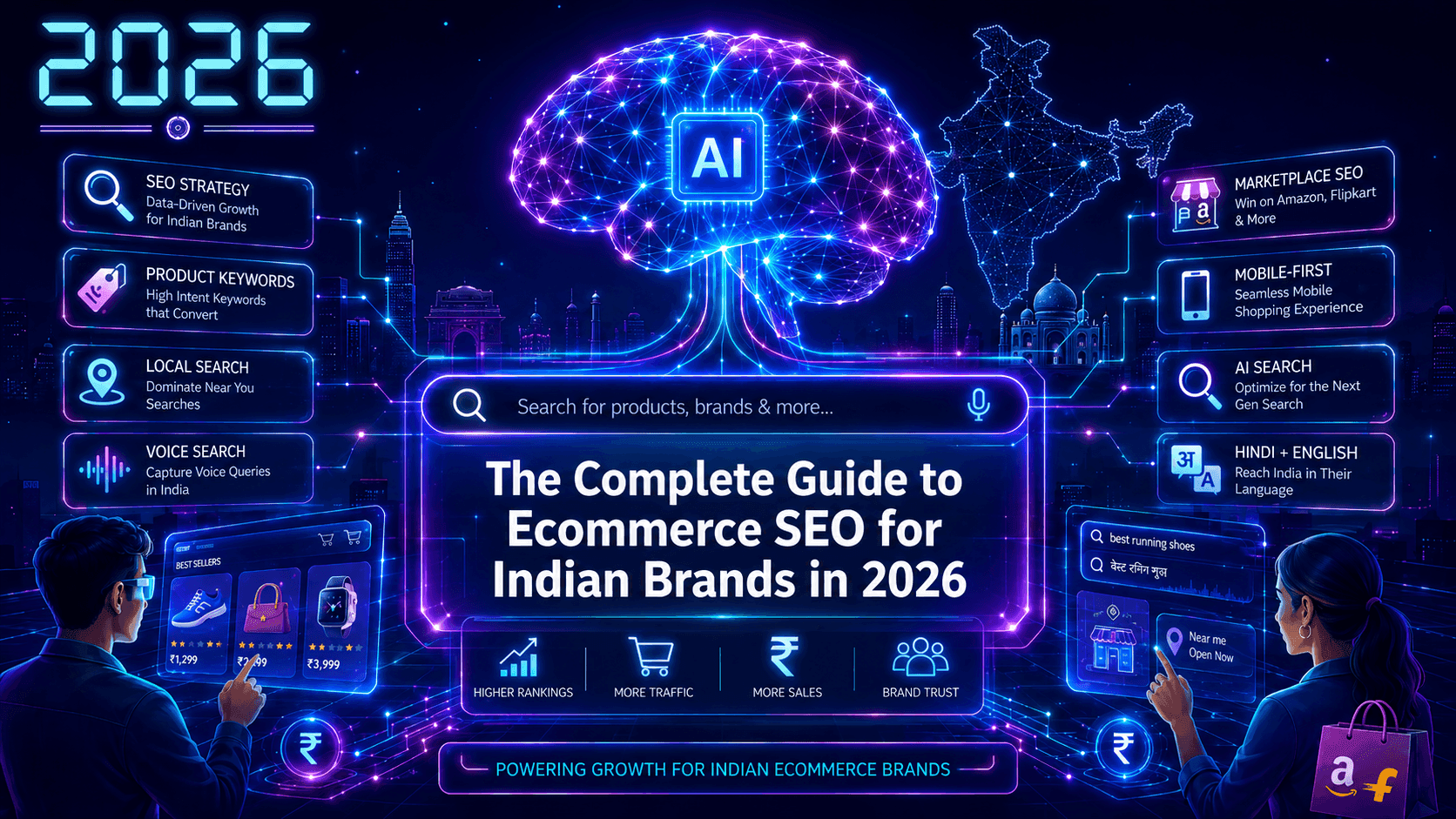
The Complete Guide to Ecommerce SEO for Indian Brands in 2026
Master Ecommerce SEO India 2026 with proven strategies to boost rankings, traffic, and sales for Indian ecommerce brands.
India's ecommerce market is projected to cross $150 billion by 2026 yet most Indian brands are leaving organic traffic on the table by treating Amazon, Flipkart, and their D2C website as three separate problems. Ecommerce SEO India 2026 is no longer just about keywords. It is about building a unified visibility strategy across every channel where your customer searches.
What is ecommerce SEO for Indian Brands and why does it matter for Indian brands in 2026?
Ecommerce SEO is the practice of optimising product listings, category pages, and brand content so that Indian consumers can discover your products through organic search on Google, on Amazon India, on Flipkart, and increasingly through AI-generated answers on platforms like ChatGPT and Gemini. In 2026, with over 900 million internet users in India and more than 60% of purchase journeys starting with a search query, ecommerce SEO is one of the highest-ROI growth levers available to D2C brands and marketplace sellers alike. Related entities that shape this landscape include Google Shopping India, Amazon A9/A10 algorithm, Flipkart's relevance engine, and vernacular search intent across Hindi, Tamil, Telugu, and other regional languages.
Building an ecommerce keyword strategy for India
The foundation of any SEO for Indian Brands 2026 plan is a keyword strategy that reflects how Indian consumers actually search not how Western SEO playbooks assume they do.
Map keywords by channel, not just by volume
A keyword like "best protein powder" behaves differently on Google (informational, comparison intent) versus Amazon India (high purchase intent, brand comparison). Your ecommerce keyword strategy India should segment terms into three buckets: marketplace purchase-intent keywords, D2C informational and brand keywords, and Google Shopping transactional terms.
Do not ignore vernacular and Hinglish queries
Searches like "सबसे अच्छा प्रोटीन पाउडर" or "protein powder sasta wala" represent a massive, underserved search volume that most brands completely ignore. Tools like Google Keyword Planner (set to India + regional language), Ubersuggest India, and Ahrefs' "Questions" filter surface these opportunities quickly.
Prioritise long-tail over head terms early
Indian ecommerce is intensely competitive at head-term level. Brands with domain authority under 30 should prioritise 3–5 word long-tail keywords with clear buying intent "biodegradable packaging for D2C brands India" will convert far better than "packaging" and is winnable in under 6 months.
Marketplace SEO: ranking on Amazon India and Flipkart
Marketplace SEO Amazon Flipkart is not a single discipline it is two separate optimisation frameworks that happen to share the same goal: getting your product in front of a buyer at the moment of decision.
Amazon India: the A10 algorithm priorities
Amazon's algorithm in 2026 weights click-through rate, conversion rate, and review velocity above raw keyword density. Your title should lead with the primary keyword within the first 5 words. Bullet points must address objections, not just list features. Backend search terms remain valuable use regional synonyms and Hinglish variants here. A+ Content pages with comparison modules consistently outperform basic listings by 15–25% on conversion.
Flipkart: where price and seller signals dominate
Flipkart's ranking engine places heavier weight on competitive pricing, seller ratings, and return rate than Amazon does. Smart ROI campaigns on Flipkart feed organic ranking signals indirectly brands that maintain sponsored visibility tend to see organic rank improvements within 6–8 weeks. Listing completeness score (Flipkart's equivalent of Amazon's listing quality score) should be above 90% before investing in any paid amplification.
"Brands that treat Amazon and Flipkart as identical channels consistently underperform. The algorithms are different, the shopper psychology is different, and the optimisation levers are different." Pinnacle Growth Consulting, Marketplace Audit Report, 2026
SEO for D2C brands: owning your own traffic channel
SEO for D2C brands India is fundamentally different from marketplace SEO because you are building an asset domain authority and topical trust that compounds over time and is entirely yours.
The core priorities for D2C SEO in 2026 are:
Topical authority over individual rankings. Google rewards brands that cover a topic deeply. A skincare D2C brand should own every informational query around ingredients, routines, and skin concerns not just rank for "vitamin C serum buy online."
Google Shopping integration with Product schema. Indian consumers increasingly use Google Shopping as a discovery and price-comparison tool. Ensure every product page has complete Product schema markup including price, availability, review, and brand properties.
Core Web Vitals on mobile. Over 78% of Indian ecommerce traffic comes from mobile. A D2C site that loads in under 2.5 seconds on a mid-range Android device will outrank a technically superior site that loads in 4 seconds.
Marketplace vs D2C pricing: the SEO angle most brands miss
This is the section most ecommerce SEO guides in India completely skip yet it is directly relevant to your organic performance on both channels.
Should D2C prices be different from Amazon prices? Yes, in most cases your D2C price should be equal to or slightly higher than your Amazon price but justified by clear value-adds such as bundling, exclusive variants, loyalty rewards, or faster personalised service. If your D2C price is simply higher with no communicated reason, organic visitors from Google will immediately cross-check Amazon, bounce from your site, and that exit signal will gradually erode your rankings.
How to price products differently on Amazon vs your D2C website? The most effective approach is channel-exclusive positioning rather than raw price differentiation. On Amazon, compete on price and review volume for your core SKUs. On your D2C website, sell bundles, subscription plans, or limited-edition variants that are not listed on Amazon. This way you are not undercutting your own marketplace presence, and your D2C site offers something Amazon literally cannot match making the conversion case easier and the bounce rate lower.
What pricing strategy works for marketplace sellers? For marketplace sellers in India, a tiered pricing strategy works best: set your MRP at a level that gives Amazon and Flipkart room to discount during sale events (Big Billion Days, Great Indian Festival) without destroying your margin. Maintain a minimum advertised price (MAP) policy if you sell through resellers. Use dynamic repricing tools to stay within 3–5% of the Buy Box price without triggering a race to the bottom. Brands that anchor their MRP correctly win the Buy Box more consistently and spend less on sponsored ads to maintain visibility.
Channel | Pricing strategy | SEO impact | Margin impact |
Amazon India | Competitive core SKU pricing | Higher CTR, better conversion signals | Medium — offset by volume |
Flipkart | Price-led with seller rating focus | Organic rank lift via Smart ROI | Lower — requires discipline |
D2C website | Bundle/exclusive variant pricing | Lower bounce rate, better dwell time | Higher — no marketplace commission |
Step-by-step: launching an ecommerce SEO campaign in India
Step 1 — Audit your current search visibility
Run a full crawl of your D2C website (Screaming Frog or Sitebulb) and pull your Amazon listing quality scores and Flipkart completeness scores simultaneously. Identify your 20 highest-potential pages and listings those ranking on page 2 or in positions 15–40 and treat these as your quick-win priority list.
Step 2 — Build a keyword map by channel
Create a master keyword sheet segmented into three columns: D2C / Google, Amazon India, and Flipkart. Assign primary and secondary keywords to each product and category page. Flag vernacular and Hinglish variants separately. Never use the same title tag on your D2C page as your Amazon listing title.
Step 3 — Optimise listings and product pages simultaneously
Update Amazon titles, bullets, and backend terms in one sprint. Simultaneously update D2C product page titles, meta descriptions, Product schema, and image alt text. Running both in parallel means you start seeing signals from both channels within the same 4–8 week window.
Step 4 — Track rankings, conversions, and channel-level profitability
Use Google Search Console for D2C organic tracking, Amazon Brand Analytics for marketplace keyword rank, and a unified dashboard (Data Studio or Looker Studio) to monitor both alongside channel-level contribution margin. SEO without profitability tracking is incomplete especially when your pricing strategy differs by channel.
Conclusion
Ecommerce SEO for Indian Brands is a multi-channel discipline, and brands that treat it as such will build compounding organic revenue that paid ads simply cannot replicate. The brands winning in 2026 are those who own their D2C traffic, dominate their marketplace categories, and price intelligently across channels not those chasing the lowest CPC. Start with your audit, build your keyword map by channel, and optimise both surfaces in parallel.
Ready to fix your pricing and protect your margins? Pinnacle Growth Consulting offers a free Pricing & Profitability Review for Indian ecommerce brands we analyse your marketplace vs D2C pricing gap and show you exactly where you are leaving money and rankings on the table. Book your free review at pinnaclegrowthconsulting.com →
Frequently Asked Questions
The best ecommerce SEO strategy for Indian brands combines optimised marketplace listings on Amazon India and Flipkart with a strong D2C content and technical SEO foundation. Prioritise vernacular keywords, Google Shopping integration, Product schema markup, and topical authority content that answers buyer questions before they even reach a product page. Brands that build both channels simultaneously reach profitability faster than those who focus on one at a time.
Marketplace listing improvements on Amazon and Flipkart typically show ranking movement within 4–8 weeks. D2C website SEO shows meaningful organic traffic growth in 3–6 months, with compounding returns beyond 12 months as domain authority builds. Investing in both simultaneously shortens overall time-to-visibility and reduces dependence on paid advertising for top-of-funnel discovery.
Both — but with different KPIs. Amazon and Flipkart SEO drives immediate high-intent purchase traffic that funds your growth in the short term. D2C website SEO builds brand equity, customer lifetime value, and margin over the long term. A blended strategy where marketplace SEO covers short-term revenue and D2C SEO builds the sustainable traffic engine is the approach Pinnacle recommends for Indian brands at every stage.
Yes, significantly. Amazon rewards keyword relevance, conversion rate, review velocity, and A+ content quality. Flipkart prioritises competitive pricing, seller ratings, listing completeness, and Smart ROI ad participation as an organic ranking signal. Indian brands should maintain distinct optimisation strategies for each platform rather than duplicating content across both.
D2C pricing does not directly affect Google rankings, but it strongly influences the user behaviour signals that do — particularly bounce rate, dwell time, and conversion rate. If shoppers land on your D2C site, see a higher price than Amazon, and immediately leave, Google registers low engagement and gradually depresses your rankings. Pricing your D2C channel with clear value differentiation — bundles, exclusives, subscriptions — keeps visitors on-site longer and improves conversion, both of which support long-term organic performance.