
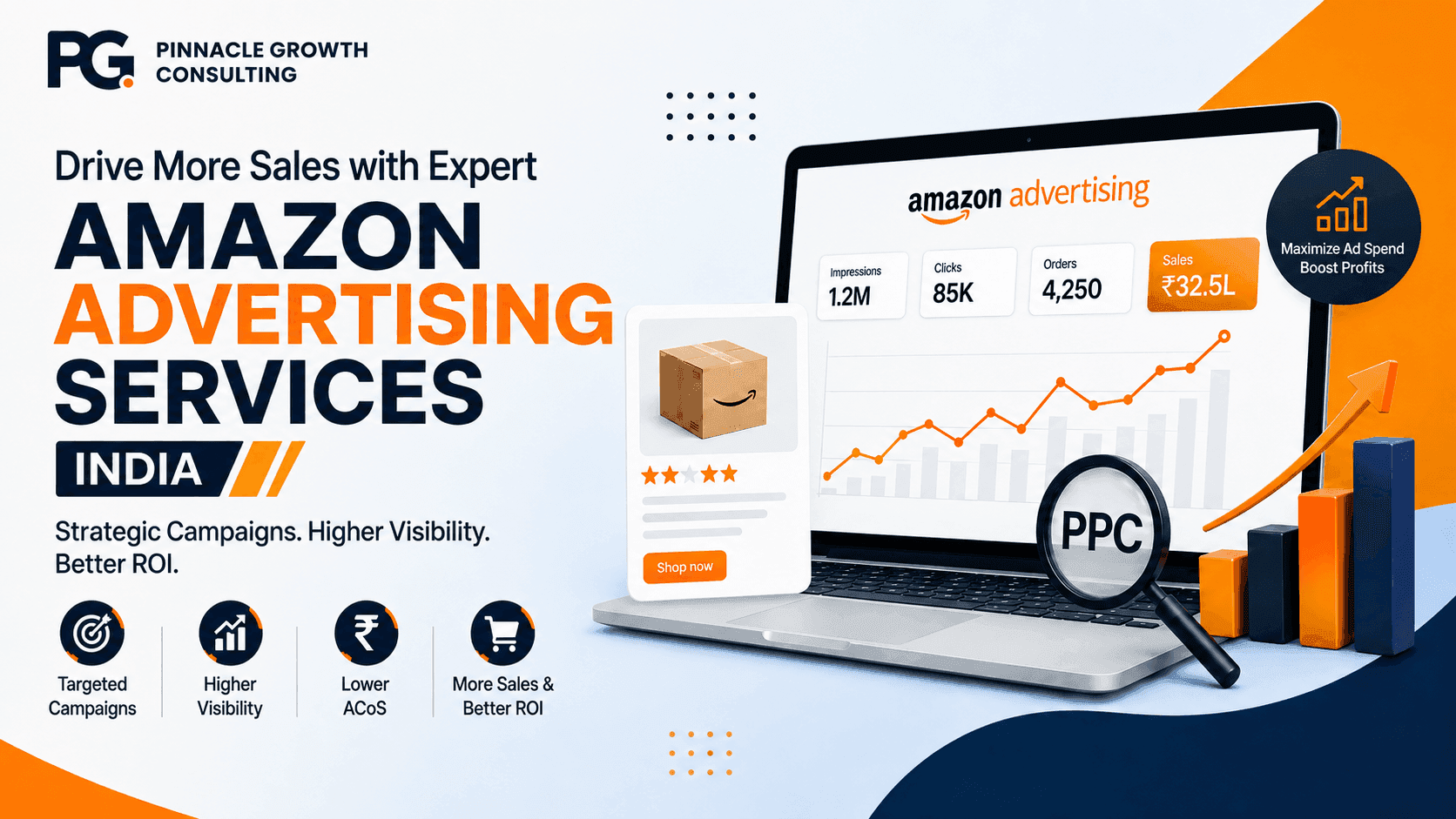
How D2C Brands Can Use Amazon Advertising to Grow Marketplace Revenue
Turn ad spend into measurable growth with the right Amazon advertising services. Learn how expert PPC management can improve visibility, lower ACoS, increase ROAS, and drive more sales.
Most D2C brands earn their early traction on their own website — through paid social, influencers, email, and organic content. Amazon is a different environment. Shoppers arrive with intent already formed, and competitors sit one click away on the same results page.
Simply listing products on Amazon does not guarantee sales. Without a deliberate approach to Amazon advertising for D2C brands, even strong products can go unnoticed in a crowded category. A working strategy needs to capture high-intent searches, support new launches, build brand recognition, and turn ad spend into sustainable marketplace revenue rather than short-term spikes.
This article covers how D2C brands can structure Amazon advertising as part of a broader growth system — ad formats, campaign strategy, budget allocation, optimization, common mistakes, and when outside expertise makes sense.
Why Amazon Advertising Matters for D2C Brands
Amazon advertising helps D2C brands reach high-intent shoppers, improve product visibility, generate sales data, accelerate product discovery, and build marketplace revenue.
Amazon shoppers are frequently searching with a purchase already in mind, which makes advertising efficient when targeted correctly. A few reasons it matters for D2C brands specifically:
Organic rankings take time to build, especially for new listings without reviews or sales history.
Sponsored placements give new products visibility they haven't earned organically yet.
Advertising supports both immediate conversions and longer-term brand awareness.
Search-term and targeting data reveal real customer demand and language.
Paid visibility can accelerate organic marketplace growth rather than replace it.
Understand the Main Amazon Advertising Formats
Sponsored Products
Amazon Sponsored Products are product-level ads that help sellers place relevant products in front of shoppers searching or browsing on Amazon. They appear within search results and on product detail pages, targeted by keywords or by specific products and categories. They're the foundation of most Amazon PPC advertising strategies because they connect directly to purchase intent — useful for launches, driving conversions on core SKUs, and defending branded searches.
Sponsored Brands
Sponsored Brands showcase a brand's logo, a custom headline, and a curated selection of products, typically appearing above or alongside search results, and can direct shoppers to a Brand Store or product collection. For established D2C brands, they're useful for building brand recall and presenting a fuller product range rather than a single item.
Sponsored Display
Sponsored Display uses audience and product-based targeting to reach shoppers on and off Amazon, including relevant product and category pages. Depending on available targeting options, it can support cross-selling, defensive strategies against competitor listings, and retargeting shoppers who viewed but didn't purchase.
Quick comparison: Sponsored Products drive conversions on high-intent searches and support launches. Sponsored Brands build visibility and showcase a product range. Sponsored Display supports awareness, retargeting, and cross-sell or defensive strategies.
Build an Amazon Advertising Strategy Around Business Goals
Campaigns launched without a clear objective are difficult to evaluate or optimize. Before setting up ads, define what success looks like — a product launch, increasing overall sales, improving visibility for underperforming listings, defending branded search terms, acquiring new-to-brand customers, growing category share, prioritizing higher-margin revenue, managing inventory strategically, or supporting seasonal demand. Campaign structure, keyword targeting, and bidding should all shift depending on which goal is the current priority.
Start With Retail Readiness Before Increasing Ad Spend
Advertising cannot fix a weak product listing — it can only send more traffic to it. If a page doesn't convert, more ad spend simply increases waste rather than revenue.
Before scaling Amazon PPC campaign management, a listing should have a clear, keyword-relevant title; benefit-focused bullet points; high-quality images; enhanced or A+ content where available; competitive pricing; consistent inventory availability; a healthy base of ratings and reviews; and relevant on-page and backend keyword optimization.
The relationship is straightforward: Traffic → Product Page Experience → Conversion Rate → Advertising Efficiency → Revenue. Weakness at any point limits everything downstream, including advertising ROI.
Use Keyword Strategy to Capture High-Intent Shoppers
A well-built Amazon advertising strategy typically layers branded keywords, generic category keywords, product-specific keywords, problem/solution keywords, competitor-related opportunities where relevant, long-tail keywords, and high-intent commercial terms.
It helps to separate keywords by function: discovery keywords introduce new shoppers to a product, conversion-focused keywords capture shoppers ready to buy, and brand defense keywords protect existing customers from competitor interception. Search-term reports from paid campaigns also surface demand patterns that can inform organic listing optimization over time.
Structure Campaigns for Better Control and Optimization
Organizing campaigns by product, category, brand, targeting type, match type, funnel objective, or profitability tier gives far more control than one broad campaign. A clearer structure makes it easier to allocate budget deliberately, adjust bids at a meaningful level, read reporting without noise, and identify winners and wasted spend faster. The goal isn't complexity for its own sake — it's a structure that supports clearer decisions.
Focus on Revenue Quality, Not Just Sales Volume
Growing Amazon marketplace revenue isn't automatically the same as growing profit. A campaign can generate strong sales volume while eroding margin if efficiency metrics aren't tracked alongside revenue.
Metrics worth watching together include impressions, click-through rate, conversion rate, cost per click, Advertising Cost of Sales (ACoS), Return on Ad Spend (ROAS), and — where relevant — Total Advertising Cost of Sales (TACoS), which reflects advertising's impact on total sales rather than just ad-attributed sales.
These should be read alongside product-level margins. A higher ACoS during a launch may be acceptable while a brand builds review volume and ranking; a mature product usually needs a tighter profitability target since organic traffic should already be doing more of the work.
Allocate Budget Based on Product Potential
Distributing budget evenly across a full catalog often underfunds the products with the most upside while overspending on weaker performers. A more effective approach identifies hero products, high-margin products, strong-converting SKUs, new launches, seasonal products, underperforming products that need conversion fixes first, and products that need a temporary push for organic ranking. Budget should shift toward products demonstrating real commercial potential rather than staying fixed by habit or catalog size.
Use Amazon Ads Across the Customer Journey
Amazon advertising works best as more than bottom-of-funnel PPC. Shoppers move through Awareness → Consideration → Conversion → Repeat Purchase / Cross-Sell, and different formats support different stages. Sponsored Display and Sponsored Brands can build early awareness and consideration; well-optimized product pages and Sponsored Products support the conversion moment; and Brand Stores plus retargeting strategies, where applicable, support repeat purchase and cross-sell after the first sale.
Optimize Amazon Advertising Continuously
Amazon PPC campaign management is an ongoing process, not a one-time setup. Regular work includes reviewing search-term reports, adding newly relevant keywords, reducing wasteful targeting, adjusting bids, shifting budget toward stronger campaigns, testing product targeting, monitoring conversion trends, reviewing placements, evaluating profitability by product, watching for seasonal shifts, and improving listings when conversion declines.
A simple framework to apply consistently: Measure → Diagnose → Optimize → Test → Scale.
Common Amazon Advertising Mistakes D2C Brands Should Avoid
Advertising before listings are retail-ready. Fix page quality and pricing first, then scale traffic.
Running campaigns without defined goals. Set a clear objective before every launch.
Targeting overly broad keywords. Balance broad discovery terms with precise, high-intent ones.
Scaling budget before validating conversion. Confirm a listing converts well before increasing spend.
Tracking ACoS without total revenue context. Weigh efficiency metrics against overall marketplace revenue and margin.
Ignoring search-term reports. Review regularly to refine targeting and cut waste.
Treating all products equally. Direct budget toward products with real commercial potential.
Stopping campaigns too quickly. Give campaigns enough time and data before judging results.
Depending entirely on paid traffic. Build organic strength so advertising isn't carrying the full load.
Failing to coordinate advertising with inventory. Align spend with stock levels to avoid stockouts or waste.
How Amazon Advertising Can Grow Marketplace Revenue
Effective advertising contributes to revenue growth through a connected sequence: Greater Visibility → More Relevant Traffic → More Product Detail Page Visits → More Conversions → More Sales Data → Stronger Organic Visibility → Higher Marketplace Revenue.
This framework holds only when the underlying fundamentals support it. Results depend on product-market fit, pricing, competitive intensity, listing quality, review volume, margins, inventory availability, and campaign execution. No advertising strategy can guarantee specific rankings, revenue, or ROAS outcomes.
When Should a D2C Brand Work With an Amazon Advertising Agency?
Certain signals suggest outside expertise is worth considering: ad spend is rising while profitability falls, the internal team lacks dedicated Amazon PPC expertise, campaign structure has grown too complex to manage, the brand is launching multiple SKUs at once, search-term analysis isn't happening consistently, reporting doesn't connect advertising to marketplace revenue, or the business wants to scale revenue systematically rather than reactively.
At this stage, many brands look for Amazon advertising services or an Amazon advertising agency that can bring structured Amazon PPC campaign management and Amazon performance marketing expertise to the table.
How Pinnacle Growth Consulting Can Support D2C Marketplace Growth
Pinnacle Growth Consulting works with D2C brands to evaluate and strengthen the areas that drive sustainable Amazon growth — advertising strategy, campaign structure, keyword targeting, PPC optimization, budget allocation, listing and conversion considerations, and performance measurement tied to actual marketplace revenue.
Rather than treating advertising as an isolated PPC channel, Pinnacle Growth Consulting approaches it as one part of a brand's overall marketplace growth system, helping identify where structure, data, or execution gaps may be limiting results. The focus stays on strategy, analysis, and steady optimization rather than promises of guaranteed outcomes.
Conclusion
Sustainable Amazon marketplace revenue growth doesn't come from any single tactic it comes from combining retail-ready listings, relevant targeting, strategic campaign structure, data-driven budget allocation, continuous Amazon ads optimization, and consistent profitability analysis. Treating advertising as one connected system, rather than disconnected campaigns, is what separates brands that scale efficiently from those that simply spend more without growing.
For D2C brands ready to bring more structure and strategy to their Amazon advertising, Pinnacle Growth Consulting can serve as a partner in building that system helping evaluate current performance and identify where the next stage of marketplace growth can come from.
Frequently Asked Questions
It means using Amazon's paid formats — Sponsored Products, Sponsored Brands, and Sponsored Display — to increase product visibility, reach high-intent shoppers, and drive marketplace sales. It complements organic performance and is especially useful for launches and competitive categories.
By combining retail-ready listings, targeted keyword strategy, well-structured campaigns, and ongoing optimization. Strong product pages, competitive pricing, and consistent inventory availability all affect how efficiently advertising converts into sales.
It depends on the goal. Sponsored Products typically drive the most direct conversions, Sponsored Brands build brand visibility, and Sponsored Display supports awareness and retargeting. Most brands use a combination rather than one format alone.
It generates immediate visibility for products that haven't yet earned strong organic rankings, and produces search-term data that can inform future campaigns and listing improvements.
There's no universal figure. Spend should reflect category competition, margins, campaign objectives, conversion rates, and growth stage — a new launch typically needs a different investment level than an established listing.