
5 Brutal Mistakes Manufacturers Make Launching Online
You control the supply chain, own the product, and know every component inside out. So why is launching a consumer brand online so brutally hard?
"The graveyard of factories that tried to pivot is massive. B2B manufacturing and B2C e-commerce are two completely different sports."
You own the supply chain, control the product, and know every component inside out. So, why do manufacturer brands fail on ecommerce? Based on extensive market analysis and operational experience, the reality is clear: B2B manufacturing and B2C ecommerce require entirely different DNA. The graveyard of factories that tried to pivot is massive.
Here is an authoritative breakdown of why manufacturers fail online and the exact pivots required to survive the digital shelf.
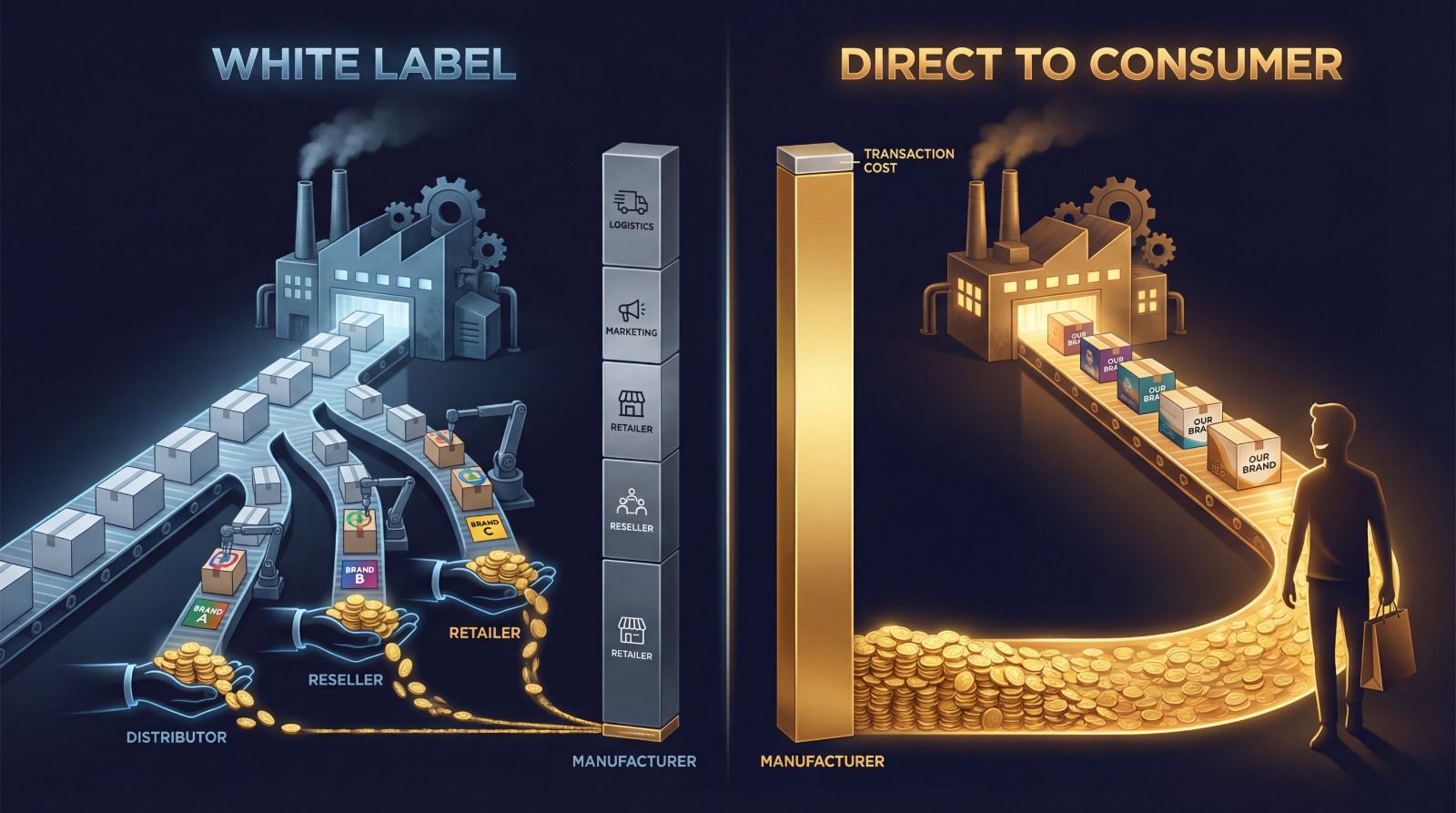
White Label vs. Direct to Consumer: When you manufacture for others, every intermediary takes a slice. Going D2C means owning the full margin stack but also owning every cost that comes with it.
White Label vs. Direct to Consumer: When you manufacture for others, every intermediary takes a slice. Going D2C means owning the full margin stack but also owning every cost that comes with it.
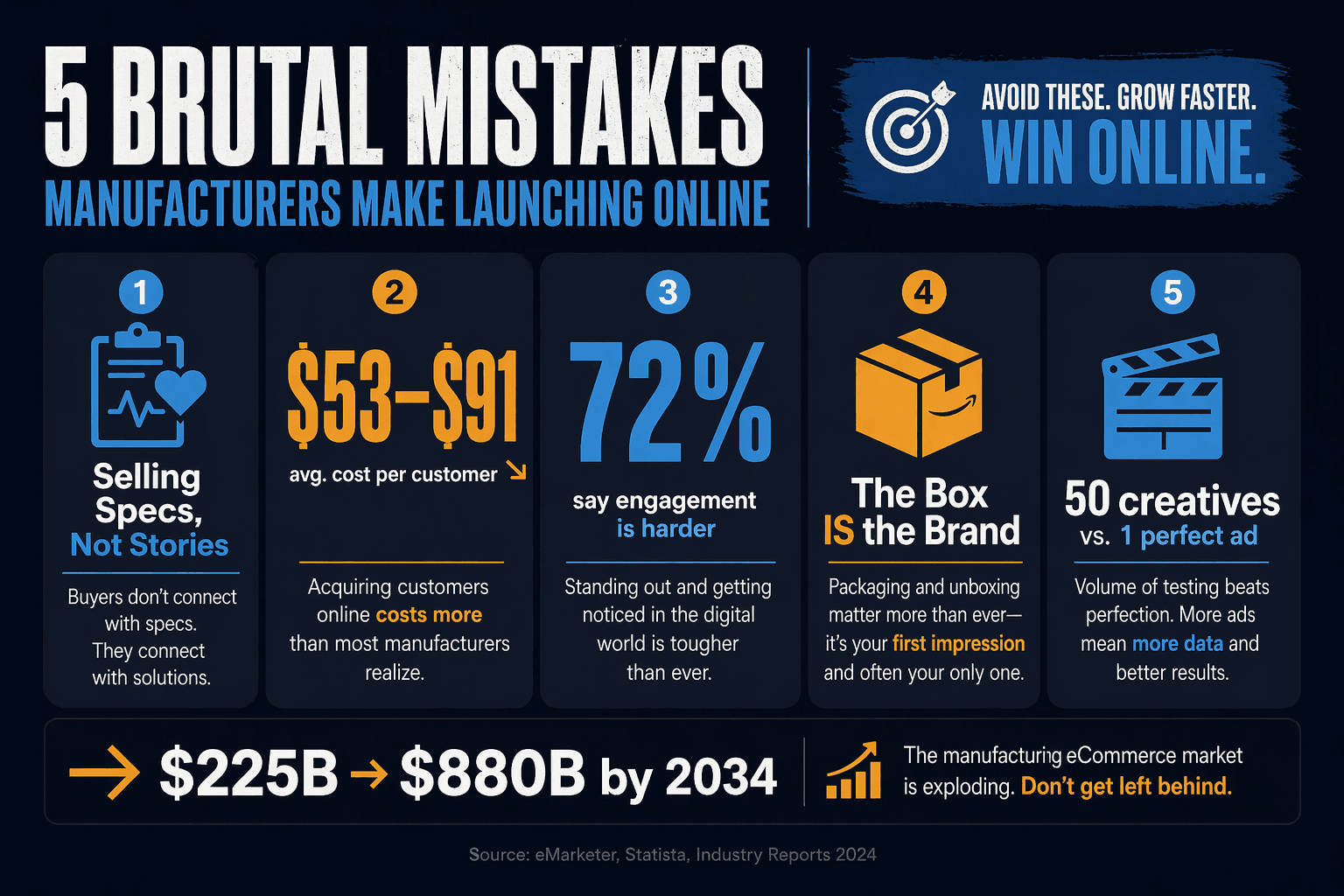
The numbers don't lie: average customer acquisition costs of $53–$91, 72% of brands say engagement is harder than expected, and the D2C market is projected to hit $880B by 2034. The opportunity is massive so is the execution gap.
MISTAKE 01
Selling "Specs" Instead of Selling a "Story"
When you spend your life in manufacturing, your world revolves around specifications tolerances, material grades, and quality control. One of the most common D2C launch errors is treating an ecommerce site like a technical manual. End consumers do not buy spec sheets; they buy stories, identity, and the feeling a product gives them.
In online retail, your brand narrative is just as important as the physical product inside the box. Without a world built around your product, you are just a commodity.
THE FIX Build context around your product. Consumers buy the story, not the spec sheet.
MISTAKE 02
The "Race to the Bottom" Pricing Trap
Because factories own the means of production, their immediate instinct is to undercut the market. This is a fatal miscalculation. In the consumer space, price is a direct signal of quality. Drastically undercutting competitors makes buyers suspicious. More critically, pricing with razor-thin wholesale margins starves your marketing engine. You must price for the B2C model, building in a heavy buffer to cover acquisition, fulfillment, and returns.

The same formulation. A completely different brand story. The bottle on the right sells for 8× the price not because the liquid inside is 8× better, but because the perceived value is.
THE FIX Price for the B2C model. Build in margins that fund customer acquisition not just cover production.
MISTAKE 03
Getting Blindsided by Customer Acquisition Costs
In traditional B2B, marketing costs are predictable. In D2C ecommerce, your landlords are Meta and Google, and rent is expensive. You might spend $40 in ads just to get a $45 first-time purchase. For a manufacturer used to strict net margins, running a first order at a loss is terrifying.
D2C is a game of Lifetime Value (LTV). You are paying to acquire a customer who will buy repeatedly. You must be financially prepared to pay the platform tax.
THE FIX Shift your success metric from first-order profit to LTV. Ugly unit economics at acquisition is normal plan for it.
MISTAKE 04
Treating the "Unboxing" Like a Logistics Problem
When shipping B2B pallets, packaging has one job: don't let the product break. When you pivot to D2C, packaging shifts from a logistical necessity to your primary marketing touchpoint. The moment a customer opens that box is their only physical interaction with your brand.
Manufacturers constantly try to cut costs here out of a habit of industrial efficiency. Do not cheap out on the final mile. Premium packaging is a retention strategy, not a cost center.
THE FIX Invest in the unboxing experience. A branded insert and tissue paper costs pennies and drives repurchase.
MISTAKE 05
Starving the Creative Content Engine
Factories run on predictability and Standard Operating Procedures (SOPs). Online marketing is the exact opposite chaotic, fast-paced, and demanding constant iteration. You cannot shoot one polished commercial and expect it to drive sales for a year.

Left: The traditional manufacturer's content process "Final v7, Pending Review," calendars full of approval meetings, and campaigns waiting months to launch. Right: The agile D2C content engine multiple cameras rolling, real-time analytics on screen, a content calendar packed with live tests. Speed wins.
The brands winning today possess the operational agility to test dozens of raw, authentic, short-form videos every single month. Speed of creative iteration beats a massive production budget every time.
THE FIX Trade corporate perfection for high-velocity, authentic creative content. 50 imperfect videos beat one polished ad.
THE EXPERT TAKEAWAY
How to avoid failing when launching consumer products online? It requires a massive ego check. Accept that being exceptional at manufacturing does not automatically make you exceptional at consumer marketing. You must rewire your entire operating model.
QUICK REFERENCE
→ | Prioritize context: | Consumers buy stories, not specs. |
→ | Fund your growth: | Price for margins that fund customer acquisition, not for volume. |
→ | Shift your metrics: | Expect ugly first-order economics; measure success by LTV. |
→ | Move faster: | Trade corporate perfection for high-velocity, authentic creative content. |
Frequently Asked Questions
Because they carry over a B2B mindset into a B2C environment. Manufacturing success is built on efficiency, cost control, and product quality, while ecommerce success depends on branding, storytelling, customer acquisition, and retention. This mismatch creates a major execution gap.
Manufacturers need to shift from “product-first thinking” to “customer-first thinking.” Instead of focusing on how the product is made, they must focus on why a customer should care, how it fits into their lifestyle, and what emotional or functional problem it solves.
Specs build credibility but don’t drive desire. Consumers don’t buy material quality or technical precision alone they buy outcomes, identity, and trust. Without a compelling story, even a superior product gets commoditized and struggles to stand out online.
They should build a narrative around the product highlighting its purpose, origin, use-case, and emotional appeal. This includes positioning, visual identity, and messaging that connects with the target audience beyond just product features.
In consumer markets, price signals perceived quality. If a product is too cheap, customers may distrust it. More importantly, low pricing leaves no room to cover marketing, logistics, and returns making the business unsustainable even if sales volume increases.
Pricing should include a buffer for customer acquisition, fulfillment, and retention efforts not just production costs. A strong D2C brand builds margin into its pricing to fund growth rather than competing only on cost.
In B2B, sales cycles are predictable and often relationship-driven. In D2C, brands rely heavily on paid platforms like Meta and Google, where acquiring even a single customer can be expensive. This makes initial orders look unprofitable.
They should focus on Lifetime Value (LTV). The goal is not to profit from the first purchase but to build a relationship that drives repeat purchases over time, making the overall customer profitable.
Packaging is often the only physical interaction a customer has with the brand. It shapes first impressions, builds perceived value, and can directly influence repeat purchases. In D2C, it acts as a marketing tool, not just a protective layer.